The Monster of Glamis: a first draft

Glamis[For a completely revised and more detailed account of the same mystery, featuring the fruits of much new research, see here.]

Glamis Castle, in Scotland, is a famous place: a picture-postcard tourist destination, childhood home of the late-lamented Queen Mother Gawd Bless ‘Er™, and – not incidentally for the purposes of this blog – notoriously the most haunted ‘house’ in Britain. Any number of spook stories are associated with the castle, from tales of ghosts materializing in visitors’ bedrooms to the legend of the infamous Earl Beardie, the so-called “Tiger Earl” – a fifteenth century Earl of Crawford whose soul is said to have been claimed by the devil while he unrepentantly played cards at Glamis upon the Sabbath day.

Best known by far, however, is the strange story of the Monster of Glamis, which (thanks in large part to its vague royal associations) has some claim to be ranked among the more pervasive legends of the twentieth century. In its evolved form (and it took some time to evolve, as we will see), this legend relates how, in the early nineteenth century, the wife of the then heir to the Earl of Strathmore gave birth in the castle to an boy who was so hideously deformed that the family took the decision to lock the child away in a secret room, denying him the chance to succeed to the earldom. More
The Grey Dog of Meoble

LochanPhoto courtesy of Iain Thornber

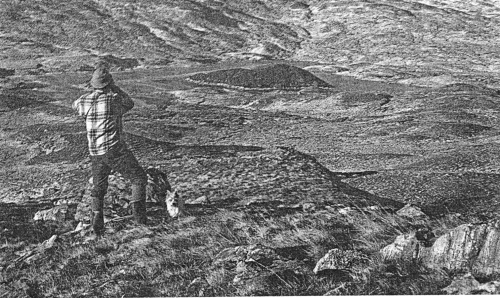
A friend’s mention of Loch Morar the other day – a phenomenally beautiful place tucked away in the heart of the ‘Rough Bounds’ of the Scottish Highlands – put me in mind of a legend from that district that is not at all well known even to folklorists, but which combines, in an interesting way, two distinct storytelling motifs: those of the ‘loyal pet’ and the ‘harbinger of death’.

The Grey Dog of Meoble (which I have seen given, in the Gaelic in which the story was first told, as an cuth glas Meobhail or an cu glas Mheobail) is a gigantic, shaggy-haired Scottish deerhound whose preternatural appearances are said to presage death to members of the Macdonald clan in the south Morar districts where the tradition first flourished. Tales of the spectral animal’s appearances certainly date to the first half of the nineteenth century; we know that Caraid nan Gaidheal, a renowned Highland piper who died in 1867, had heard the legend (John Gibson, Old and New World Highland Bagpiping (Montreal: McGill-Queen’s Press, 2002, p.318). They come not only from the tiny crofting hamlet of Meoble (pronounced “Meeble”) – a settlement, now all but abandoned, in an isolated district a mile from the shores of Loch Morar – but from other parts of Scotland and even Canada.

Most tales of the Grey Dog concern the hound’s appearances to Morar MacDonalds who are on the point of death
More

The longest prison sentences ever served

Now expanded, revised and updated to April 2017

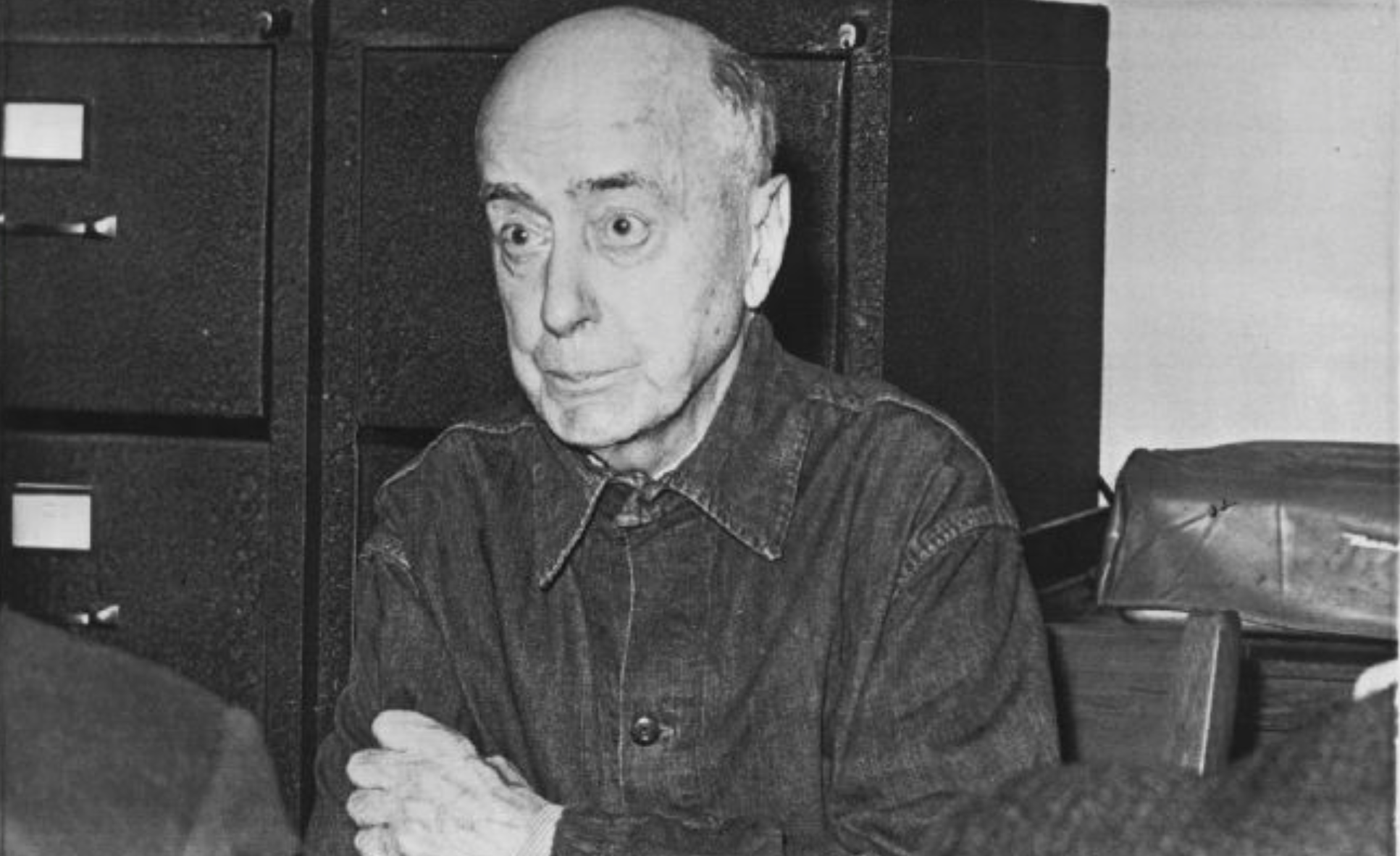
Richard Honeck on his 23,420th – and final – day in jail.

Record-setting old lag Richard Honeck on his 23,420th – and final – day in jail.

Richard Honeck (1879-1976), an American murderer, served what was, at the time, the longest prison sentence ever to end in a prisoner’s release. Jailed in November 1899 for the killing of a former school friend, Honeck was paroled from Menard Correctional Center in Chester, Illinois on 20 December 1963, having served 64 years and one month of his life sentence. In the decades between his conviction and the time his case came to public notice again in August 1963, he received only a single letter – a four-line note from his brother in June 1904 – and two visitors: a friend in 1904, and a newspaper reporter in 1963.

Honeck, a telegraph operator and the son of a wealthy dealer in farm equipment, was 21 years old when he was arrested in Chicago in September 1899 for the killing of Walter F. Koeller. He and another man, Herman Hundhausen, had gone to Koeller’s room armed with an eight-inch bowie knife, a sixteen-inch bowie knife, a silver-plated case knife, a .44 caliber revolver, a .38 caliber revolver, a .22 caliber revolver, a club, and two belts of cartridges. They also carried a getaway kit: two satchels filled with dime novels, obscene etchings, and clothes from which the names had been cut (New York Times, 4+5 September 1899). More

The horrible history of the Ostrich Inn

draft_lens3253522module29629372photo_1240684025The_Ostrich_Inn_Colnbrook_Slough_500x524

The Ostrich Inn, Colnbrook

An old friend, Alan Murdie, has written an interesting  essay which discusses, among several gory stories, the supposedly spook-infested Ostrich Inn in Colnbrook, Buckinghamshire – where ‘a past landlord named Jarman is supposed to have murdered up to 60 guests on the premises, in either the 16th or 18th century’. The pub’s unusual name rang a bell, and after a short hunt I turned up a story about the same place that I clipped from the Daily Telegraph, 31 October 1989:

In the shadow of one of London’s ghastliest locations, one of England’s oldest pubs is on the market – together with a ghastly history.

The Ostrich Inn, a Grade II listed freehouse near Heathrow Airport, is said to date back to 1106 and was the scene of 60 grisly murders committed by 12th century landlord John Jarman and his wife.

After inviting wealthy travellers to sleep on a specially-made hinged bed, Jarman would say to his wife, “There is now a fat pig to be had if you want one.” She would answer: “I pray you put him in the hogsty till tomorrow.” The victim would then fall through a trapdoor into a vat of boiling water. More

Wonderful, terrific and eccentric magazines

wonderful+1

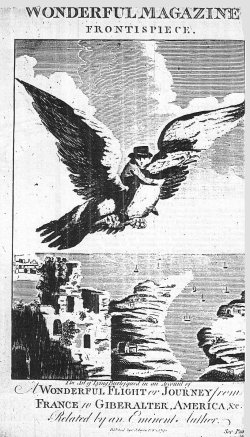
Frontispiece for the Wonderful Magazine

I love history and I love research: always have done, to a degree other people find – well, let’s just say ‘unusual’. To give you an idea of what I mean, let me take you back to the summer of 1982, and the last term of my first year at university. Now, first years at most Cambridge colleges sit their Prelims in that term – that’s preliminary exams, the sort that don’t count towards your degree but do count when it comes to ruining one’s summer. By sheer dumb luck, however, I had gone up to Peterhouse, the oldest and most eccentric of colleges, and Peterhouse scorned Prelims. This meant that I spent the eight weeks of that term with a lot of spare time on my hands; most of my friends, the ones at other colleges, were feverishly revising, and there wasn’t a great deal going on. My fellow Petreans took advantage of this freedom to do a lot of drinking, punting, and garden partying, but even aged 19, I have to say, my idea of a good time was more to head to the University Library and read.

I wasn’t quite swot enough, in truth, to spend the time reading stuff that might have helped me academically. What I actually did was to retreat to the dusty pastures of North Front 6, where it was always cool and dark and the smell of ancient books was overpowering. Nobody ever seemed to go North Front 6, which had tiny windows and no natural light, and was, and probably still is, a sort of elephants’ graveyard where old, moribund and essentially useless periodicals went to die. It was paradise for me, though, and it was up there, that term, that I first chanced upon a run of one of the magazines that I want to talk about today.

It was called The Mirror of Literature, Art and Amusement, published in London in the 1820s and the 1830s, and it was filled with an extensive selection of eye-opening stories of the sort that nowadays appear in the “news in brief” columns of national newspapers. More

A Scottish spinster at the Battle of Nechtanesmere, 685AD

A Pictish carving which possibly depicts the great battle of 685.

Being an historian, I readily admit to a special fondness for that rarest of Fortean phenomena, the “timeslip” case. These are incidents in which a witness appears to travel back through time, in some unexplained and unexpected way, and is able to witness at first hand an event in the past. The proper name for the phenomenon is retrocognition, and by far the best-known example of it is the celebrated Versailles incident of August 1901, which involved two female English academics on a visit to Paris who took a fork in the path in the grounds of the palace of Versailles and became convinced that they had somehow begun walking through the gardens as they existed in the late eighteenth century, at the time of Marie Antoinette.

In the course of their ‘adventure,’ the women remembered passing several structures which did not exist in 1901, and encountering a number of people, clad in convincing period dress, whom they initially supposed to be actors rehearsing a play. Their story has been the subject of considerable investigation, and though far from all of the results favour the ladies’ interpretation, the incident nonetheless still ranks among a surprisingly large number of researchers’ “classic cases”. There are, however, three or four other, much less celebrated, timeslip cases that follow a very similar pattern, and I want to have a look at one of those today. More

Ghosts, witches, vampires, fairies and the law of murder

Ghost

Thomas Millwood meets his end. From a contemporary book illustration.

Late on the evening of 3 January 1804, a bricklayer by the name of Thomas Millwood left his home in Hammersmith, to the west of London. He was smartly dressed in the sort of clothes favoured by men of his trade: “linen trowsers entirely white, washed very clean, a waistcoat of flannel, apparently new, very white, and an apron, which he wore round him.” Unfortunately for Millwood, though, those clothes proved to be the death of him. At 10.30pm, while he was walking alone down Black-lion-lane, he was confronted and shot dead by a customs officer called Francis Smith – thus setting in motion one of the strangest, best-remembered and most influential cases in British legal history.

The Millwood murder is of interest to us because Smith’s motive for killing him was decidedly peculiar. Hammersmith, then a village on the outskirts of London, had been terrorised for more than a month by reports that some sort of malignant ghost or spirit was haunting the graveyard of St Paul’s chapel-of-ease. Today this cemetery stands in the shadow of the A4 flyover and right next to the busy four-lane Hammersmith roundabout, but 200 years ago it was considerably more isolated. St Paul’s was then still surrounded by fields, and the paths that ran past the graveyard were unpaved and unlit. It’s not difficult to see how, in the depths of winter (the Hammersmith ghost scare ran from December 1803 to January 1804), frightening stories could readily circulate, nor why several local men took it upon themselves to patrol the darkened streets in the hope of encountering and ‘laying’ the ghost. Milwood, in his all-white clothes, had been mistaken for the apparition twice earlier that same day. It was his bad luck that the third time the same mistake was made, the man facing him was not just nervous but armed with a shotgun.

Smith, when he realised his mistake, was horrified. He gave himself up immediately and was swiftly charged with murder and tried at the Old Bailey less than a week later. More

Emily Brontë: a fantasy-prone personality

emily_bronte

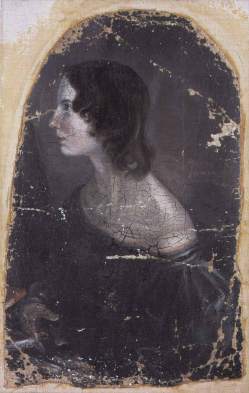
Emily Brontë: a fantasy-prone personality?

More than a quarter of a century has passed since a couple of psychologists named Theodore X. Barber and Sheryl Wilson first published their important study into the central role that a percipient’s fantasy life plays in the nature, frequency and detail of the paranormal claims they make. According to this theory, ‘fantasy-proneness’ (the term Barber and Wilson coined to describe such imagination-driven experiences) directly correlates with – and to a large extent explains – a wide variety of unusual and psychical experiences, including the propensity to see ghosts, hear voices, and undergo close encounters with entities of various exotic varieties.

The critical point, according to Barber and Wilson, is that the ‘fantasy-prone personalities’ they identified were liable to blur the divide between imagination and reality, allowing the former to intrude into the latter in ways that made their imaginary experiences seem quite real. The pair went on to list a total of 14 indicators of fantasy-proneness, and suggested that individuals who experience six or more of these could be labelled “fantasy-prone”. These 14 indicators are: More

Curses! Archduke Franz Ferdinand and his astounding death car

princip-arested

Gavrilo Princip under arrest

It’s hard to think of another event in the troubled twentieth century that had quite the shattering impact of the assassination of Archduke Franz Ferdinand [below] at Sarajevo on 28 June 1914. The Archduke was heir to the throne of the tottering Austro-Hungarian empire; his killers – a motley band of amateurish students – were Serbian nationalists (or possibly Yugoslav nationalists; historians remain divided on the topic) who wanted to turn Austrian Bosnia into a part of a new Slav state. The guns and bombs they used to kill the Archduke, meanwhile, were supplied by the infamous Colonel Apis, head of Serbian military intelligence. All this was quite enough to provoke Austria-Hungary into declaring war on Serbia, after which, with the awful inevitability that AJP Taylor famously described as ‘war by timetable’, Europe slid inexorably into the horrors of the First World War as the rival Great Powers began to mobilise and counter-mobilise against each other.

887_Erzherzog_Franz_Ferdinand_von_Oesterreich

Fran Ferdinand

To say that all this is well-known is a bit of an understatement. Seen from the Fortean perspective, however, the events of that day in Sarajevo have interesting aspects that often go unremarked. The appalling combination of implausible circumstance that resulted in assassination is one; Franz Ferdinand had survived an earlier attempt to kill him on the fateful day, emerging unscathed from the explosion of a bomb that bounced off the folded hood of the his convertible and exploded under a car following behind him in his motorcade. That bomb injured several members of the Imperial entourage, and these men were taken to hospital. It was Franz Ferdinand’s impulsive decision, later in the day, to visit the wounded in hospital – a decision none of his assassins could possibly have predicted – that took him directly past the spot where Gavrilo Princip, the man who actually killed him, had decided pretty much at random to position himself. It was chauffeur Leopold Lojka’s unfamiliarity with the new route that led him to take a wrong turning and, confused, pull to a halt just six feet from Princip himself. For the Archduke to be presented, as a stationary target, to the one man in a crowd of thousands still determined to kill him was a remarkable example of sheer bad luck, but, even then, the odds still favoured Franz Ferdinand’s survival. Princip (seen in the photo at the head of this entry being manhandled away just after the shooting) was so hemmed in by the crowd that he was unable to pull out and prime the bomb he was carrying. Instead, he was forced to resort to his pistol, but failed to actually aim it. According to his own later testimony, Princip confessed: More

The loss of the Saladin and the search for Walter Powell MP

saladin

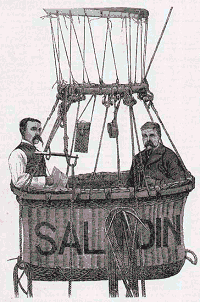
The Saladin balloon, c.1881.

At a time when MPs are in the news, and not often for the right reasons, I want to take a moment to dwell on the more worthwhile, and (from my perspective, anyway) peculiarly illuminating career of a long-forgotten predecessor of the current bunch of petty crooks. His name was Walter Powell (1842-1881) [below right], he was Tory MP for Malmesbury in Wiltshire, and his strange and lonely death offers a good deal of unexpected insight into the perennially fascinating topics of expectant attention and witness perception.

First, a snippet of biography. Walter Powell was the youngest son of a tough and ruthless Welsh mine owner (a tautology, I know) who ran his pits for profit first and safety very much last, emerging during the 1840s as the largest coal exporter in the world. Having driven through a 20% cut in wages and broken the resultant strike, Thomas Powell’s mines were plagued by accidents, culminating in two major explosions at Dyffryn, in Aberdare, and the deaths of more than 80 men. According to Walter Powell’s biographer, the Dyffryn disasters belatedly shamed Thomas senior into repentence for his past behaviour, and inculcated in Walter Powell a determination to use his own inherited wealth more for the public good.

In the late 1860s, Powell moved to Wiltshire, where in 1868 he was selected as Conservative parliamentary candidate for the market town of Malmesbury. Powell won the seat in the subsequent election with a narrow majority of 23, which most likely says something positive about his personality and character, as well as his wealth; the election was a Liberal triumph, and Malmesbury had been a solidly Liberal seat since the 1830s, so Powell’s victory was achieved very much against the prevailing political winds of the day. The evidence suggests he was a good MP and a benefactor to the town; he earned the soubriquet “the poor man’s friend,” and among his achievements was the endowment of a Ragged School there and the supply of 50 tons of coal each winter to Malmesbury’s “aged poor”. More pertinently, from our perspective, Powell was also an enthusiast for all sorts of new inventions. He acquired a magic lantern at around the time just such a contraption was suspected of being used to create the apparitions of the Virgin Mary at Knock, in Ireland, and in 1880, after the death of his wife, he took up ballooning and became very keen on aeronautics.

Ballooning in those days was a preserve of the wealthy. More