A Scottish spinster at the Battle of Nechtanesmere, 685AD

A Pictish carving which possibly depicts the great battle of 685.

Being an historian, I readily admit to a special fondness for that rarest of Fortean phenomena, the “timeslip” case. These are incidents in which a witness appears to travel back through time, in some unexplained and unexpected way, and is able to witness at first hand an event in the past. The proper name for the phenomenon is retrocognition, and by far the best-known example of it is the celebrated Versailles incident of August 1901, which involved two female English academics on a visit to Paris who took a fork in the path in the grounds of the palace of Versailles and became convinced that they had somehow begun walking through the gardens as they existed in the late eighteenth century, at the time of Marie Antoinette.

In the course of their ‘adventure,’ the women remembered passing several structures which did not exist in 1901, and encountering a number of people, clad in convincing period dress, whom they initially supposed to be actors rehearsing a play. Their story has been the subject of considerable investigation, and though far from all of the results favour the ladies’ interpretation, the incident nonetheless still ranks among a surprisingly large number of researchers’ “classic cases”. There are, however, three or four other, much less celebrated, timeslip cases that follow a very similar pattern, and I want to have a look at one of those today. More

Curses! Archduke Franz Ferdinand and his astounding death car

princip-arested

Gavrilo Princip under arrest

It’s hard to think of another event in the troubled twentieth century that had quite the shattering impact of the assassination of Archduke Franz Ferdinand [below] at Sarajevo on 28 June 1914. The Archduke was heir to the throne of the tottering Austro-Hungarian empire; his killers – a motley band of amateurish students – were Serbian nationalists (or possibly Yugoslav nationalists; historians remain divided on the topic) who wanted to turn Austrian Bosnia into a part of a new Slav state. The guns and bombs they used to kill the Archduke, meanwhile, were supplied by the infamous Colonel Apis, head of Serbian military intelligence. All this was quite enough to provoke Austria-Hungary into declaring war on Serbia, after which, with the awful inevitability that AJP Taylor famously described as ‘war by timetable’, Europe slid inexorably into the horrors of the First World War as the rival Great Powers began to mobilise and counter-mobilise against each other.

887_Erzherzog_Franz_Ferdinand_von_Oesterreich

Fran Ferdinand

To say that all this is well-known is a bit of an understatement. Seen from the Fortean perspective, however, the events of that day in Sarajevo have interesting aspects that often go unremarked. The appalling combination of implausible circumstance that resulted in assassination is one; Franz Ferdinand had survived an earlier attempt to kill him on the fateful day, emerging unscathed from the explosion of a bomb that bounced off the folded hood of the his convertible and exploded under a car following behind him in his motorcade. That bomb injured several members of the Imperial entourage, and these men were taken to hospital. It was Franz Ferdinand’s impulsive decision, later in the day, to visit the wounded in hospital – a decision none of his assassins could possibly have predicted – that took him directly past the spot where Gavrilo Princip, the man who actually killed him, had decided pretty much at random to position himself. It was chauffeur Leopold Lojka’s unfamiliarity with the new route that led him to take a wrong turning and, confused, pull to a halt just six feet from Princip himself. For the Archduke to be presented, as a stationary target, to the one man in a crowd of thousands still determined to kill him was a remarkable example of sheer bad luck, but, even then, the odds still favoured Franz Ferdinand’s survival. Princip (seen in the photo at the head of this entry being manhandled away just after the shooting) was so hemmed in by the crowd that he was unable to pull out and prime the bomb he was carrying. Instead, he was forced to resort to his pistol, but failed to actually aim it. According to his own later testimony, Princip confessed: More

The loss of the Saladin and the search for Walter Powell MP

saladin

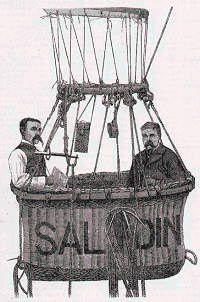
The Saladin balloon, c.1881.

At a time when MPs are in the news, and not often for the right reasons, I want to take a moment to dwell on the more worthwhile, and (from my perspective, anyway) peculiarly illuminating career of a long-forgotten predecessor of the current bunch of petty crooks. His name was Walter Powell (1842-1881) [below right], he was Tory MP for Malmesbury in Wiltshire, and his strange and lonely death offers a good deal of unexpected insight into the perennially fascinating topics of expectant attention and witness perception.

First, a snippet of biography. Walter Powell was the youngest son of a tough and ruthless Welsh mine owner (a tautology, I know) who ran his pits for profit first and safety very much last, emerging during the 1840s as the largest coal exporter in the world. Having driven through a 20% cut in wages and broken the resultant strike, Thomas Powell’s mines were plagued by accidents, culminating in two major explosions at Dyffryn, in Aberdare, and the deaths of more than 80 men. According to Walter Powell’s biographer, the Dyffryn disasters belatedly shamed Thomas senior into repentence for his past behaviour, and inculcated in Walter Powell a determination to use his own inherited wealth more for the public good.

In the late 1860s, Powell moved to Wiltshire, where in 1868 he was selected as Conservative parliamentary candidate for the market town of Malmesbury. Powell won the seat in the subsequent election with a narrow majority of 23, which most likely says something positive about his personality and character, as well as his wealth; the election was a Liberal triumph, and Malmesbury had been a solidly Liberal seat since the 1830s, so Powell’s victory was achieved very much against the prevailing political winds of the day. The evidence suggests he was a good MP and a benefactor to the town; he earned the soubriquet “the poor man’s friend,” and among his achievements was the endowment of a Ragged School there and the supply of 50 tons of coal each winter to Malmesbury’s “aged poor”. More pertinently, from our perspective, Powell was also an enthusiast for all sorts of new inventions. He acquired a magic lantern at around the time just such a contraption was suspected of being used to create the apparitions of the Virgin Mary at Knock, in Ireland, and in 1880, after the death of his wife, he took up ballooning and became very keen on aeronautics.

Ballooning in those days was a preserve of the wealthy. More

The ghost ship and the President

Deering1Chance can be a fine thing.

The darker recesses of the Herbert Hoover Presidential Library would never top my mental list of likely sources of really interesting material, but, leafing through the catalogue of the Lawrence Richey papers held there yesterday, I stumbled across a name I hadn’t heard in quite a while: that of the Carroll A. Deering.

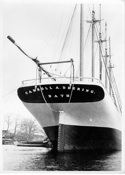
The Deering was an elegant five-masted schooner that went aground on Diamond Shoals, off the coast of North Carolina, back in January 1921, and her name still crops up frequently in the literature of mysteries of the sea. At the time of her stranding, she was on the return leg of a voyage from her home port in Virginia to Brazil, and, as was the case with the Mary Celeste, to which she has often been compared, she seems to have been, at least until going aground on the shoals, in a sound, sailable condition despite a recent brush with foul weather. To make matters more intriguing, the first men to board the wreck found an evening meal sitting, uneaten, on the stove. The Deering‘s crew of 11 men were nowhere to be seen (and neither were the ship’s boats, another thing this ghost ship has in common with the Mary Celeste). None of them were ever seen alive again.

The Deering stuck in my mind for two reasons: More