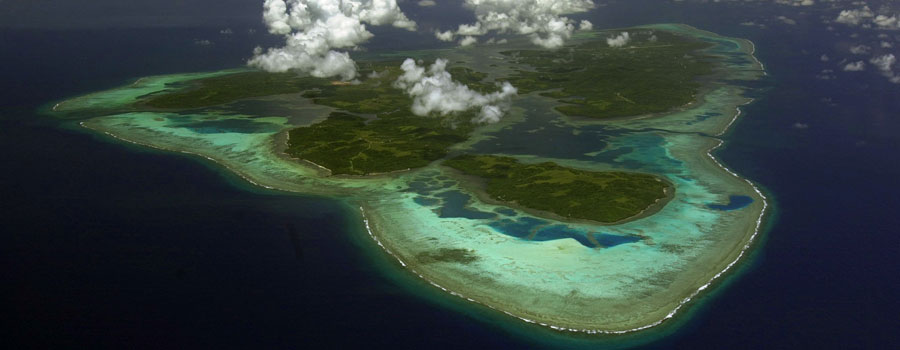
The island of Yap from the air: a western Pacific paradise where almost everything needed to sustain life grew comfortably to hand.
It was a typhoon, or so it’s said, that cast up David O’Keefe on Yap in 1871, and when he finally left the island 30 years later, it was another typhoon that drowned him as he made his way home to Savannah.
Between those dates, though, O’Keefe carved himself a permanent place in the history of the Pacific. So far as the press was concerned, he did it by turning himself into the “king of the cannibal islands”: a 6-foot-2, red-haired Irishman who lived an idyllic tropical existence, was “ruler of thousands” of indigenous people, and commanded “a standing army of twelve naked savages.” (“They were untutored, but they revered him, and his law was theirs.”) [New York Times; New York Tribune; Watchman & Southron] It was this version of O’Keefe’s story that made it to the silver screen half a century later in the forgettable Burt Lancaster vehicle His Majesty O’Keefe (1954), and this version, says scholar Janet Butler, that is still believed by O’Keefe’s descendants in Georgia. [Butler pp.177-8, 191]
The reality is rather different, and in some ways even more remarkable. For if O’Keefe was never a king, he certainly did build the most successful private trading company in the Pacific, and—at a time when most Western merchants in the region exploited the islanders they dealt with, then called in U.S. or European warships to back them up—he worked closely with them, understood them and made his fortune by winning their trust and help. This itself makes O’Keefe worthy of remembrance, for while the old sea-captain was most assuredly not perfect (he had at least three wives and several mistresses, and introduced the Yapese to both alcohol and firearms), he is still fondly recalled on the island. It doesn’t hurt, so far as the strangeness of the story goes, that O’Keefe ingratiated himself on Yap by securing a monopoly on the supply of the island’s unique currency: giant stone coins, each as much as 12 feet in diameter and weighing up to four and a half tons.
But wait; we’re getting ahead of ourselves. Let’s start with the convoluted history that brought O’Keefe to Yap. More



 A Blast From The Past