A Russian prince on a Wichita road gang

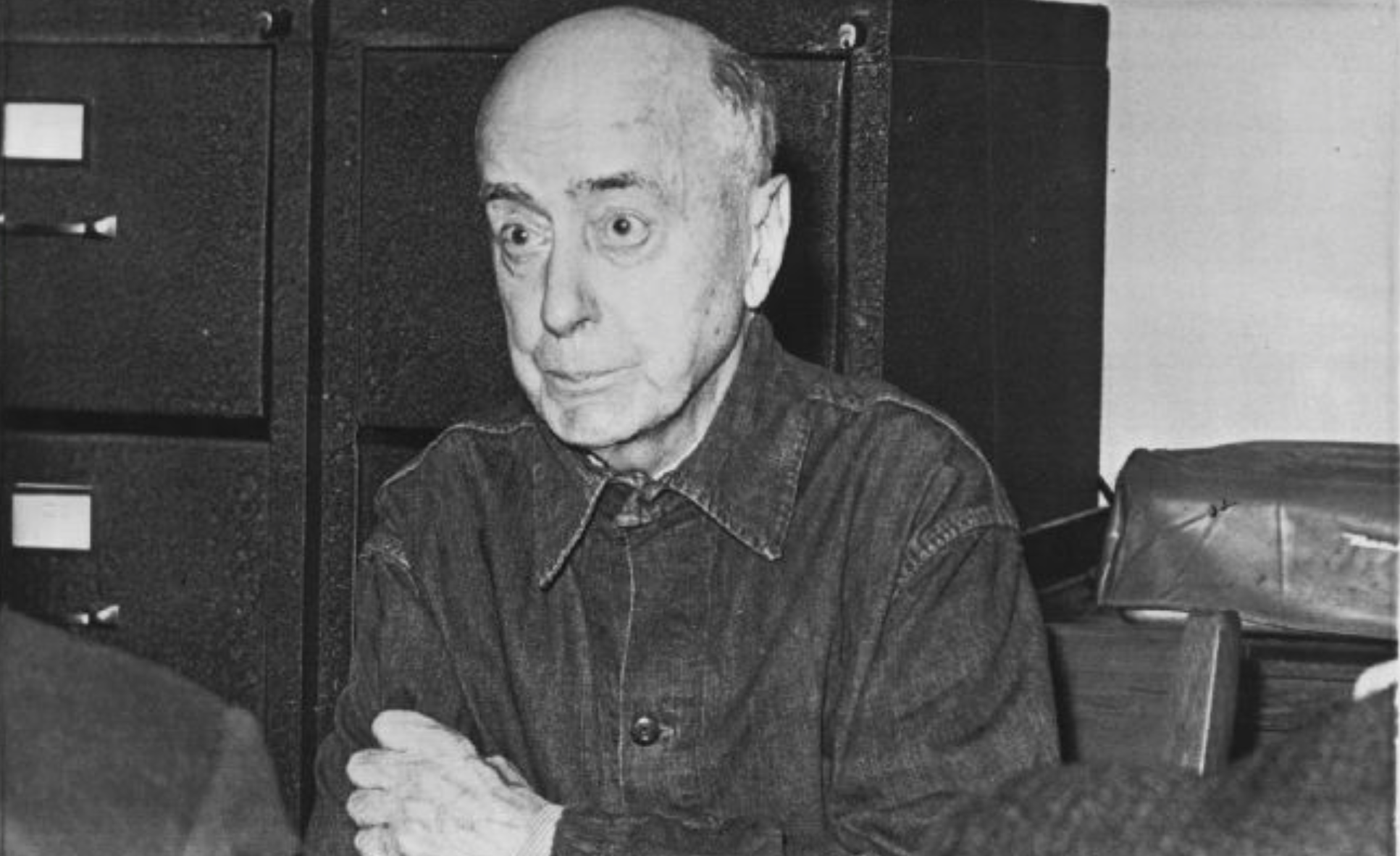
The imposter’s imposter. Prince Michael Romanoff, AKA Harry Gerguson of New York, AKA Harry Ferguson of Litchfield, IL, AKA Herschel Geguzin of Vilna, Lithuania: bellhop, day labourer, drinks salesman, international confidence man and famed Hollywood restaurateur

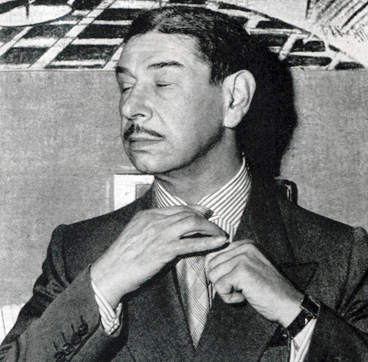
For most of the 1940s and 1950s, Prince Mike Romanoff was one of the best-known and best-loved figures in Hollywood. A man of great generosity and unparalleled charm, he not only owned and ran the swankiest restaurant in Beverly Hills, but was also a close friend to many of the stars who thronged there to see and be seen. Romanoff (1890-1971) was one of Humphrey Bogart’s most cherished companions, and a favourite acquaintance of David Niven, who wrote a warm and admiring appreciation of him in Bring on the Empty Horses, his best-selling book of Hollywood anecdotes. By the time he appeared as a guest on the panel show What’s My Line [1957; below], Mike was so well known that, almost uniquely, the panellists had to be blindfolded, and, to prevent the immediate identification of his distinctively fruity British accent, he himself was permitted to communicate only with a whistle.

All of this might have been considered par for the course for someone who full styling was Prince Michael Alexandrovitch Dmitry Obolensky Romanoff; who habitually smoked cigarettes monogrammed with the imperial Russian ‘R’; and who had been schooled at Eton, at Harrow and at Winchester, and attended not only Oxford and Harvard, but also the Royal Military College at Sandhurst, Cambridge, Yale, Princeton, the Sorbonne and Heidelberg. It might have been only a little remarkable for a man who – at least according to his own account – had driven a taxi for the French army during the defence of Paris and then fought on the Western Front as a British lieutenant, and on the Eastern Front as a Cossack colonel; who “knew the Sudan like the back of my hand”; who had won the Legion d’Honneur for some act of unspecified gallantry, and had gone on to defend the Winter Palace against rampaging Bolsheviks; had served six years in solitary confinement for killing a German nobleman in a duel; and who was able to produce at least some proof that he enjoyed a close, if oddly hazy, relationship with the former ruling dynasty of Russia. [Niven pp.147, 150, 152; Johnston, Education pp.247-9]  It was, however, a truly startling achievement for a man who had actually done none of those things, and who was, in reality, no sort of aristocrat at all. More

Truth, beauty and Pancho Villa

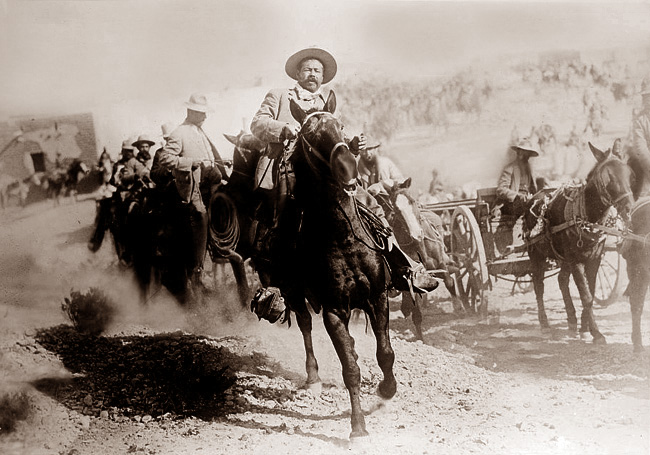
Pancho Villa pictured shortly after the Battle of Ojinaga, in January 1914 – an engagement he delayed for the benefit of American newsreel cameras. The still comes from Mutual Film’s exclusive footage.

The first casualty of war is truth, they say, and nowhere was that sage old aphorism more true than in Mexico during the revolutionary period between 1910 and 1920. In all the blood and chaos that followed the overthrow of Porfirio Diaz, who had been dictator of Mexico ever since 1876, what was left of the central government in Mexico City found itself at war with several contending rebel forces – most notably the Liberation Army of the South, commanded by Emiliano Zapata, and the Chihuahua-based División del Norte, led by the even more celebrated bandit-rebel Pancho Villa. The three-cornered civil war that followed was notable for several things: its unrelenting savagery, its unending confusion, and – north of the Rio Grande, at least – its unusual film deals. Specifically, it’s remembered for the bizarre contract Villa was supposed to have signed with a leading American newsreel company in January 1914. Under the terms of this deal, it is said, the rebels undertook to fight their revolution for the benefit of the movie cameras – in exchange for a large advance, payable in gold. More

The loneliest shop in the world

The view from the Birdsville Track.

The view from the Birdsville Track.

Harrods, in the bustling heart of London, is in a good location for a shop. So, for that matter, is Macy’s, which boasts of serving 350,000 New Yorkers every day at Christmas time. Whereas down at the Mulka Store, in the furthermost reaches of South Australia, George and Mabel Aiston used to think themselves lucky if they pulled in a customer a week.

Mulka’s proper name is Mulkaundracooracooratarraninna, a long name for a place that is a long way from anywhere. It stands on an apology for a road known as the Birdsville Track – until quite recently no more than a set of tyre prints stretching, as the locals put it, “from the middle of nowhere to the back of beyond.” The track begins in Marree, a very small outback town, and winds its way up to Birdsville, a considerably smaller one (“seven iron houses burning in the sun between two deserts”) many hundreds of miles to the north. Along the way it inches over the impenetrable Ooroowillanie sandhills and traverses Cooper Creek, a dried-up river bed that occasionally floods to place a five-mile-wide obstacle in the path of unwary travellers, before skirting the tyre-puncturing fringes of the Sturt Stony Desert.

Make your way past all those obstacles, and, “after jogging all day over the treeless plain,” you’d eventually stumble across the Mulka Store, nestled beneath a single clump of pepper trees. To one side of the shop, like some ever-present intimation of mortality, lay the lonely fenced-off grave of Edith Scobie, “died December 31 1892 aged 15 years 4 months” – quite possibly of the sort of ailment that is only fatal when you live a week’s journey from the nearest doctor. To the rear was nothing but the “everlasting sandhills, now transformed to a delicate salmon hue in the setting sun.” And in front, beside a windswept garden gate, “a board sign which announced in fading paint but one word: STORE. Just in case the traveller might be in some doubt.” More

The Emperor’s electric chair

The death chair in Auburn prison, c.1890

award-2010Many countries have folk-tales that feature foolish kings – monarchs whose vanity causes them to make catastrophic misjudgements or attempt impossible things. Greek mythology offers the tradition of King Midas, who lived to regret wishing for the power to turn everything he touched into gold; for we Brits, the foolish ruler is King Canute, who – at least in the common modern telling of the tale – allowed courtiers to flatter him that even the seas would obey his commands, and consequently got his feet wet in a failed attempt to turn back the tides.1

Most of these legends are hundreds of years old, of course, but the motif is a potent one and it still crops up from time to time. Here, for example, is a story that has stuck firmly in my mind ever since I first read it in The Book of Lists, a best-selling compendium of all sorts of remarkable trivia, first published in 1977:

The Abyssinian electric chair

On August 6, 1890, the first electric chair in history was put into use in the death chamber of Auburn Prison in New York. In distant Abyssinia – now called Ethiopia – Emperor Menelik II (1844-1913) heard about it and decided that this new method of execution should become part of his modernisation plan for his country. Immediately, he put in an order for three electric chairs from the American manufacturer. When the chairs arrived and were unpacked, the emperor was mortified to learn that they wouldn’t work – Abyssinia had no electricity. Determined that his investment would not be completely wasted, Emperor Menelik adopted one of the electric chairs for his imperial throne.

David Wallechinsky et al, The Book of Lists (London: Corgi, 1977) p.463.

Pretty amusing, and plainly I’m not the only person who finds this odd tale peculiarly memorable; the editors of The Book of Lists themselves ranked it among their “15 favourite oddities of all time,” and if you type the search string ‘Menelik’s electric chair’ into Google, you come up with several thousand hits from sites such as anecdotage.com, all of which are clearly based on the BoL‘s telling of the story; they contain the same basic information, but nothing different or new. More

Lord Dacre’s ghost

Lord+Dacre_0

Hugh Trevor-Roper (Lord Dacre)

Adam Sisman’s sympathetic new biography of Hugh Trevor-Roper (Lord Dacre), the brilliant if acerbic historian, contains an unexpectedly fascinating passage on the great controversialist’s declining years that sheds a ray of light on the way in which witnesses perceive ghosts.

In his late 80s, Sisman notes, Trevor-Roper was diagnosed with glaucoma and then developed a cataract. Soon afterwards, he began to suffer some alarming hallucinations: “He would look up from his desk and see the trees in leaf in mid-winter, or the landscape whizzing by as if he were aboard a train… Once, as he went to put out the dustbin, he found himself lost in a cemetery of dead machines, surrounded by rusting combine harvesters, lorries, cranes and derricks. Inside, the house grew an extra staircase.” Other outlandish figments of the historian’s imagination included gigantic trees and even a complete train at a platform at Didcot Station (which Trevor-Roper attempted to board).

All of this eventually led to a diagnosis of Charles Bonnet Syndrome –  a little-known condition, first described well over 200 years ago, in which those suffering from failing vision unconsciously compensate by dredging up memories with which to populate the fading landscape. Typically these vsions are what are known as “Lilliput hallucinations” (in which the hallucinated objects appear on a reduced scale), but as Trevor-Roper’s own case shows, it’s also possible to experience the opposite, and also extremely realistic visions of human figures, even within one’s own home. An experience of the latter sort occurred to Trevor-Roper in 2002. More

The longest prison sentences ever served

Now expanded, revised and updated to April 2017

Richard Honeck on his 23,420th – and final – day in jail.

Record-setting old lag Richard Honeck on his 23,420th – and final – day in jail.

Richard Honeck (1879-1976), an American murderer, served what was, at the time, the longest prison sentence ever to end in a prisoner’s release. Jailed in November 1899 for the killing of a former school friend, Honeck was paroled from Menard Correctional Center in Chester, Illinois on 20 December 1963, having served 64 years and one month of his life sentence. In the decades between his conviction and the time his case came to public notice again in August 1963, he received only a single letter – a four-line note from his brother in June 1904 – and two visitors: a friend in 1904, and a newspaper reporter in 1963.

Honeck, a telegraph operator and the son of a wealthy dealer in farm equipment, was 21 years old when he was arrested in Chicago in September 1899 for the killing of Walter F. Koeller. He and another man, Herman Hundhausen, had gone to Koeller’s room armed with an eight-inch bowie knife, a sixteen-inch bowie knife, a silver-plated case knife, a .44 caliber revolver, a .38 caliber revolver, a .22 caliber revolver, a club, and two belts of cartridges. They also carried a getaway kit: two satchels filled with dime novels, obscene etchings, and clothes from which the names had been cut (New York Times, 4+5 September 1899). More

A Scottish spinster at the Battle of Nechtanesmere, 685AD

A Pictish carving which possibly depicts the great battle of 685.

Being an historian, I readily admit to a special fondness for that rarest of Fortean phenomena, the “timeslip” case. These are incidents in which a witness appears to travel back through time, in some unexplained and unexpected way, and is able to witness at first hand an event in the past. The proper name for the phenomenon is retrocognition, and by far the best-known example of it is the celebrated Versailles incident of August 1901, which involved two female English academics on a visit to Paris who took a fork in the path in the grounds of the palace of Versailles and became convinced that they had somehow begun walking through the gardens as they existed in the late eighteenth century, at the time of Marie Antoinette.

In the course of their ‘adventure,’ the women remembered passing several structures which did not exist in 1901, and encountering a number of people, clad in convincing period dress, whom they initially supposed to be actors rehearsing a play. Their story has been the subject of considerable investigation, and though far from all of the results favour the ladies’ interpretation, the incident nonetheless still ranks among a surprisingly large number of researchers’ “classic cases”. There are, however, three or four other, much less celebrated, timeslip cases that follow a very similar pattern, and I want to have a look at one of those today. More

Ghosts, witches, vampires, fairies and the law of murder

Ghost

Thomas Millwood meets his end. From a contemporary book illustration.

Late on the evening of 3 January 1804, a bricklayer by the name of Thomas Millwood left his home in Hammersmith, to the west of London. He was smartly dressed in the sort of clothes favoured by men of his trade: “linen trowsers entirely white, washed very clean, a waistcoat of flannel, apparently new, very white, and an apron, which he wore round him.” Unfortunately for Millwood, though, those clothes proved to be the death of him. At 10.30pm, while he was walking alone down Black-lion-lane, he was confronted and shot dead by a customs officer called Francis Smith – thus setting in motion one of the strangest, best-remembered and most influential cases in British legal history.

The Millwood murder is of interest to us because Smith’s motive for killing him was decidedly peculiar. Hammersmith, then a village on the outskirts of London, had been terrorised for more than a month by reports that some sort of malignant ghost or spirit was haunting the graveyard of St Paul’s chapel-of-ease. Today this cemetery stands in the shadow of the A4 flyover and right next to the busy four-lane Hammersmith roundabout, but 200 years ago it was considerably more isolated. St Paul’s was then still surrounded by fields, and the paths that ran past the graveyard were unpaved and unlit. It’s not difficult to see how, in the depths of winter (the Hammersmith ghost scare ran from December 1803 to January 1804), frightening stories could readily circulate, nor why several local men took it upon themselves to patrol the darkened streets in the hope of encountering and ‘laying’ the ghost. Milwood, in his all-white clothes, had been mistaken for the apparition twice earlier that same day. It was his bad luck that the third time the same mistake was made, the man facing him was not just nervous but armed with a shotgun.

Smith, when he realised his mistake, was horrified. He gave himself up immediately and was swiftly charged with murder and tried at the Old Bailey less than a week later. More

Curses! Archduke Franz Ferdinand and his astounding death car

princip-arested

Gavrilo Princip under arrest

It’s hard to think of another event in the troubled twentieth century that had quite the shattering impact of the assassination of Archduke Franz Ferdinand [below] at Sarajevo on 28 June 1914. The Archduke was heir to the throne of the tottering Austro-Hungarian empire; his killers – a motley band of amateurish students – were Serbian nationalists (or possibly Yugoslav nationalists; historians remain divided on the topic) who wanted to turn Austrian Bosnia into a part of a new Slav state. The guns and bombs they used to kill the Archduke, meanwhile, were supplied by the infamous Colonel Apis, head of Serbian military intelligence. All this was quite enough to provoke Austria-Hungary into declaring war on Serbia, after which, with the awful inevitability that AJP Taylor famously described as ‘war by timetable’, Europe slid inexorably into the horrors of the First World War as the rival Great Powers began to mobilise and counter-mobilise against each other.

887_Erzherzog_Franz_Ferdinand_von_Oesterreich

Fran Ferdinand

To say that all this is well-known is a bit of an understatement. Seen from the Fortean perspective, however, the events of that day in Sarajevo have interesting aspects that often go unremarked. The appalling combination of implausible circumstance that resulted in assassination is one; Franz Ferdinand had survived an earlier attempt to kill him on the fateful day, emerging unscathed from the explosion of a bomb that bounced off the folded hood of the his convertible and exploded under a car following behind him in his motorcade. That bomb injured several members of the Imperial entourage, and these men were taken to hospital. It was Franz Ferdinand’s impulsive decision, later in the day, to visit the wounded in hospital – a decision none of his assassins could possibly have predicted – that took him directly past the spot where Gavrilo Princip, the man who actually killed him, had decided pretty much at random to position himself. It was chauffeur Leopold Lojka’s unfamiliarity with the new route that led him to take a wrong turning and, confused, pull to a halt just six feet from Princip himself. For the Archduke to be presented, as a stationary target, to the one man in a crowd of thousands still determined to kill him was a remarkable example of sheer bad luck, but, even then, the odds still favoured Franz Ferdinand’s survival. Princip (seen in the photo at the head of this entry being manhandled away just after the shooting) was so hemmed in by the crowd that he was unable to pull out and prime the bomb he was carrying. Instead, he was forced to resort to his pistol, but failed to actually aim it. According to his own later testimony, Princip confessed: More

The ghost ship and the President

Deering1Chance can be a fine thing.

The darker recesses of the Herbert Hoover Presidential Library would never top my mental list of likely sources of really interesting material, but, leafing through the catalogue of the Lawrence Richey papers held there yesterday, I stumbled across a name I hadn’t heard in quite a while: that of the Carroll A. Deering.

The Deering was an elegant five-masted schooner that went aground on Diamond Shoals, off the coast of North Carolina, back in January 1921, and her name still crops up frequently in the literature of mysteries of the sea. At the time of her stranding, she was on the return leg of a voyage from her home port in Virginia to Brazil, and, as was the case with the Mary Celeste, to which she has often been compared, she seems to have been, at least until going aground on the shoals, in a sound, sailable condition despite a recent brush with foul weather. To make matters more intriguing, the first men to board the wreck found an evening meal sitting, uneaten, on the stove. The Deering‘s crew of 11 men were nowhere to be seen (and neither were the ship’s boats, another thing this ghost ship has in common with the Mary Celeste). None of them were ever seen alive again.

The Deering stuck in my mind for two reasons: More