The mystery of the five wounds

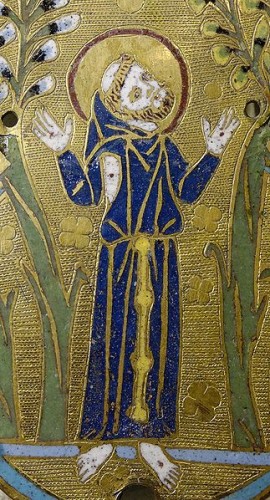
St Francis receives the stigmata. From a foil plaque on a 13th- century reliquary.

On September 14, 1224, a Saturday, Francis of Assisi—noted ascetic and holy man, future saint—was preparing to enter the second month of a retreat with a few close companions on Monte La Verna, overlooking the River Arno in Tuscany. Francis had spent the previous few weeks in prolonged contemplation of the suffering Jesus Christ on the cross, and he may well have been weak from protracted fasting. As he knelt to pray in the first light of dawn (notes the Fioretti—the ‘Little flowers of St Francis of Assisi,’ a collection of legends and stories about the saint),

he began to contemplate the Passion of Christ… and his fervor grew so strong within him that he became wholly transformed into Jesus through love and compassion…. While he was thus inflamed, he saw a seraph with six shining, fiery wings descend from heaven. This seraph drew near to St Francis in swift flight, so that he could see him clearly and recognize that he had the form of a man crucified… After a long period of secret converse, this mysterious vision faded, leaving… in his body a wonderful image and imprint of the Passion of Christ. For in the hands and feet of Saint Francis forthwith began to appear the marks of the nails in the same manner as he had seen them in the body of Jesus crucified.

In all, Francis found that he bore five marks: two on his palms and two on his feet, where the nails that fixed Christ to the cross were traditionally believed to have been hammered home, and the fifth on his side, where the Bible says Jesus had received a spear thrust from a Roman centurion.

Thus was the first case of stigmata—the appearance of marks or actual wounds paralleling those Christ received during Crucifixion—described. Later stigmatics (and there have been several hundred of them) have exhibited similar marks, though some bear only one or two wounds, while others also display scratches on their foreheads, where Christ would have been injured by his crown of thorns. Through the centuries, stigmata has become one of the best-documented, and most controversial, of mystical phenomena. The extensive record makes it possible to compare cases that occurred centuries apart.
Continue reading
History heroes: Marc Bloch

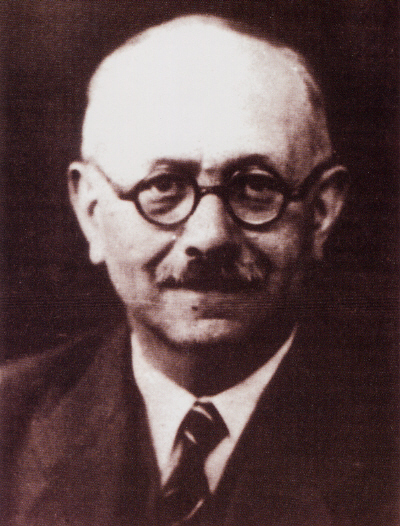
Marc Bloch: Historian. French Resistance leader. Hero.

At eight on the evening of June 16, 1944—not long before dusk on the tenth day after the Allied invasion of France–the Gestapo dragged 28 French resistance fighters from the cells where they had been incarcerated, tortured and interrogated at Montluc prison, Lyon. Handcuffed in pairs, the men were thrust onto an open truck and driven to an empty field outside a little village known as Saint-Didier-de-Formans. Along the way, a German officer bragged to them that the war would still be won, and that London was about to be destroyed by V1 flying bombs.

London would, of course, survive, and the war would not be won by Nazi Germany, but that was scant consolation to the resistance men as they were taken four by four into the field for execution. The accounts of two men among the prisoners who miraculously survived being shot in the back at close range allow us to know something of their final moments. There were no pleas for mercy. Some of the men shouted out last words as they were led into the field—”Adieu ma femme!” one of them called—but most remarkable was the brief scene that played out between the oldest and the youngest of the prisoners.

The younger man was really a boy, 16 years old and terrified of what was about to happen. The older was small, balding but distinguished-looking, and, at 58, he wore round glasses and the haggard look of a prisoner who had survived repeated torture. As the execution party cocked its guns, the boy groaned, “This is going to hurt.” “No, my boy, it doesn’t hurt,” the older man assured him. He reached out to enclose the child’s hands in his own and held them, shouting “Vive la France!” as the first volley of machine-gun fire rang out.
Continue reading

An ice cream war

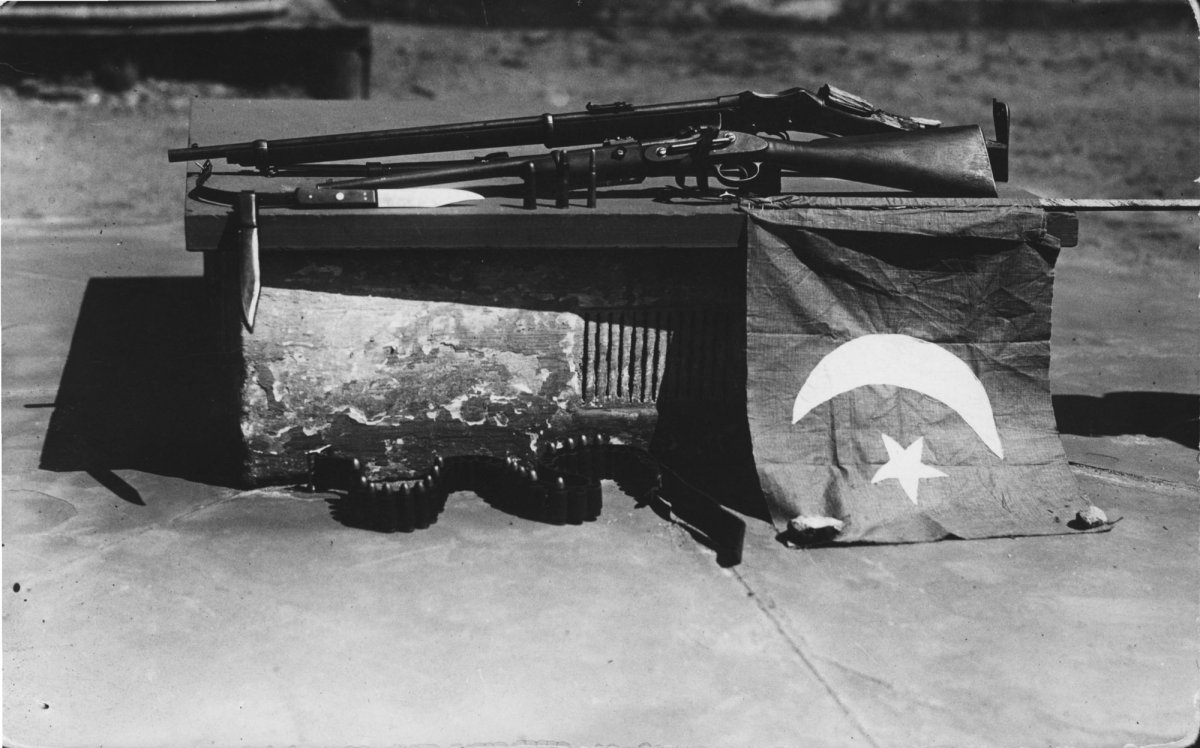
The Turkish flag flown, and rifles used, by Mullah Abdullah and Gool Mohammed in their two-man war against the British empire launched at Broken Hill, New South Wales, on 1 January 1915

The Turkish flag flown, and rifles used, by Mullah Abdullah and Gool Mohammed in their two-man war against the British empire launched at Broken Hill, New South Wales, on 1 January 1915

The war seemed a very long way away to the citizens of Broken Hill that January 1.

It was the height of the southern summer, and the Australian silver-mining town baked in the outback desert heat, 720 miles from Sydney and half a world away from the mud and blood of the Western Front. The First World War was less than five months old, and only a fool would have accused the hardened miners of Broken Hill of lacking patriotism, but on that first day of 1915 they wanted nothing more than to enjoy a rare holiday with their families and forget about their troubles—not just the war, which Australia had joined alongside Britain on the day it was declared, but also the grim economic times that were closing mines and putting miners out of work.

More than 1,200 men, women and children clambered aboard the makeshift train that would take them a few miles up the line to Silverton for the annual town picnic. But for Broken Hill that New Year’s Day, war was not 12,000 miles away; it was just over a ridge a mile or two along the track, where a couple of Afghans had raised the Turkish flag over an ice cream cart and were preparing to launch a two-man war. Continue reading

Gavrilo Princip’s sandwich

Gavrilo Princip is arrested for the assassination of Archduke Franz Ferdinand and his wife–Sarajevo, June 28, 1914.

It was the great flash point of the 20th century, an act that set off a chain reaction of calamity: two World Wars, 80 million deaths, the Russian Revolution, the rise of Hitler, the atomic bomb. Yet it might never have happened–we’re now told– had Gavrilo Princip not got hungry for a sandwich.

We’re talking the assassination of Archduke Franz Ferdinand, of course—the murder that set the crumbling Austro-Hungarian Empire on a collision course with Serbia, and Europe down the slippery slope that led to the outbreak of the First World War a month after Princip pulled the trigger on June 28, 1914. More specifically, though, we’re talking the version of events that’s being taught in many schools today. It’s an account that, while respectful of the significance of Franz Ferdinand’s death, hooks pupils’ attention by stressing a tiny, awe-inspiring detail: that if Princip had not stopped to eat a sandwich where he did, he would never have been in the right place to spot his target. No sandwich, no shooting. No shooting, no war.

It’s a compelling story, and one that is told in serious books and on multiple websites. For the most part, it goes something like this:

It is the summer of 1914, and Bosnia has just become part of the Austro-Hungarian empire. A handful of young Bosnian-born Serbs decide to strike a blow for the integration of their people into a homeland for southern Slavs by assassinating the heir to the Austrian throne. Their opportunity comes when it is announced that Franz Ferdinand will be making a state visit to the provincial capital, Sarajevo.

Continue reading

One man against tyranny: Georg Elser’s lone attempt to blow up Hitler

Georg Elser, whose attempt to kill Hitler came within moments of succeeding, commemorated on a stamp. The German phrase means “I wanted to prevent war.”

Maria Strobel could not believe it of her Führer. Adolf Hitler and his party—a group of senior Nazis that included Heinrich Himmler, Joseph Goebbels and Reinhard Heydrich—had spent more than an hour in her Munich bierkeller. Hitler had delivered a trademark speech, and, while they listened, Himmler and the others had run up a large beer bill. But the whole group had left in a hurry—leaving the tab unpaid and Strobel untippped.

Much annoyed, the Bavarian waitress set about clearing up the mess. She had made only a small dent in the pile of steins when, at 9:20 p.m. precisely, there was a huge explosion only a few feet behind her. A stone pillar disintegrated in the blast, bringing part of the ceiling crashing down in a rain of wood and masonry. The explosion hurled Strobel the length of the hall and out through the bierkeller’s doors. Though stunned, she survived—the person closest to the blast to do so. Eight others were not so fortunate, and a further 63 were so badly injured that they had to be helped out into the open air. As they staggered toward safety, the dais where Hitler had been standing eight minutes earlier lay crushed beneath six feet of heavy timber, bricks and rubble.

Hitler always said he had “the luck of the devil,” Continue reading

“Tamám Shud”

Mortuary photo of the unknown man found dead on Somerton Beach, south of Adelaide, Australia, in December 1948. Sixty-three years later, the man’s identity remains a mystery, and it’s still not clear how – or even if – he was murdered.

Most murders aren’t that difficult to solve. The husband did it. The wife did it. The boyfriend did it, or the ex-boyfriend did. The crimes fit a pattern, the motives are generally clear.

Of course, there are always a handful of cases that don’t fit the template, where the killer is a stranger or the reason for the killing is bizarre. It’s fair to say, however, that nowadays the authorities usually have something to go on. Thanks in part to advances such as DNA technology, the police are seldom baffled anymore.

They certainly were baffled, though, in Adelaide, the capital of South Australia, in December 1948. And the only thing that seems to have changed since then is that a story that began simply—with the discovery of a body on the beach on the first day of that southern summer—has become ever more mysterious. In fact, this case (which remains, theoretically at least, an active investigation) is so opaque that we still do not know the victim’s identity, have no real idea what killed him, and cannot even be certain whether his death was murder or suicide.

What we can say is that the clues in the Somerton Beach mystery (or the enigma of the “Unknown Man,” as it is known Down Under) add up to one of the world’s most perplexing cold cases. It may be the most mysterious of them all. Continue reading

The last of the Cornish packmen

Elis the pedlar, a Welsh packman working the villages around Llanfair in about 1885. John Thomas Collection, National Library of Wales

Before the coming of the railways, and the buses, and the motor car, when it was not uncommon for isolated farms to be a day’s walk from the nearest shops, the closest many people got to a department store was when a wandering peddler came to call.

Wheeled transport was still expensive then, and most rural roads remained unmade, so the great majority of these traveling salesmen carried their goods on their backs. Their packs usually weighed about a hundredweight (100 pounds, or about 50 kilos—not much less than their owners), and they concealed a treasure trove of bits and pieces, everything from household goods to horsehair wigs, all neatly arranged in drawers.  Since the customers were practically all female, the best-sellers were almost always beauty products; readers of Anne of Green Gables may recall that she procured the dye that colored her hair green from just such a peddler.

Over the years, these fixtures of the rural scene went by many names; they were buffers, or duffers, or packmen, or dustyfoots. Some were crooks, but a surprisingly high proportion of them were honest tradesmen, more or less, for it was not possible to built a profitable round without providing customers with a reasonable service. By the middle of the nineteenth century, it has been estimated, an honest packman on the roads of England might earn more than a pound a week, a pretty decent income at that time. More

The Old Man of the Lake

Crater Lake

It would not be difficult to argue that Crater Lake, in central Oregon, is the most beautiful body of fresh water in the world. The lake, which is almost perfectly circular in shape, in unquestionably startling. It sits at the top of a 7,000-foot-high dormant volcano and fills its crater. It is about six miles from side to side, a remarkable 1,950 feet deep (ranking it ninth in the world in terms of depth), and is almost entirely surrounded by cliffs that rise to heights of nearly 2,000 feet above its chilly waters. No rivers or even streams flow into it; the lake is filled entirely with snowmelt and rainwater, and though it practically glows indigo in the North West’s summer sunshine, its water is actually so crystal clear that plant life has been found merrily photosynthesizing on the bottom at depths of 350 feet.

What makes Crater Lake unique, though, is its most celebrated occupant: not a fish, not a bird, but a floating tree trunk known familiarly for decades as the Old Man of the Lake. More

Natives of the Red Dragon

The Welsh dragon on the First World War memorial to the men of the 38th (Welsh) division at Mametz Wood.

The Welsh dragon on the First World War memorial to the men of the 38th (Welsh) division at Mametz Wood.

Today is St David’s Day, the national day of Wales, and it seems an appropriate moment to post what remains perhaps my very favourite story among all the thousands of strange tales that I have read.

That is a large claim – I tend to read a fair bit – but I still find what follows so surreal and so magical, in its combination of the gentle, the mundane and the extraordinary, that for me each reading is like immersing myself in a warm bath. All right, it’s pretty hard to credit that it’s literally ‘true’; it helps that it’s a Welsh story, and that I’m a proud Welshman – and that the tale remains all but unknown; the account first appeared in print in 1928, and so far as I can tell has never made it onto the Internet. The names of the characters involved are so common that it would be extremely difficult to check if they were actually real or not; Radnor Forest, though, is real – and is, according to local legend, the place where the last Welsh dragon still lies sleeping (Daniel Parry-Jones, A Country Parson. London: Batsford, 1975). The strange stamps you’re about to read of did exist. No other comment is possible – but then perhaps none is necessary.

Here, then, is the story as I first read it – it is based, as mentioned in the first lines, on an article originally published in the 1920s in a children’s stamp magazine [The Stamp Lover, 1928 p.274]  The best thing to do is simply to sit back and enjoy. More

An abandoned lifeboat at world’s end

Breaking news: a credible solution to the Bouvet Island lifeboat mystery has been found. See comments for 22-27 May 2011, 12 November 2011, 17-20 March & 9 April 2016, and 28 December 2023.

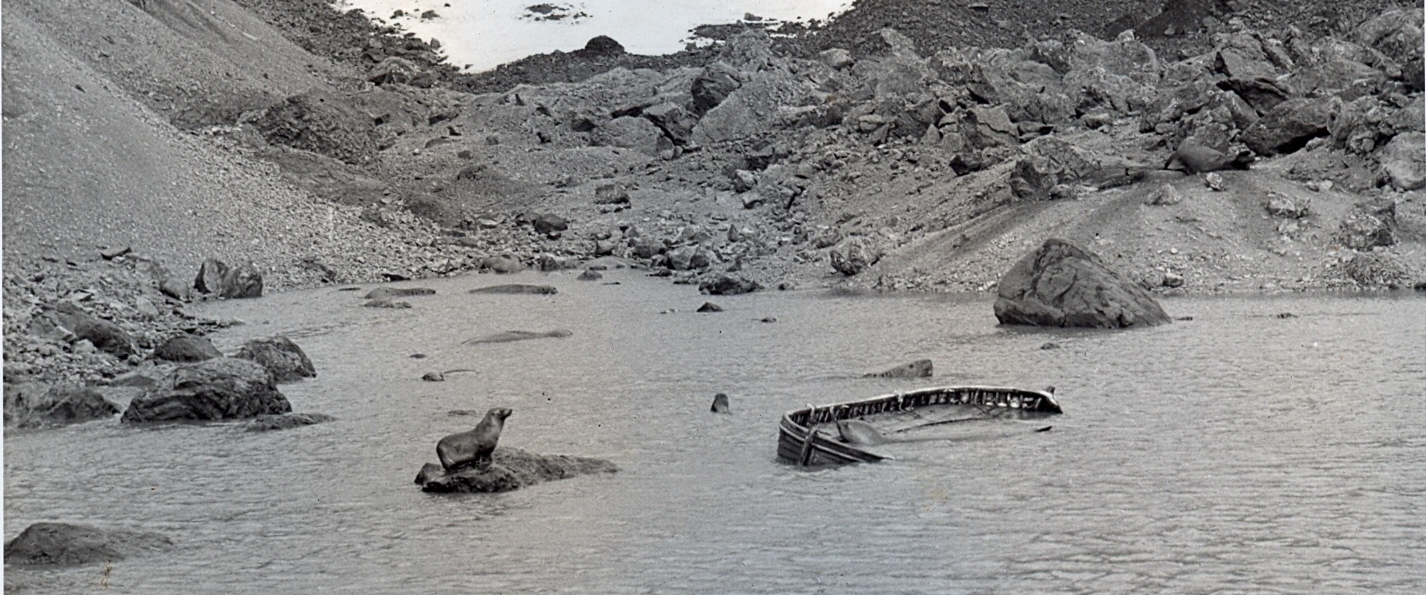
The unidentified whaler or ship's lifeboat found abandoned on Bouvet Island on 2 April 1964

The unidentified whaler or ship’s lifeboat found abandoned on Bouvet Island on 2 April 1964

LongreadsThere is no more forbidding place on earth.

Bouvet Island lies in the furthest reaches of the storm-wracked Southern Ocean, far south even of the Roaring Forties. It is a speck of ice in the middle of a freezing fastness: a few square miles of uninhabited volcanic basalt groaning under several hundred feet of glacier, scraped raw by gales, shrouded by drifts of sea-fog, and utterly devoid of trees, shelter, or landing places.

What it does have is a mystery. More