Some experiments with severed heads

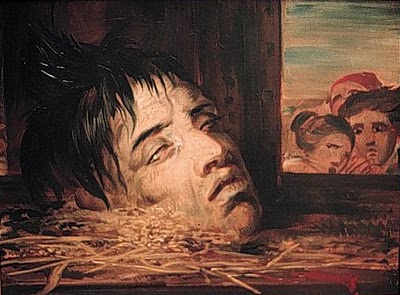
Antoine Joseph Wiertz: Guillotined Head (1855). Musée Antoine Wiertz, Brussels.

Antoine Joseph Wiertz: Guillotined Head (1855). Musée Antoine Wiertz, Brussels.

Early on the morning of 18 February 1848, two men and a woman walked into the square in front of the Porte de Hal, in Brussels, where a public execution was due to take place shortly after dawn. They were there to conduct a ground-breaking scientific study, and, by prior arrangement with the Belgian penal authorities, were permitted to climb onto the scaffold and wait next to the guillotine at the spot where the severed heads of two condemned criminals were scheduled to drop into a blood red sack.

One of the men was Antoine Joseph Wiertz, a well known Belgian painter and also a fine hypnotic subject. With him were his friend, Monsieur D_____, a noted hypnotist, and a witness. Wiertz’s purpose on that winter’s day was to carry out a unique and extraordinary experiment. Long haunted by the desire to know whether a severed head remained conscious after a guillotining, the painter had agreed to be hypnotised and instructed to identify himself with a man who was about to be executed for murder. More

The Shogun’s reluctant ambassadors

March 1839: the Japanese cargo ship Cho-ja maru, dismasted and without her rudder, wallows in the Pacific shortly before her surviving crew were picked up by the American whaler James Loper. Artist unknown; Sonkei Archives, Tokyo

When Matthew Perry sailed his squadron of warships into Edo Bay in July 1853 – and compelled the local authorities, under threat of bombardment, to accept a trade treaty with the United States – Japan had been a closed society for well over two centuries. Under the policy known as Sakoku (“locking the country”), practically all trade with the outside world had been strictly prohibited. Christianity was banned, foreigners already in Japan were expelled, and others were forbidden, on pain of death, from entering imperial territory. The Japanese, similarly, were not permitted to leave. For 220 years, the country remained almost entirely isolated, mostly peaceful, and profoundly mysterious and alluring to outsiders.

Whatever the reasons for Japan’s self-imposed seclusion – they are all too frequently reduced to fear of fast-encroaching Christianity, though inevitably they were quite a bit more complex than that [Boxer pp.308-400; Eiichi pp.21-58] – Sakoku produced peculiar results. Japan’s only formal foreign relations were with Korea; strictly limited trade was carried on, but the only westerners allowed anywhere on Japanese territory were the Dutch, and they were favoured largely because, being Calvinists, they had no interest in converting anyone to their religion. Dutch traders, in turn, were restricted to a single “factory,” or base, located on an island just off Nagasaki and chosen to ensure that there could be no easy intercourse with the locals. A few Japanese, specially trained to act as interpreters, had access to the factory, and one or two Dutch merchants, on special occasions, travelled to Edo, the capital, in palanquins. But all but a tiny handful of Japanese had never seen a European and had no access to western thoughts or ideas. Dutch woollen cloth (the principal import) was scarce and hence fashionable and highly sought-after. For the most part, however, it was easy for the Japanese to believe that their visitors were very different to them – indeed, quite possibly, not human:

Most Japanese regarded foreigners (and particularly Europeans) as a special variety of goblin that bore only superficial resemblance to a normal human being. The usual name given to the Dutch was komo or “red hairs,” a name intended more to suggest a demonic being than to describe the actual coloring of the foreigners’ hair. The Portuguese had also at one time been declared by the shogunate to possess “cat’s eyes, huge noses, red hair and shrike’s-tongues” … More
Truth, beauty and Pancho Villa

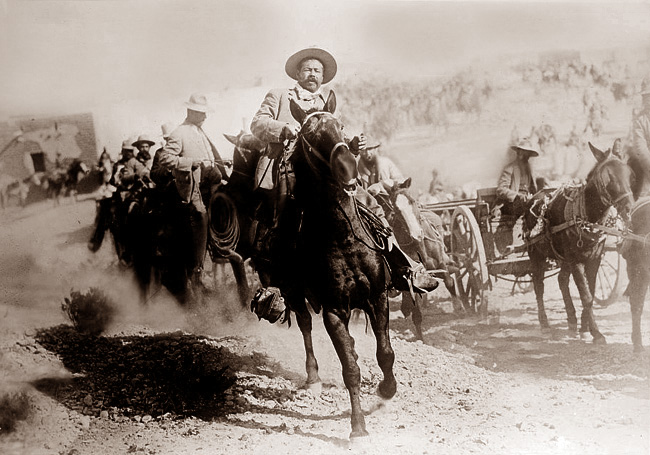
Pancho Villa pictured shortly after the Battle of Ojinaga, in January 1914 – an engagement he delayed for the benefit of American newsreel cameras. The still comes from Mutual Film’s exclusive footage.

The first casualty of war is truth, they say, and nowhere was that sage old aphorism more true than in Mexico during the revolutionary period between 1910 and 1920. In all the blood and chaos that followed the overthrow of Porfirio Diaz, who had been dictator of Mexico ever since 1876, what was left of the central government in Mexico City found itself at war with several contending rebel forces – most notably the Liberation Army of the South, commanded by Emiliano Zapata, and the Chihuahua-based División del Norte, led by the even more celebrated bandit-rebel Pancho Villa. The three-cornered civil war that followed was notable for several things: its unrelenting savagery, its unending confusion, and – north of the Rio Grande, at least – its unusual film deals. Specifically, it’s remembered for the bizarre contract Villa was supposed to have signed with a leading American newsreel company in January 1914. Under the terms of this deal, it is said, the rebels undertook to fight their revolution for the benefit of the movie cameras – in exchange for a large advance, payable in gold. More

Erotic secrets of Lord Byron’s tomb

Byron in death, Greece, spring 1824.

It was hot and dusty in the crypt, and it had been hard work breaking into it. Now the vicar had gone, along with his invited guests, to take his supper. The churchwarden and two workmen armed with spades were left to wait for their return, loitering by the grave they had come to examine – the tomb of Lord Byron the poet.

We didn’t take too kindly to that,” said Arnold Houldsworth. “I mean, we’d done the work. And Jim Bettridge suddenly says, ‘Let’s have a look on him.’ ‘You can’t do that,’ I says. ‘Just you watch me,’ says Jim. He put his spade in, there was a layer of wood, then one of lead, and I think another one of wood. And there he was, old Byron.”

“Good God, what did he look like?” I said.

“Just like in the portraits. He was bone from the elbows to his hands and from the knees down, but the rest was perfect. Good-looking man putting on a bit of weight, he’d gone bald. He was quite naked, you know,” and then he stopped, listening for something that must have been a clatter of china in the kitchen, where his wife was making tea for us, for he went on very quickly,  “Look, I’ve been in the Army, I’ve been in bathhouses, I’ve seen men. But I never saw nothing like him.” He stopped again, and nodding his head, meaningfully, as novelists say, began to tap a spot just above his knee. “He was built like a pony.”

“How many of you take sugar?” said Mrs Houldsworth, coming with the tea. More

Naked as nature intended? Catherine Crowe in Edinburgh, February 1854

You might call it parapsychology’s greatest mystery. Did Catherine Crowe – sixtysomething literary stalwart of the mid-nineteenth century, passionate advocate of the German ghost story, and author of that runaway best-seller The Night Side of Nature (London, 2 vols.: Newby, 1848) – really tear through the streets of Edinburgh at the end of February 1854, naked but for a handkerchief clutched in one plump hand and a visiting card in the other? And, if she did, was it because she had experienced a nervous breakdown, or because the spirits had convinced her that, once her clothes were shed, she would become invisible? More

The Emperor’s electric chair

The death chair in Auburn prison, c.1890

award-2010Many countries have folk-tales that feature foolish kings – monarchs whose vanity causes them to make catastrophic misjudgements or attempt impossible things. Greek mythology offers the tradition of King Midas, who lived to regret wishing for the power to turn everything he touched into gold; for we Brits, the foolish ruler is King Canute, who – at least in the common modern telling of the tale – allowed courtiers to flatter him that even the seas would obey his commands, and consequently got his feet wet in a failed attempt to turn back the tides.1

Most of these legends are hundreds of years old, of course, but the motif is a potent one and it still crops up from time to time. Here, for example, is a story that has stuck firmly in my mind ever since I first read it in The Book of Lists, a best-selling compendium of all sorts of remarkable trivia, first published in 1977:

The Abyssinian electric chair

On August 6, 1890, the first electric chair in history was put into use in the death chamber of Auburn Prison in New York. In distant Abyssinia – now called Ethiopia – Emperor Menelik II (1844-1913) heard about it and decided that this new method of execution should become part of his modernisation plan for his country. Immediately, he put in an order for three electric chairs from the American manufacturer. When the chairs arrived and were unpacked, the emperor was mortified to learn that they wouldn’t work – Abyssinia had no electricity. Determined that his investment would not be completely wasted, Emperor Menelik adopted one of the electric chairs for his imperial throne.

David Wallechinsky et al, The Book of Lists (London: Corgi, 1977) p.463.

Pretty amusing, and plainly I’m not the only person who finds this odd tale peculiarly memorable; the editors of The Book of Lists themselves ranked it among their “15 favourite oddities of all time,” and if you type the search string ‘Menelik’s electric chair’ into Google, you come up with several thousand hits from sites such as anecdotage.com, all of which are clearly based on the BoL‘s telling of the story; they contain the same basic information, but nothing different or new. More

The chupatty movement

Why were thousands of chapatis – an Indian unleavened bread – carried by night across the interior of India in the months before the outbreak of the great Sepoy Rebellion? And why did not even the people who bore them know what they were for?

Thousands of chapatis – an Indian unleavened bread – carried by night across the interior of India in the months before the outbreak of the great Sepoy Rebellion. But why did not even the people who bore them know what they were for?

“There is a most mysterious affair going on throughout the whole of India at present,” wrote Dr Gilbert Hadow in a letter to his sister at home in Britain dated March 1857. “No one seems to know the meaning of it… It is not known where it originated, by whom or for what purpose, whether it is supposed to be connected to any religious ceremony or whether it has to do with some secret society. The Indian papers are full of surmises as to what it means. It is called ‘the chupatty movement.’” [Hibbert p.59]

The “movement” that Dr Hadow was describing was a remarkable example of rumour gone wild. It consisted of the distribution of many thousands of chapatis – unleavened Indian breads – which were passed from hand to hand and from village to village throughout the mofussil (interior) of the Subcontinent. That these chapatis really existed is beyond doubt; what made their distribution truly bizarre and inexplicable was that nobody knew for sure what they were for. More

The miniature coffins found on Arthur’s Seat

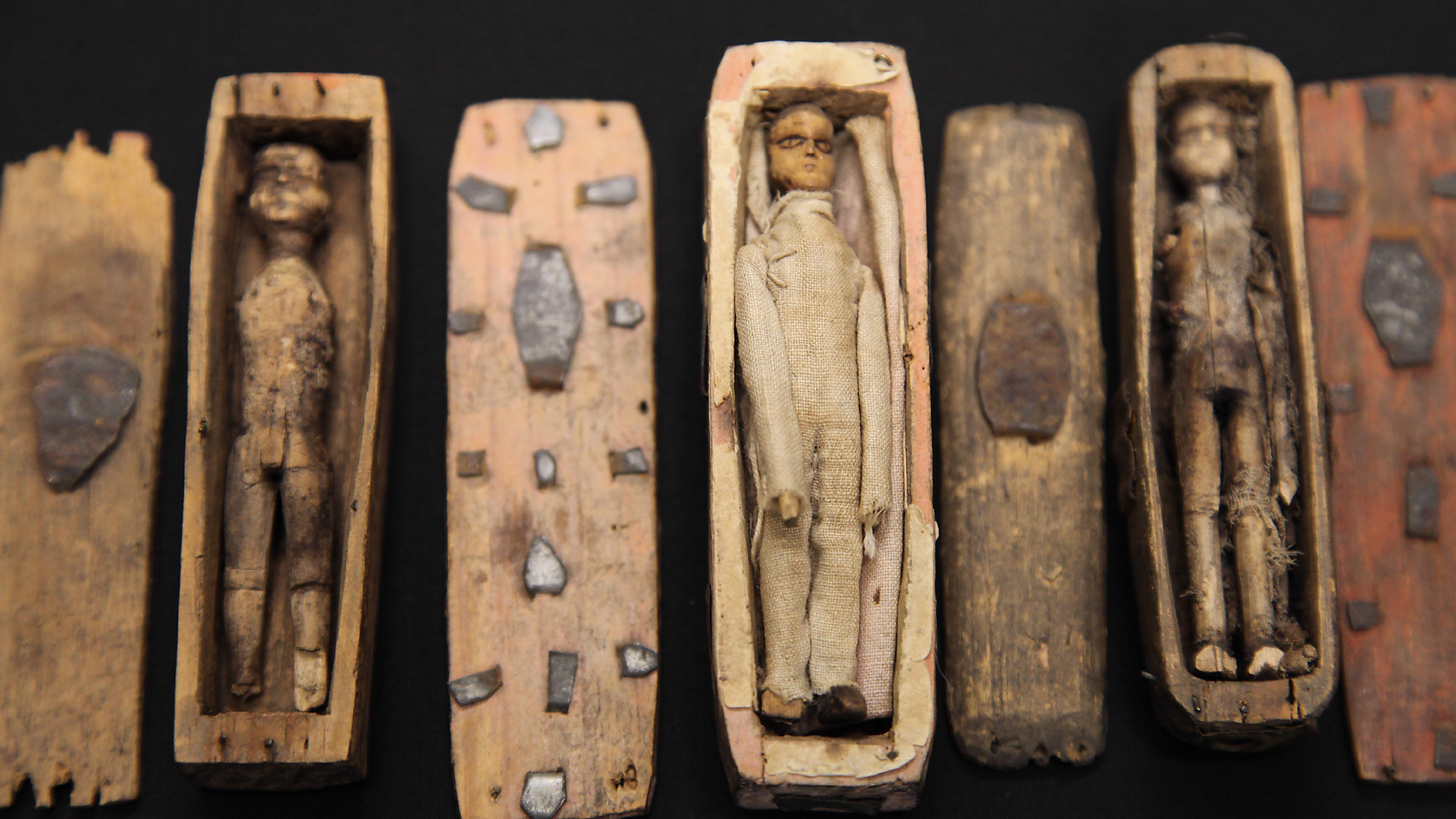
Seventeen miniature coffins were discovered high above Edinburgh in 1836, and eight of them survive today in the collection of the National Museum of Scotland.

It may have been Charles Fort who described the strange discovery best:

London Times, July 20, 1836:

That, early in July, 1836, some boys were searching for rabbits’ burrows in the rocky formation, near Edinburgh, known as Arthur’s Seat. In the side of a cliff, they came upon some thin sheets of slate, which they pulled out.

Little cave.

Seventeen tiny coffins.

Three or four inches long.

In the coffins were miniature wooden figures. They were dressed differently in both style and material. There were two tiers of eight coffins each, and a third one begun, with one coffin.

The extraordinary datum, which has especially made mystery here: More

The Monster of Glamis: a first draft

Glamis[For a completely revised and more detailed account of the same mystery, featuring the fruits of much new research, see here.]

Glamis Castle, in Scotland, is a famous place: a picture-postcard tourist destination, childhood home of the late-lamented Queen Mother Gawd Bless ‘Er™, and – not incidentally for the purposes of this blog – notoriously the most haunted ‘house’ in Britain. Any number of spook stories are associated with the castle, from tales of ghosts materializing in visitors’ bedrooms to the legend of the infamous Earl Beardie, the so-called “Tiger Earl” – a fifteenth century Earl of Crawford whose soul is said to have been claimed by the devil while he unrepentantly played cards at Glamis upon the Sabbath day.

Best known by far, however, is the strange story of the Monster of Glamis, which (thanks in large part to its vague royal associations) has some claim to be ranked among the more pervasive legends of the twentieth century. In its evolved form (and it took some time to evolve, as we will see), this legend relates how, in the early nineteenth century, the wife of the then heir to the Earl of Strathmore gave birth in the castle to an boy who was so hideously deformed that the family took the decision to lock the child away in a secret room, denying him the chance to succeed to the earldom. More

The Grey Dog of Meoble

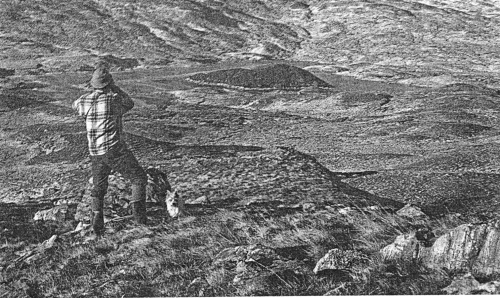
LochanPhoto courtesy of Iain Thornber

A friend’s mention of Loch Morar the other day – a phenomenally beautiful place tucked away in the heart of the ‘Rough Bounds’ of the Scottish Highlands – put me in mind of a legend from that district that is not at all well known even to folklorists, but which combines, in an interesting way, two distinct storytelling motifs: those of the ‘loyal pet’ and the ‘harbinger of death’.

The Grey Dog of Meoble (which I have seen given, in the Gaelic in which the story was first told, as an cuth glas Meobhail or an cu glas Mheobail) is a gigantic, shaggy-haired Scottish deerhound whose preternatural appearances are said to presage death to members of the Macdonald clan in the south Morar districts where the tradition first flourished. Tales of the spectral animal’s appearances certainly date to the first half of the nineteenth century; we know that Caraid nan Gaidheal, a renowned Highland piper who died in 1867, had heard the legend (John Gibson, Old and New World Highland Bagpiping (Montreal: McGill-Queen’s Press, 2002, p.318). They come not only from the tiny crofting hamlet of Meoble (pronounced “Meeble”) – a settlement, now all but abandoned, in an isolated district a mile from the shores of Loch Morar – but from other parts of Scotland and even Canada.

Most tales of the Grey Dog concern the hound’s appearances to Morar MacDonalds who are on the point of death
More