The most terrible tunnel

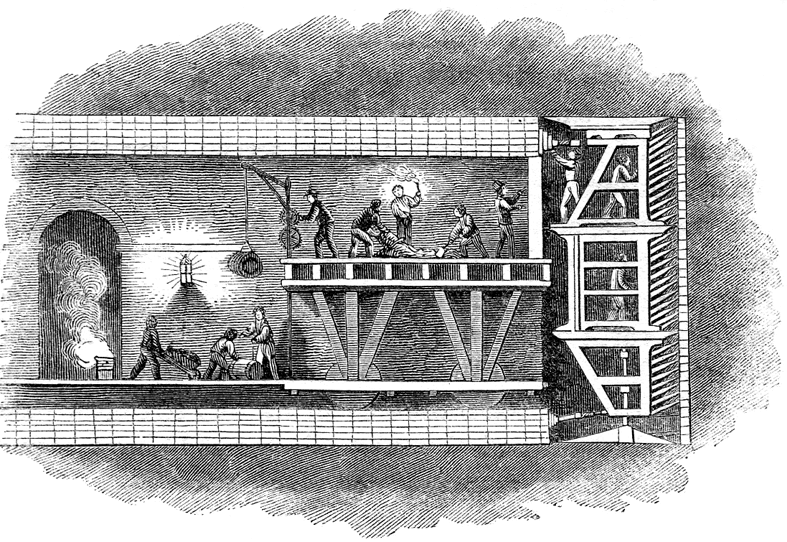
Labourers working at the face of the Thames Tunnel were protected by Marc Brunel’s newly-invented “Shield”; behind them, other gangs hurried to roof the tunnel before the river could burst in. Nineteenth century lithograph.

At the beginning of the 19th century, the port of London was the busiest in the world. Cargoes that had traveled thousands of miles, and survived all the hazards of the sea, piled up on the wharves of Rotherhithe—only for their owners to discover that the slowest, most frustrating portion of their journey often lay ahead of them. Consignments intended for the southern (and most heavily populated) parts of Britain had to be heaved onto creaking ox carts and hauled through the docklands and across London Bridge, which had been built in the 12th century and was as cramped and impractical as its early date implied. By 1820, it had become the center of the world’s largest traffic jam.

It was a situation intolerable to a city with London’s pride, and it was clear that if private enterprise could build another crossing closer to the docks, there would be a tidy profit to be made in tolls. Another bridge was out of the question—it would deny sailing ships access to the deepwater dock known as the Pool of London—and ambitious men turned their thoughts to driving a tunnel beneath the Thames instead.

This was not such an obvious idea as it might appear. Although demand for coal was growing fast as the industrial revolution hit high gear, working methods remained primitive. Tunnels were dug by men wielding picks in sputtering candlelight. No engineers had ever tunneled under a major river, and the Thames was an especially tricky one. To the north, London was built on a solid bed of clay, ideal tunneling material. To the south and east, however, lay deep strata of water-bearing sand and oozing quicksand, all broken up by layers of gravel, silt, petrified trees and the debris of ancient oyster beds. The ground was semi-liquid, and at depth it became highly pressurized, threatening to burst into any construction site. Continue reading
The great tea race

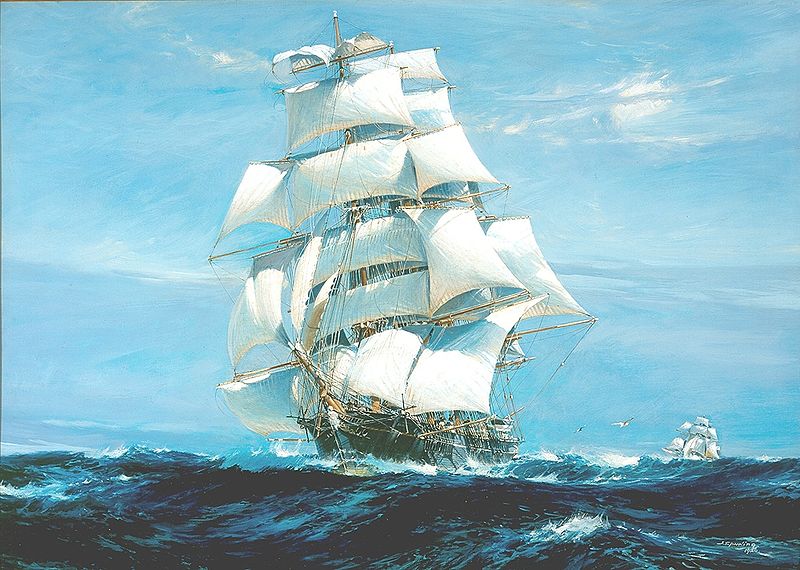
Ariel and Taeping at sea during the great Tea Race of 1866. Oil painting by Jack Spurling, 1926.

Captain John Keay, master of the new British clipper ship Ariel, had good reason to feel pleased with himself. He had secured the first cargo of tea to come to market at the great Chinese port of Foochow (modern Fuzhou) in 1866—560 tons of first and second pickings, freighted at the high price of £7 a ton: the very finest leaves available. The cargo had been floated out to him in lighters, packed in more than 12,000 hand-made tea chests, and stowed below decks in the record time of just four days.

Now Ariel was weighing anchor. It was 5 p.m. on the evening of May 28, which made her the first tea clipper to sail for London that season. She was a brand new ship: “A perfect beauty,” Keay recalled, “to every nautical man who saw her; in symmetrical grace and proportion of hull, spars, sails, rigging and finish she satisfied the eye and put all in love with her without exception. Very light airs gave her headway, and I could trust her like a thing alive in all evolutions.”

Ariel was indeed the fleetest vessel of her time; flying the astounding total of more than 26,000 square feet of canvas, she could reach speeds of 16 knots, far faster than contemporary steamers. But the advantage that Keay held over the other clippers crowded in the port was minimal, and Ariel was unlucky with her tugs. The paddle steamer Island Queen, hired to take the clipper in tow, lacked the power to carry her across the bar of the Min River against a falling tide. Stranded for the night, Keay and his crack crew were forced to lie at anchor and watch as their rivals completed their own hurried loading and started in pursuit. That evening the rival Fiery Cross came down the river towed by a more powerful tug, edged her way into clear water, and set a course east across the China Sea. Keay was still negotiating the bar next morning when two other clippers, Serica and Taeping, appeared beside him. The Tea Race of 1866—the most exciting in the history of the China trade—was on. Continue reading

On hidden history

5 writersThe best stories from history lie beyond the margins of textbooks, says the historian. He tells us about five extraordinary tales from the past, from visions of the Virgin Mary to the golden age of the American con artist.

Here’s the text of a long interview that I gave to the brilliant The Browser site about ‘hidden history’ – what it is, what bits of it are most worth reading, and why we should care. I’m pretty happy with how it came out, and if you like the sort of stories featured in this blog and are looking for some recommendations for further reading, it’s not a bad place to start.

Will you start by telling me what you mean by “hidden history”?

For me, it’s the history that exists beyond the margins and the textbooks and what we normally consider to be history: George Washington, Henry VIII, Hitler. I have the capacity to be interested in pretty much all history, because it’s all about us being human. But I’m most interested in stuff no one else is interested in – I really like knowing things that other people have missed out on. All the books I’ve recommended are about periods and episodes in history that are little known but which I find peculiarly fascinating. I think that’s because they are all, ultimately, about the extremes of human experience. We can learn a lot about ourselves as human beings by seeing how we react in instances where we are confronted by extremes – whether they are economic, as in my book Tulipomania [about the 17th century tulip market in Holland], or life-threatening, as in Batavia’s Graveyard [about a Dutch East India company ship that was shipwrecked in 1629].

And all these books you’ve chosen, as well as your own, are very much about the individuals and their stories?

Yes, I’m interested in the ordinary people of history. One of the things I try to do when I write is to dignify them by showing a bit of interest in their lives and what happened to them, rather than treating them as if they’re another disposable number, which is how, quite often, they were treated in life. All these books I’ve chosen have a similar sort of approach. For example, Joseph Mitchell is renowned for taking seriously people who were very much at the margins of New York society. Continue reading

The mystery of the five wounds

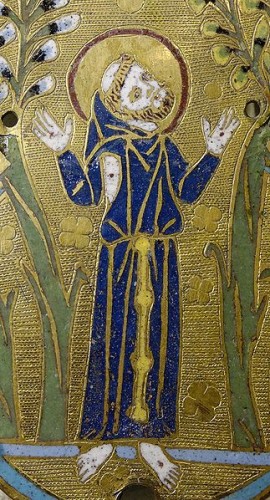
St Francis receives the stigmata. From a foil plaque on a 13th- century reliquary.

On September 14, 1224, a Saturday, Francis of Assisi—noted ascetic and holy man, future saint—was preparing to enter the second month of a retreat with a few close companions on Monte La Verna, overlooking the River Arno in Tuscany. Francis had spent the previous few weeks in prolonged contemplation of the suffering Jesus Christ on the cross, and he may well have been weak from protracted fasting. As he knelt to pray in the first light of dawn (notes the Fioretti—the ‘Little flowers of St Francis of Assisi,’ a collection of legends and stories about the saint),

he began to contemplate the Passion of Christ… and his fervor grew so strong within him that he became wholly transformed into Jesus through love and compassion…. While he was thus inflamed, he saw a seraph with six shining, fiery wings descend from heaven. This seraph drew near to St Francis in swift flight, so that he could see him clearly and recognize that he had the form of a man crucified… After a long period of secret converse, this mysterious vision faded, leaving… in his body a wonderful image and imprint of the Passion of Christ. For in the hands and feet of Saint Francis forthwith began to appear the marks of the nails in the same manner as he had seen them in the body of Jesus crucified.

In all, Francis found that he bore five marks: two on his palms and two on his feet, where the nails that fixed Christ to the cross were traditionally believed to have been hammered home, and the fifth on his side, where the Bible says Jesus had received a spear thrust from a Roman centurion.

Thus was the first case of stigmata—the appearance of marks or actual wounds paralleling those Christ received during Crucifixion—described. Later stigmatics (and there have been several hundred of them) have exhibited similar marks, though some bear only one or two wounds, while others also display scratches on their foreheads, where Christ would have been injured by his crown of thorns. Through the centuries, stigmata has become one of the best-documented, and most controversial, of mystical phenomena. The extensive record makes it possible to compare cases that occurred centuries apart.
Continue reading

“Above the Senior Wrangler”

Philippa Fawcett. When she placed first in the Cambridge mathematical tripos in 1890, she forced a reassessment of nineteenth-century belief in the inferiority of the “weaker sex.”

To be a woman in the Victorian age was to be weak: the connection was that definite. To be female was also to be fragile, dependent, prone to nerves and—not least—possessed of a mind that was several degrees inferior to a man’s. For much of the 19th century, women were not expected to shine either academically or athletically, and those who attempted to do so were cautioned that they were taking an appalling risk. Mainstream medicine was clear on this point: to dream of studying at the university level was to chance madness or sterility, if not both.

It took generations to transform this received opinion; that, a long series of scientific studies, and the determination and hard work of many thousands of women. For all that, though, it is still possible to point to one single achievement, and one single day, and say: this is when everything began to change. That day was June 7, 1890, when—for the first and only time—a woman ranked first in the mathematical examinations held at the University of Cambridge. It was the day that Philippa Fawcett placed “above the Senior Wrangler.”

To understand why one woman’s achievement so shook the prejudices of the Victorian age—and why newspapers from the New York Times to the Times of India thought it worthwhile to devote thousands of words to an exam that today means little to anybody but the students themselves—it is necessary to understand why Cambridge mathematics mattered in the 19th century. Continue reading

In search of Queen Victoria’s voice

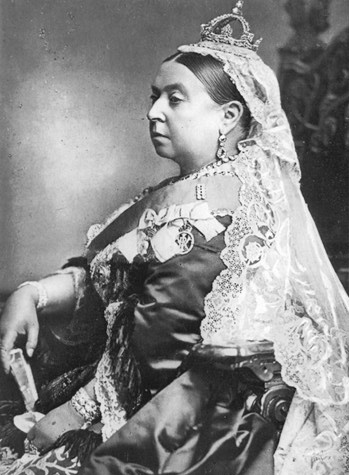
“Greetings, Britons and everybody.” Queen Victoria in 1887, at about the time she made her Graphophone recording.

It is a woman’s voice, but it sounds as though it comes drifting toward us across some vast and unbridgeable distance. It is all but drowned out by the snaps and the crackles and pops of what is by any standard a primitive recording. And yet—listened to over and over again—the voice does begin to sound refined. Perhaps even a little bit imperious.

The words that the woman speaks are muffled, but it is possible to make at least a few of them out. Some people have sworn that they can hear “tomatoes,” for example, blurted out toward the end of the track. But what about the very first syllables preserved on the recording—a 20-second audio segment believed to have been made more than 130 years ago, late in 1888, in the earliest days of the recording industry? Is that really the voice of Her Imperial Majesty Queen Victoria? And, if it is, can she really be welcoming her listeners with the words: “Greetings, Britons and everybody”?

There is no real doubt that Britain’s longest-reigning monarch allowed her voice to be recorded in that long-ago fall. The man who made the recording freely discussed it and it is recalled in a letter in the Royal Archives, dated 1907; the incident also rates a passing mention (without a source attribution) in Elizabeth Longford’s exhaustive biography of the Queen, Victoria R.I. The question is what happened to the recording after it was made—and, in a broader sense, why it matters whether it still exists. The search for the recording takes us from the New Jersey laboratories of Thomas Edison to the Highlands of Scotland, and from the archives of the Rolls-Royce motor company to the vaults beneath London’s Science Museum. Before we set of on that trail, though, we first need to understand why anyone should be interested in a few utterly unimportant phrases spoken by a long-dead queen. Continue reading

Amazons: inside the King of Dahomey’s all-woman army

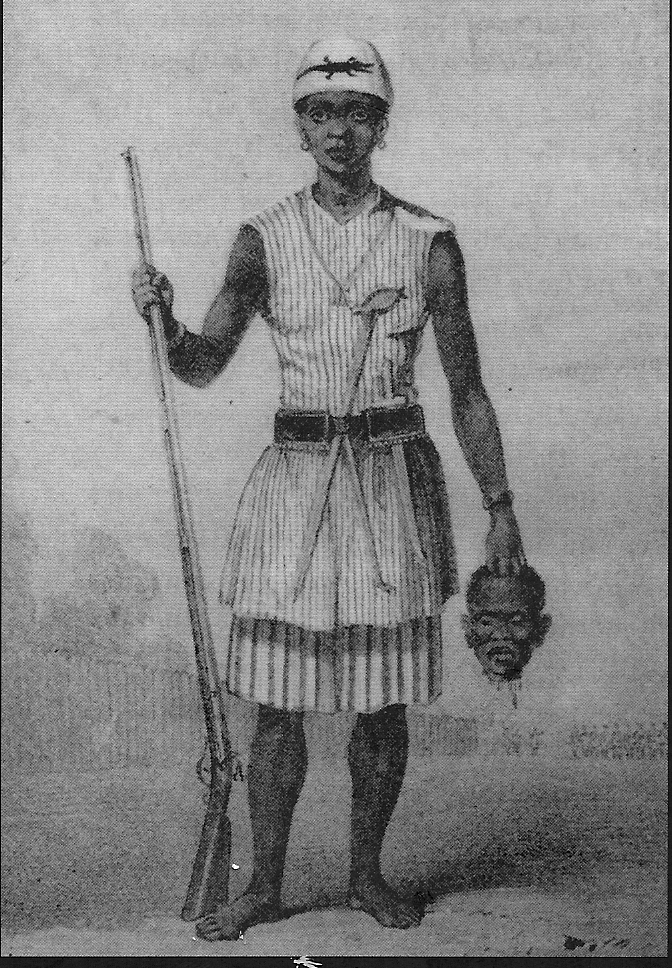
One of Dahomeys’ amazons, with a musket, club, dagger—and her enemy’s severed head. From Forbes, Dahomy and the Dahomans (1851).

It is noon on a humid Saturday in the fall of 1861, and a missionary by the name of Francesco Borghero has been summoned to a parade ground in Abomey, the capital of the small West African state of Dahomey. He is seated on one side of a huge, open square right in the center of the town–Dahomey is renowned as a “Black Sparta,” a fiercely militaristic society bent on conquest, whose soldiers strike fear into their enemies all along what is still known as the Slave Coast. The maneuvers begin in the face of a looming downpour, but King Glele is eager to show off the finest unit in his army to his European guest.

As Father Borghero fans himself, 3,000 heavily armed soldiers march into the square and begin a mock assault on a series of defenses designed to represent an enemy capital. The Dahomean troops are a fearsome sight, barefoot and bristling with clubs and knives. A few, known as Reapers, are armed with gleaming three-foot-long straight razors, each wielded two-handed and capable, the priest is told, of slicing a man clean in two. Continue reading

Pablo Fanque’s fair

Pablo Fanque: expert equestrian, tightrope walker, acrobat, showman–and Britain’s first black circus owner.

Anyone who has ever listened to The Beatles’ Sergeant Pepper’s Lonely Hearts Club Band–and that’s a few hundred million people at the last estimate–will know the swirling melody and appealingly nonsensical lyrics of “Being for the Benefit of Mr. Kite,” one of the most unusual tracks on that most eclectic of albums.

For the benefit of Mr. Kite
There will be a show tonight on trampoline
The Hendersons will all be there
Late of Pablo Fanque’s Fair—what a scene
Over men and horses, hoops and garters
Lastly through a hogshead of real fire!
In this way Mr. K. will challenge the world!

But who are these people, these horsemen and acrobats and “somerset turners” of a bygone age? Those who know a bit about the history of the circus in its mid-Victorian heyday–before the coming of the music halls and the cinema stole its audience, at a time when a traveling show could set up in a mid-size town and play for two or three months without exhausting demand–will recognize that John Lennon got his vocabulary right when he wrote those lyrics. “Garters” are banners stretched between poles aloft held by two men; the “trampoline,” in those days, was simply a springboard, and the “somersets” Mr. Henderson undertakes to “throw on solid ground” were somersaults.

While true Beatlemaniacs will know that Mr. Kite and his companions were real performers in a real troupe, however, few will realize that they were associates of what was probably the most successful, and almost certainly the most beloved, “fair” to tour Britain in the mid-Victorian period. And almost none will know that Pablo Fanque–the man who owned the circus—was more than simply an exceptional showman and perhaps the finest horsemen of his day. He was also a black man making his way in an almost uniformly white society, and doing it so successfully that he played to mostly capacity houses for the best part of 30 years. Continue reading

Inside the Great Pyramid

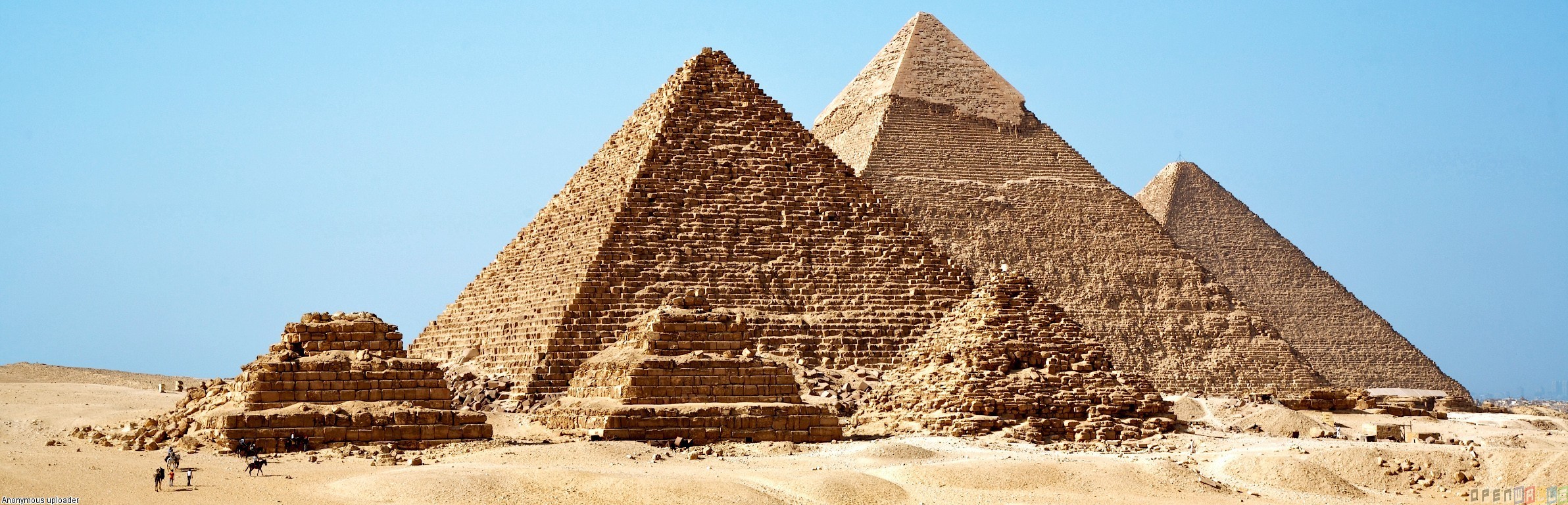
The Great Pyramid–built for the Pharaoh Khufu in about 2570 B.C., sole survivor of the Seven Wonders of the ancient world, and still arguably the most mysterious structure on the planet

The Great Pyramid–built for the Pharaoh Khufu in about 2570 B.C. [rear], sole survivor of the Seven Wonders of the ancient world, and still arguably the most mysterious structure on the planet

There is a story, regrettably apocryphal, about Napoleon and the Great Pyramid. When Bonaparte visited Giza during his Nile expedition of 1798 (it goes), he determined to spend a night alone inside the King’s Chamber, the granite-lined vault that lies precisely in the center of the pyramid. This chamber is generally acknowledged as the spot where Khufu, the most powerful ruler of Egypt’s Old Kingdom (c.2690-2180 BC), was interred for all eternity, and it still contains the remains of Pharaoh’s sarcophagus—a fractured mass of red stone that is said to ring like a bell when struck.

Having ventured alone into the pyramid’s forbidding interior and navigated its cramped passages armed with nothing but a guttering candle, Napoleon emerged the next morning white and shaken, and thenceforth refused to answer any questions about what had befallen him that night. Not until 23 years later, as he lay on his death bed, did the emperor at last consent to talk about his experience. Hauling himself painfully upright, he began to speak—only to halt almost immediately.

“Oh, what’s the use,” he murmured, sinking back. “You’d never believe me.” Continue reading

The king of hard currency

The island of Yap from the air: a wester Pacific paradise where almost everything needed to sustain life grew comfortably to hand.

The island of Yap from the air: a western Pacific paradise where almost everything needed to sustain life grew comfortably to hand.

It was a typhoon, or so it’s said, that cast up David O’Keefe on Yap in 1871, and when he finally left the island 30 years later, it was another typhoon that drowned him as he made his way home to Savannah.

Between those dates, though, O’Keefe carved himself a permanent place in the history of the Pacific. So far as the press was concerned, he did it by turning himself into the “king of the cannibal islands”: a 6-foot-2, red-haired Irishman who lived an idyllic tropical existence, was “ruler of thousands” of indigenous people, and commanded “a standing army of twelve naked savages.” (“They were untutored, but they revered him, and his law was theirs.”) [New York Times; New York Tribune; Watchman & Southron] It was this version of O’Keefe’s story that made it to the silver screen half a century later in the forgettable Burt Lancaster vehicle His Majesty O’Keefe (1954), and this version, says scholar Janet Butler, that is still believed by O’Keefe’s descendants in Georgia. [Butler pp.177-8, 191]

The reality is rather different, and in some ways even more remarkable. For if O’Keefe was never a king, he certainly did build the most successful private trading company in the Pacific, and—at a time when most Western merchants in the region exploited the islanders they dealt with, then called in U.S. or European warships to back them up—he worked closely with them, understood them and made his fortune by winning their trust and help. This itself makes O’Keefe worthy of remembrance, for while the old sea-captain was most assuredly not perfect (he had at least three wives and several mistresses, and introduced the Yapese to both alcohol and firearms), he is still fondly recalled on the island. It doesn’t hurt, so far as the strangeness of the story goes, that O’Keefe ingratiated himself on Yap by securing a monopoly on the supply of the island’s unique currency: giant stone coins, each as much as 12 feet in diameter and weighing up to four and a half tons.

But wait; we’re getting ahead of ourselves. Let’s start with the convoluted history that brought O’Keefe to Yap. More