Fishmonger’s Hall: how William Crockford beggared the British aristocracy

William Crockford—identified here as “Crockford the Shark”—sketched by the great British caricaturist Thomas Rowlandson in about 1825. Rowlandson, himself an inveterate gambler who blew his way through a $10.5 million family fortune, knew the former fishmonger before he opened the club that would make his name.

The redistribution of wealth, it seems safe to say, is vital to the smooth operation of any functioning economy. Historians can point to plenty of examples of the disasters that follow whenever some privileged elite decides to seal itself off from the hoi-polloi and pull up the ladder that its members used to clamber to the top of the money tree. And while there always will be argument as to how that redistribution should occur (whether compulsorily, via high taxation and a state safety net, or voluntarily, via the hotly debated “trickle-down effect”), it can be acknowledged that whenever large quantities of surplus loot have been accumulated, the sniff of wealth tends to create fascinating history—and produce some remarkable characters as well.

Take William Crockford, who began his career as a London fishmonger and ended it, half a century later, as perhaps the wealthiest self-made man in England. Crockford managed this feat thanks to one extraordinary talent—an unmatched skill for gambling—and one simple piece of good fortune: to be alive early in the 19th century, when peace had returned to Europe after four decades of war and a generation of bored young aristocrats, who a few years earlier would have been gainfully employed in fighting Napoleon, found themselves with far too much time on their hands.

The result was a craze for heavy gambling that ran throughout the notoriously dissolute Regency period (c.1815-1838). The craze made Crockford rich and bankrupted a generation of the British aristocracy; at the height of his success, around 1830, the former fishmonger was worth the equivalent of perhaps $160 million today, and practically every cent of it had come straight from the pockets of  the aristocrats whom “Crocky” had lured into the luxurious gambling hell that he had built on London’s fashionable St. James’s Street. So successful was Crockford at his self-appointed task of relieving his victims of their family fortunes that there are, even today, eminent British families that have never properly recovered from their ancestors’ encounters with him.
Continue reading

A visit to the underworld: the unsolved mystery of the tunnels at Baia

Baiae and the Bay of Naples, painted by J.M.W. Turner in 1823, well before modernization of the area obliterated most traces of its Roman past. Image: Wikicommons.

Baia and the Bay of Naples, painted by J.M.W. Turner in 1823, well before modernisation of the area obliterated most traces of its Roman past. Image: Wikicommons.

Now revised and updated to September 2016.

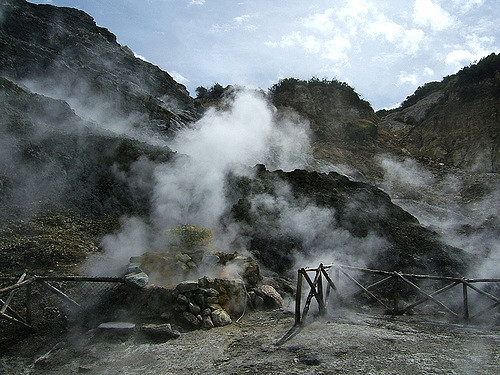
There is nothing remotely Elysian about the Phlegræan Fields; nothing sylvan, nothing green. The Fields, which lie on the north shore of the Bay of Naples, are part of the caldera of a volcano that is the twin of Mount Vesuvius, the destroyer of Pompeii, a few miles to the east. The volcano is still active, but, today, its most obvious feature is this barren, rubble-strewn plateau. Fire bursts from the rocks in places, and clouds of sulphurous gas snake out of vents that lead up from deep underground.

The Fields, in short, are hellish, and it is no surprise that they have always been associated with all manner of strange tales. Most interesting, perhaps, is the myth of the Cumæan sibyl, who took her name from the nearby town of Kyme – Cumæ – a Greek colony that flourished in about 550 B.C., when the Etruscans still held sway much of central Italy and Rome was nothing but a city-state ruled over by a line of tyrannical kings.

Sulfur drifts from a vent on the barren volcanic plateau known as the Phlegraean Fields, a harsh moonscape associated with legends of prophecy.

Sulphur drifts from a vent on the barren volcanic plateau known as the Phlegraean Fields, a harsh moonscape associated with legends of prophecy.

The sibyl, so the story goes, was a woman named Amalthæa who lurked in a cave on the Phlegræan Fields. She had once been young and beautiful –beautiful enough to attract the attentions of the sun god, Apollo, who offered her one wish in exchange for her virginity. Pointing to a heap of dust, Amalthæa asked for a year of life for each particle in the pile, but (as is usually the way in such old tales) she failed to allow for the vindictiveness of the gods. Ovid, in Metamorphoseshas her lament that “like a fool, I did not ask that all those years should come with ageless youth as well.” Instead, she aged but could not die. Virgil depicted her scribbling predictions of the future on oak leaves that lay scattered about the entrance to her cave, and states that the cave itself concealed an entrance to the underworld.

The best known – and from our perspective the most interesting – of all the tales associated with the sibyl is supposed to date to the reign of Tarquinius Superbus – Tarquin the Proud. He was the last of the mythic kings of Rome, and some historians, at least, concede that he really did live and rule in the 6th century B.C. According to legend, the sibyl travelled to Tarquin’s palace bearing nine books of prophecy that set out the future of Rome. She offered the set to the king for a price so enormous that he summarily declined – at which the prophetess went away, burned the first three of the books, and returned, offering the remaining six to Tarquin at the same price. Once again, the king refused, though less arrogantly this time, and the sibyl burned three more of the precious volumes. The third time she approached the king, he thought it wise to accede to her demands. Rome purchased the three remaining books of prophecy at the original steep price.

Continue reading

The Swedish Meteor: the blazing career and mysterious death of Charles XII

The mummified head of Charles XII, photographed at the time of his exhumation in 1917, and showing the exit wound–or was it?–left by the projectile that killed him during the siege of Fredrikshald in 1718.

Sweden has had her share of memorable monarchs. In the 16th and 17th centuries, it seemed that every other ruler crowned in Stockholm was astonishing in one way or another. Gustav Vasa, Gustavus Adolphus, Queen Christina, Charles XI–between them, to the surprise of generations of students who have presumed that the conjunction of the words “Swedish” and “imperialism” in their textbooks is some sort of typographical error, they turned the country into the greatest power in northern Europe. “I had no inkling,” the writer Gary Dean Peterson admits in his study of this period, “that the boots of Swedish soldiers once trod the streets of Moscow, that Swedish generals had conquered Prague and stood at the gates of Vienna. Only vaguely did I understand that a Swedish king had defeated the Holy Roman Emperor and held court on the Rhine, that a Swede had mounted the throne of Poland, then held at bay the Russian and Turk.” But they did and he had.

The Swedish monarchs of this period were fortunate. They ruled at a time when England, France and Germany were torn apart by wars between Catholics and Protestants, as the great Polish-Lithuanian Commonwealth began its steep decline and before Muscovy had transformed itself into Russia and begun its drive to the west. Yet their empire endured into the 1720s, and even then it took two decades of constant war to destroy it—not to mention an overwhelming alliance of all of their enemies, led by the formidable Peter the Great. Continue reading

Walking to utopia

Asutralian convicts formed into a chain gang – a sketch made near Sydney in 1842.

Australian convicts formed into a chain gang – a sketch made near Sydney in 1842.

What is it that makes us human? The question is as old as man, and has had many answers. For quite a while, we were told that our uniqueness lay in using tools; today, some seek to define humanity in terms of an innate spirituality, or a creativity that cannot (yet) be aped by a computer. For the historian, however, another possible response suggests itself. That’s because our history can be defined, surprisingly helpfully, as the study of a struggle against fear and want—and where these conditions exist, it seems to me, there is always that most human of responses to them: hope.

The ancient Greeks knew it; that’s what the legend of Pandora’s box is all about. And Paul’s First Letter to the Corinthians speaks of the enduring power of faith, hope and charity, a trio whose appearance in the skies over Malta during the darkest days of World War II is worthy of telling of some other day. But it is also possible to trace a history of hope. It emerges time and again as a response to the intolerable burdens of existence, beginning when (in Thomas Hobbes’s famous words) life in the “state of nature” before government was “solitary, poor, nasty, brutish and short,” and running like a thread on through the ancient and medieval periods until the present day.

I want to look at one unusually enduring manifestation of this hope: the idea that somewhere far beyond the toil and pain of mere survival there lies an earthly paradise, which, if reached, will grant the traveler an easy life. This utopia is not to be confused with the political or economic Shangri-las that have also been believed to exist somewhere “out there” in a world that was not yet fully explored (the kingdom of Prester John, for instance–a Christian realm waiting to intervene in the war between crusaders and Muslims in the Middle East–or the golden city of El Dorado, concealing its treasure deep amidst South American jungle). It is a place that’s altogether earthier—the paradise of peasants, for whom heaven was simply not having to do physical labor all day, every day.
Continue reading

The demonization of Empress Wu

A 17th-century Chinese depiction of Wu, from Empress Wu of the Zhou, published c.1690. No contemporary image of the empress exists.

Most nations of note have had at least one great female leader. Not the United States, of course, but one thinks readily enough of Hatshepsut of ancient Egypt, Russia’s astonishing Catherine the Great, or Trung Trac of Vietnam.

These women were rarely chosen by their people. They came to power, mostly, by default or stealth; a king had no sons, or an intelligent queen usurped the powers of her useless husband. However they rose, though, it has always been harder for a woman to rule effectively than it was for a man–more so in the earlier periods of history, when monarchs were first and foremost military leaders, and power was often seized by force.

So queens and empresses regnant were forced to rule like men, and yet roundly criticized when they did so. Sweden’s fascinating Queen Christina was nearly as infamous for eschewing her sidesaddle and riding in breeches as she was for the more momentous decision that she took to convert to Catholicism–while, mustering her troops in 1588 as the Spanish Armada sailed up the Channel, even Elizabeth I felt constrained to begin a morale-boosting address with a denial of her sex: “I know I have the body of a weak and feeble woman, but I have the heart and stomach of a king, and a king of England too.”

Of all these female rulers, though, none has aroused so much controversy, or wielded such great power, as a monarch whose real achievements and character remain obscured behind layers of obloquy. Her name was Wu Zetian, and in the seventh century A.D. she became the only woman in more than 3,000 years of Chinese history to rule in her own right.
Continue reading

The worst job there has ever been

A tosher at work c. 1850 ,sieving raw sewage in one of the dank, dangerous and uncharted sewers beneath the streets of London. From Mayhew’s London Labour and the London Poor.

To live in any large city during the 19th century, at a time when the state provided little in the way of a safety net, was to witness poverty and want on a scale unimaginable in most Western countries today. In London, for example, the combination of low wages, appalling housing, a fast-rising population and miserable health care resulted in the sharp division of one city into two. An affluent minority of aristocrats and professionals lived comfortably in the good parts of town, cossetted by servants and conveyed about in carriages, while the great majority struggled desperately for existence in stinking slums where no gentleman or lady ever trod, and which most of the privileged had no idea even existed. It was a situation accurately and memorably skewered by Dickens, who in Oliver Twist introduced his horrified readers to Bill Sikes’s lair in the very real and noisome Jacob’s Island, and who has Mr. Podsnap, in Our Mutual Friend, insist: “I don’t want to know about it; I don’t choose to discuss it; I don’t admit it!”

Out of sight and all too often out of mind, the working people of the British capital nonetheless managed to conjure livings for themselves in extraordinary ways. Our guide to the enduring oddity of many mid-Victorian occupations is Henry Mayhew, whose monumental four-volume study of London Labour and the London Poor remains one of the classics of working-class history. Mayhew–whom we last met a year ago, describing the lives of London peddlers of this period–was a pioneering journalist-cum-sociologist who interviewed representatives of hundreds of eye-openingly odd trades, jotting down every detail of their lives in their own words to compile a vivid, panoramic overview of everyday life in the mid-Victorian city.

Among Mayhew’s more memorable meetings were encounters with the “bone grubber,” the “Hindoo tract seller,” an eight-year-old girl watercress-seller and the “pure finder,” whose surprisingly sought-after job was picking up dog mess and selling it to tanners, who then used it to cure leather. None of his subjects, though, aroused more fascination–or greater disgust–among his readers than the men who made it their living by forcing entry into London’s sewers at low tide and wandering through them, sometimes for miles, searching out and collecting the miscellaneous scraps washed down from the streets above: bones, fragments of rope, miscellaneous bits of metal, silver cutlery and–if they were lucky–coins dropped in the streets above and swept into the gutters.
Continue reading

The Villisca Axe Murders 100 years on

Joe and Sarah Moore, c.1905 with their eldest two children, Herman and Katherine. All four, together with two younger children and two of Katherine’s young friends, would die together in June 1912, killed by an unidentified ax-wielding assailant. The unsolved crime remains Iowa’s most infamous murder mystery.

Shortly after midnight on June 10, 1912—one hundred years ago this week—a stranger hefting an ax lifted the latch on the back door of a two-story timber house in the little Iowa town of Villisca. The door was not locked—crime was not the sort of thing you worried about in a modestly prosperous Midwest settlement of no more than 2,000 people, all known to one another by sight—and the visitor was able to slip inside silently and close the door behind him. Then, according to a reconstruction attempted by the town coroner next day, he took an oil lamp from a dresser, removed the chimney and placed it out of the way under a chair, bent the wick in two to minimize the flame, lit the lamp, and turned it down so low it cast only the faintest glimmer in the sleeping house.

Still carrying the ax, the stranger walked past one room in which two girls, ages 12 and 9, lay sleeping, and slipped up the narrow wooden stairs that led to two other bedrooms. He ignored the first, in which four more young children were sleeping, and crept into the room in which 43-year-old Joe Moore lay next to his wife, Sarah. Raising the ax high above his head—so high it gouged the ceiling—the man brought the flat of the blade down on the back of Joe Moore’s head, crushing his skull and probably killing him instantly. Then he struck Sarah a blow before she had time to wake or register his presence.

The Moore house in Villisca, 1912. One of the town’s larger and better-appointed properties, it still stands today and has been turned into Villisca’s premier tourist attraction. For a price, visitors can stay in the house overnight; there is no shortage of interested parties.

Leaving the couple dead or dying, the killer went next door and used the ax—Joe’s own, probably taken from where it had been left in the coal shed—to kill the four Moore children as they slept. Once again, there is no evidence that Herman, 11; Katherine, 10; Boyd, 7; or Paul, 5, woke before they died. Nor did the assailant or any of the four children make sufficient noise to disturb Katherine’s two friends, Lena and Ina Stillinger, as they slept downstairs. The killer then descended the stairs and took his ax to the Stillinger girls, the elder of whom may finally have awakened an instant before she, too, was murdered.

What happened next marked the Villisca killings as truly peculiar and still sends shivers down the spine a century after the fact. Continue reading

Run out of town on an ass: how Queen Victoria (allegedly) struck Bolivia off the map

A Bolivian donkey of the 1850s. From Herndon and Gibbon, Exploration of the Valley of the Amazon (1854).

To be one of Queen Victoria’s ambassadors in the middle of the 19th century, when British power was at its height, was to be something close to a king—in parts of the world, close to a god. Backed by the full might of the Royal Navy, which ruled unchallenged over the Seven Seas, solitary Englishmen thousands of miles from home could lay down their version of the law to entire nations, and do so with the cool self-confidence that came from knowing that, with a word, they could set in motion perhaps the mightiest war machine that the world had ever seen. (“Tell these ugly bastards,” Captain William Packenham once instructed his quaking interpreter, having stalked, unarmed, into the midst of a village seething with Turkish brigands, “that I am not going to tolerate any more of their bestial habits.”)

Men of this caliber did not expect to be be treated lightly, much less ordered to pay their respects to a pair of naked buttocks belonging to the president of Bolivia’s new mistress. Yet that—according to a tradition that has persisted since at least the early 1870s, and is widely known in South America as one of several “Black Legends” associated with the continent —was the uncomfortable experience of a British plenipotentiary who encountered the Bolivian caudillo Mariano Melgarejo in 1867. Accounts of the event go on to relate that when the diplomat indignantly refused, he was seized, stripped naked, trussed with ropes and thrust onto a donkey, facing backward. Thus afforded a clear view of the animal’s posterior, Britain’s outraged ambassador was paraded three times around the main square of the capital before being expelled from the country.
Continue reading

Hitler and hot jazz

Nazi propaganda minister Joseph Goebbels makes a point. Still from 1930s German film footage.

Amid the collection of thugs, sycophants, stone-eyed killers and over-promoted incompetents who comprised the wartime leadership of Nazi Germany, Joseph Goebbels stood out. For one thing, he was genuinely intelligent—he had earned a doctorate in Romantic literature before becoming Hitler’s propaganda chief. For another, he understood that his ministry needed to do more than merely hammer home the messages of Hitler’s ideology.

Goebbels knew he needed to engage—with an increasingly war-weary German public, and with the Allied servicemen whose morale he sought to undermine. This clear-eyed determination to deal with reality, not fantasy, led him to some curious accommodations. None, however, were quite so strange as his attempts to harness the dangerous attractions of dance music to Hitler’s cause. It was an effort that led directly to the creation of that oxymoron in four-bar form: a Nazi-approved, state-sponsored hot jazz band known as Charlie and His Orchestra.

By the late 1930s, swing and jazz were by far the most popular music of the day, for dancing and for listening. But, originating as they did in the United States, with minimal contributions from Aryan musicians, the Nazis loathed them. The official party line was that these forms were entartete musik (“degenerate music”), and that their improvised breaks and pounding rhythms risked undermining German purity and discipline. In public speeches, the Nazis put it more harshly than that. Jazz, Goebbels insisted, was nothing but “jungle music.”

Throughout the war years, it was German policy to suppress the music, or at least tame it. This resulted in some remarkable decrees, among them the clauses of a ban promulgated by a Nazi gauleiter in Bohemia and recalled (faithfully, he assures us—“they had engraved themselves deeply on my mind”) by the Czech dissident Josef Skvorecky in the introduction to his novella The Bass Saxophone. They are worth quoting in full:
Continue reading

Khrushchev in water wings: on Mao, humiliation, and the origins of the Sino-Soviet split

Khrushchev and Mao meet in Beijing, July 1958. Khrushchev would find himself less formally dressed at their swimming-pool talks a week later.

The list of things that Nikita Khrushchev would never be and could not do was long; some of them would change history. It has been seriously suggested, for example, that the reason Khrushchev survived the murderous Soviet-era purges of the paranoid 1930s and early 1950s—when tens of thousands of other apparatchiks were rewarded for their loyalty with a bullet in the back of the neck—is that, standing just 5 feet 3 inches tall, he was the one member of the politburo who did not tower over the man he would replace, the 5-foot-6 Stalin. It is also possible that, had he been a better swimmer, the disastrous break between the Communist parties of Russia and China—the Sino-Soviet Split, which would help guarantee the west victory in the Cold War—might have been averted.

Explaining why Khrushchev’s prowess in the pool mattered means explaining Khrushchev. The Soviet premier came from peasant stock and was working in a mine when revolution came to Russia in 1917. For years afterward he was a minor player on the Soviet stage and a figure of fun to many senior Communists; the perception that he posed no threat, indeed, became a major asset. Barely educated—he had only four years of formal schooling—and hailing from a rural backwater in the Ukraine, Khrushchev was sometimes coarse, often foul-mouthed and all too easily intimidated by an effortless patrician such as the British Prime Minister Harold Macmillan (who stood 6 feet tall and was a former Oxford classics scholar, Guards officer and war hero). An enthusiast for hopeless scientific “breakthroughs,” such as a death ray for rats, Khrushchev had a variable attention span and a sketchy grasp of technical detail. He was also so ungainly that Stalin once amused himself by forcing his protégé to dance a gopakthe famous squatting, spinning, kicking Cossack dance that demands precisely the sort of athleticism and agility that Khrushchev conspicuously lacked.
Continue reading