Colonel Parker: murderer?

Colonel Tom Parker—the title was awarded to him by Louisiana Governor Jimmie Davis in 1948 for political services rendered—claimed until 1982 to have been born in West Virginia. In fact he was a Dutchman, and the circumstances under which he left the Netherlands in 1929 remain a puzzle to this day.

The Colonel always was a mystery. But that was very much the way he liked it.

It was, of course, a tough trick to pull off, because the Colonel’s name was Tom Parker, and Tom Parker managed Elvis Presley. Since Elvis was the biggest name in the entertainment industry, his manager could hardly help appearing in the spotlight, too. For the most part that was not a problem, because Parker had a showman’s instincts and he enjoyed publicity. But, even so, he was always anxious to ensure that attention never settled for very long on two vexed questions: exactly who he was and precisely where he came from.

So far as the wider world knew, the Colonel was Thomas Andrew Parker, born in Huntingdon, West Virginia, some time shortly after 1900. He had toured with carnivals, worked with elephants and managed a palm-reading booth before finding his feet in the early 1950s as a music promoter. Had anyone taken the trouble to inquire, however, they would have discovered that there was no record of the birth of any Thomas Parker in Huntingdon. They might also have discovered that Tom Parker had never held a U.S. passport—and that while he had served in the U.S. Army, he had done so as a private. Indeed, Parker’s brief military career had ended in ignominy. In 1932, he had gone absent without leave and served several months in military prison for desertion. He was released only after he had suffered what his biographer Alanna Nash terms a “psychotic breakdown.” Diagnosed as a psychopath, he was discharged from the Army. A few years later, when the draft was introduced during the World War II, Parker ate until he weighed more than 300 pounds in a successful bid to have himself declared unfit for further service.

For the most part, these details did not emerge until the 1980s, years after Presley’s death and well into the Colonel’s semi-retirement (he eventually died in 1997). But when they did they seemed to explain why, throughout his life, Parker had taken such enormous care to keep his past hidden—why he had settled a lawsuit with Elvis’ record company when it became clear that he would have to face cross-examination under oath, and why, far from resorting to the sort of tax-avoidance schemes that managers typically offered to their clients, he had always let the IRS calculate his taxes. The lack of a passport might even explain the single greatest mystery of Presley’s career: why the Colonel had turned down dozens of offers, totaling millions of dollars, to have his famous client tour the world. Elvis was just as famous in London, Berlin and Tokyo–yet in a career of almost 30 years, he played a total of only three concerts on foreign soil, in Canada in 1957. Although border-crossing formalities were minimal then, the Colonel did not accompany him.

Parker serving in the U.S. Army, c.1929. Photographer unknown.

Although it took years for the story to leak out, the mystery of the Colonel’s origins had actually been solved as early as the spring of 1960, in the unlikely surrounds of a hairdressers’ salon in the Dutch town of Eindhoven. There a woman by the name of Nel Dankers van Kuijk flicked through a copy of Rosita, a Belgian women’s magazine. It carried a story about Presley’s recent discharge from the U.S. Army, illustrated by a photo of the singer standing in the doorway of a train and waving to his fans. The large figure of Elvis’s manager, standing grinning just behind his charge, made Dankers-van Kuijk jump.

The man had aged and grown grotesquely fat. But she still knew him as her long-lost brother.

Continue reading

The mysterious Mr. Zedzed, the wickedest man in the world

basil zaharoff

Zaharoff promenade.jpg

Zacharias Basileus Zacharoff, better known as Sir Basil Zaharoff: arsonist, bigamist and pimp, arms dealer, honorary knight of the British Empire, confidant of kings, and all-round international man of mystery.

Late in November 1927, an elderly Greek man sat in his mansion in Paris and tended a fire. Every time it flickered and threatened to die, he reached to one side and tossed another bundle of papers or a leather-bound book into the grate. For two days the old man fed the flames, at one point creating such a violent conflagration that his servants worried he would burn the whole house down. By the time he had finished, a vast pile of confidential papers, including 58 years’ worth of diaries that recorded every detail of a most scandalous career, had been turned to ash. Thus the shadowy figure whom the press dubbed “the Mystery Man of Europe” ensured that his long life would remain, for the most part, an impenetrable enigma.

Few men have acquired so evil a reputation as did Basil Zaharoff, alias Count Zacharoff, alias Prince Zacharias Basileus Zacharoff, known to his intimates as “Zedzed.” Born in Anatolia, then part of the Ottoman Empire, perhaps in 1849, Zaharoff was a brothel tout, bigamist and arsonist, a benefactor of great universities and an intimate of royalty who reached his peak of infamy as an international arms dealer—a “merchant of death,” as his many enemies preferred it.

In his prime, Zaharoff was more than a match for the notorious Aleister Crowley in any contest to be dubbed the Wickedest Man in the World. Still remembered as the inventor of the Systeme Zaharoff—a morally bankrupt sales technique that involved a single unscrupulous arms dealer selling to both parties in a conflict he has helped to provoke—he made a fortune working as a super-salesman for Vickers, the greatest of all British private arms firms, whom he served for 30 years as “our General Representative abroad.” He expressed no objection to, and indeed seemed rather to enjoy, being referred to as “the Armaments King.”

Men of the Constantinople Fire Brigade, an Ottoman army unit well-known in the 19th century for its corruption. In the 1860s Zaharoff was employed there as an arsonist, setting fires that could be extinguished for profit.

Zaharoff’s youth remains shrouded in mystery and rumor, much of it put about by Zedzed himself. He was born in the Turkish town of Mughla, the son of a Greek importer of attar of roses, and soon proved to be an astonishing linguist—he would later be described as the master of 10 languages. At some point, it is supposed, the family moved briefly to Odessa, on Russia’s Black Sea coast, where they Russified their name. But remarkably little proper documentation survives from this or any other period of Zaharoff’s career. As one early biographer, the Austrian Robert Neumann, put it:

You ask for his birth certificate. Alas! a fire destroyed the church registers. You search for a document concerning him in the archives of the Vienna War Office. The folder is there, but it is empty; the document has vanished…. He buys a château in France and—how does the story of the editor of the Documents politiques go?—”Sir Basil Zaharoff at once buys up all the picture postcards… which show the château, and strictly prohibits any more photographs being taken.”

Continue reading

The Monster of Glamis

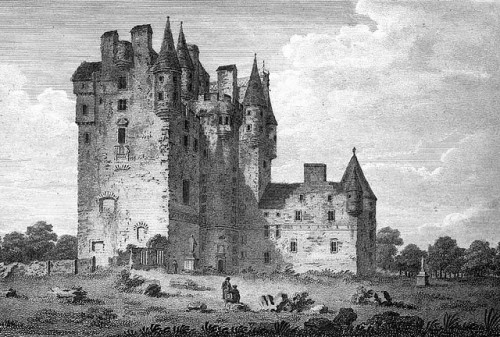
Glamis Castle in the 18th century, shortly before its “mystery” began.

“If you could even guess the nature of this castle’s secret,” said Claude Bowes-Lyon, 13th Earl of Strathmore, “you would get down on your knees and thank God it was not yours.”

That awful secret was once the talk of Europe. From perhaps the 1840s until 1905, the Earl’s ancestral seat at Glamis Castle, in the Scottish lowlands, was home to a “mystery of mysteries”—an enigma that involved a hidden room, a secret passage, solemn initiations, scandal, and shadowy figures glimpsed by night on castle battlements.

The conundrum engaged two generations of high society until, soon after 1900, the secret itself was lost. One version of the story holds that it was so terrible that the 13th Earl’s heir flatly refused to have it revealed to him. Yet the mystery of Glamis (pronounced “Glams”) remains, kept alive by its association with royalty (the heir was grandfather to Elizabeth II) and by the fact that at least some members of the Bowes-Lyon family insisted it was real.

Sir Walter Scott, the popular 19th-century novelist, was the first man to tell of the ‘secret’ of Glamis.

Glamis Castle is mentioned by Shakespeare—Macbeth, that most cursed of characters, was Thane of Glamis—and in 1034 the Scottish King Malcolm II died there, perhaps murdered. But the present castle was constructed only in the 15th century, around a central tower whose walls are, in places, 16 feet thick. Glamis has been the family seat of the Strathmore Earls since then, but by the late 18th century it lay largely empty, its owners preferring to live somewhere less drafty, less isolated and less melancholy.

In their absence, Glamis was left in the care of a factor, or estate manager, and it was to this factor that a young Walter Scott applied in 1790 to spend a night in one of its rooms. Scott became the first of several writers to note the castle’s oppressive atmosphere. “I must own,” he wrote in an account published in 1830, “as I heard door after door shut, after my conductor had retired, I began to consider myself as too far from the living and somewhat too near to the dead.” What was more, the great novelist added, Glamis was said to hide a secret room—a useful addition to any residence in 15th-century Scotland, where violence was seldom far away. Its location was known only to the Earl, his factor and his heir.

In one sense, however, the most interesting thing about Scott’s account is what it doesn’t say. The novelist wrote nothing to suggest that the castle’s hidden chamber had an occupant. Yet, within half a century of his visit, it had begun to be rumored that the room concealed an unknown captive—a prisoner who had been held there all his life.

Continue reading

Nice things to say about Attila the Hun

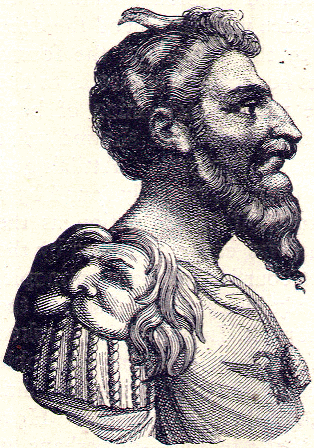
An 1894 engraving of Attila from Horne’s Great Men and Famous Women, adapted from an antique medal. In depicting Attila with horns and goatish physiognomy, the engraver stressed the diabolical aspects of his character.

He called himself flagellum Dei, the scourge of God, and even today, 1,500 years after his blood-drenched death, his name remains a byword for brutality. Ancient artists placed great stress on his inhumanity, depicting him with goatish beard and devil’s horns. Then as now, he seemed the epitome of an Asian steppe nomad: ugly, squat and fearsome, lethal with a bow, interested chiefly in looting and in rape.

His real name was Attila, King of the Huns, and even today the mention of it jangles some atavistic panic bell deep within civilized hearts. For Edward Gibbon—no great admirer of the Roman Empire that the Huns ravaged repeatedly between 434 and 453 A.D.—Attila was a “savage destroyer” of whom it was said that “the grass never grew on the spot where his horse had trod.” For the Roman historian Jordanes, he was “a man born into the world to shake the nations.” As recently as a century ago, when the British wanted to emphasize how barbarous and how un-English their opponents in the First World War had grown—how very far they had fallen short in their sense of honor, justice and fair play—they called the Germans “Huns.” Continue reading