A Russian prince on a Wichita road gang

The imposter’s imposter. Prince Michael Romanoff, AKA Harry Gerguson of New York, AKA Harry Ferguson of Litchfield, IL, AKA Herschel Geguzin of Vilna, Lithuania: bellhop, day labourer, drinks salesman, international confidence man and famed Hollywood restaurateur

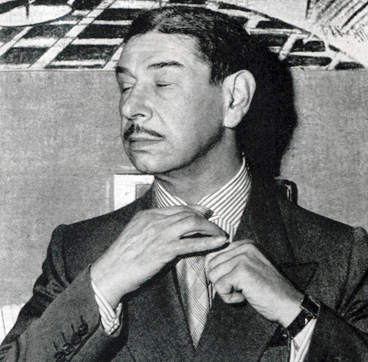
For most of the 1940s and 1950s, Prince Mike Romanoff was one of the best-known and best-loved figures in Hollywood. A man of great generosity and unparalleled charm, he not only owned and ran the swankiest restaurant in Beverly Hills, but was also a close friend to many of the stars who thronged there to see and be seen. Romanoff (1890-1971) was one of Humphrey Bogart’s most cherished companions, and a favourite acquaintance of David Niven, who wrote a warm and admiring appreciation of him in Bring on the Empty Horses, his best-selling book of Hollywood anecdotes. By the time he appeared as a guest on the panel show What’s My Line [1957; below], Mike was so well known that, almost uniquely, the panellists had to be blindfolded, and, to prevent the immediate identification of his distinctively fruity British accent, he himself was permitted to communicate only with a whistle.

All of this might have been considered par for the course for someone who full styling was Prince Michael Alexandrovitch Dmitry Obolensky Romanoff; who habitually smoked cigarettes monogrammed with the imperial Russian ‘R’; and who had been schooled at Eton, at Harrow and at Winchester, and attended not only Oxford and Harvard, but also the Royal Military College at Sandhurst, Cambridge, Yale, Princeton, the Sorbonne and Heidelberg. It might have been only a little remarkable for a man who – at least according to his own account – had driven a taxi for the French army during the defence of Paris and then fought on the Western Front as a British lieutenant, and on the Eastern Front as a Cossack colonel; who “knew the Sudan like the back of my hand”; who had won the Legion d’Honneur for some act of unspecified gallantry, and had gone on to defend the Winter Palace against rampaging Bolsheviks; had served six years in solitary confinement for killing a German nobleman in a duel; and who was able to produce at least some proof that he enjoyed a close, if oddly hazy, relationship with the former ruling dynasty of Russia. [Niven pp.147, 150, 152; Johnston, Education pp.247-9]  It was, however, a truly startling achievement for a man who had actually done none of those things, and who was, in reality, no sort of aristocrat at all. More

The Shogun’s reluctant ambassadors

March 1839: the Japanese cargo ship Cho-ja maru, dismasted and without her rudder, wallows in the Pacific shortly before her surviving crew were picked up by the American whaler James Loper. Artist unknown; Sonkei Archives, Tokyo

When Matthew Perry sailed his squadron of warships into Edo Bay in July 1853 – and compelled the local authorities, under threat of bombardment, to accept a trade treaty with the United States – Japan had been a closed society for well over two centuries. Under the policy known as Sakoku (“locking the country”), practically all trade with the outside world had been strictly prohibited. Christianity was banned, foreigners already in Japan were expelled, and others were forbidden, on pain of death, from entering imperial territory. The Japanese, similarly, were not permitted to leave. For 220 years, the country remained almost entirely isolated, mostly peaceful, and profoundly mysterious and alluring to outsiders.

Whatever the reasons for Japan’s self-imposed seclusion – they are all too frequently reduced to fear of fast-encroaching Christianity, though inevitably they were quite a bit more complex than that [Boxer pp.308-400; Eiichi pp.21-58] – Sakoku produced peculiar results. Japan’s only formal foreign relations were with Korea; strictly limited trade was carried on, but the only westerners allowed anywhere on Japanese territory were the Dutch, and they were favoured largely because, being Calvinists, they had no interest in converting anyone to their religion. Dutch traders, in turn, were restricted to a single “factory,” or base, located on an island just off Nagasaki and chosen to ensure that there could be no easy intercourse with the locals. A few Japanese, specially trained to act as interpreters, had access to the factory, and one or two Dutch merchants, on special occasions, travelled to Edo, the capital, in palanquins. But all but a tiny handful of Japanese had never seen a European and had no access to western thoughts or ideas. Dutch woollen cloth (the principal import) was scarce and hence fashionable and highly sought-after. For the most part, however, it was easy for the Japanese to believe that their visitors were very different to them – indeed, quite possibly, not human:

Most Japanese regarded foreigners (and particularly Europeans) as a special variety of goblin that bore only superficial resemblance to a normal human being. The usual name given to the Dutch was komo or “red hairs,” a name intended more to suggest a demonic being than to describe the actual coloring of the foreigners’ hair. The Portuguese had also at one time been declared by the shogunate to possess “cat’s eyes, huge noses, red hair and shrike’s-tongues” … More

Truth, beauty and Pancho Villa

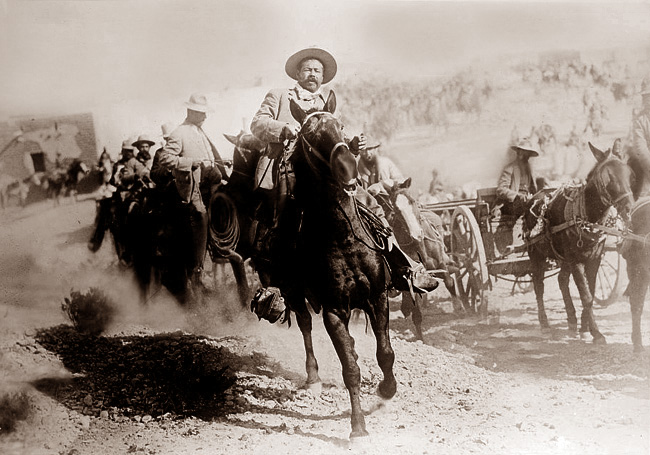
Pancho Villa pictured shortly after the Battle of Ojinaga, in January 1914 – an engagement he delayed for the benefit of American newsreel cameras. The still comes from Mutual Film’s exclusive footage.

The first casualty of war is truth, they say, and nowhere was that sage old aphorism more true than in Mexico during the revolutionary period between 1910 and 1920. In all the blood and chaos that followed the overthrow of Porfirio Diaz, who had been dictator of Mexico ever since 1876, what was left of the central government in Mexico City found itself at war with several contending rebel forces – most notably the Liberation Army of the South, commanded by Emiliano Zapata, and the Chihuahua-based División del Norte, led by the even more celebrated bandit-rebel Pancho Villa. The three-cornered civil war that followed was notable for several things: its unrelenting savagery, its unending confusion, and – north of the Rio Grande, at least – its unusual film deals. Specifically, it’s remembered for the bizarre contract Villa was supposed to have signed with a leading American newsreel company in January 1914. Under the terms of this deal, it is said, the rebels undertook to fight their revolution for the benefit of the movie cameras – in exchange for a large advance, payable in gold. More

The loneliest shop in the world

The view from the Birdsville Track.

The view from the Birdsville Track.

Harrods, in the bustling heart of London, is in a good location for a shop. So, for that matter, is Macy’s, which boasts of serving 350,000 New Yorkers every day at Christmas time. Whereas down at the Mulka Store, in the furthermost reaches of South Australia, George and Mabel Aiston used to think themselves lucky if they pulled in a customer a week.

Mulka’s proper name is Mulkaundracooracooratarraninna, a long name for a place that is a long way from anywhere. It stands on an apology for a road known as the Birdsville Track – until quite recently no more than a set of tyre prints stretching, as the locals put it, “from the middle of nowhere to the back of beyond.” The track begins in Marree, a very small outback town, and winds its way up to Birdsville, a considerably smaller one (“seven iron houses burning in the sun between two deserts”) many hundreds of miles to the north. Along the way it inches over the impenetrable Ooroowillanie sandhills and traverses Cooper Creek, a dried-up river bed that occasionally floods to place a five-mile-wide obstacle in the path of unwary travellers, before skirting the tyre-puncturing fringes of the Sturt Stony Desert.

Make your way past all those obstacles, and, “after jogging all day over the treeless plain,” you’d eventually stumble across the Mulka Store, nestled beneath a single clump of pepper trees. To one side of the shop, like some ever-present intimation of mortality, lay the lonely fenced-off grave of Edith Scobie, “died December 31 1892 aged 15 years 4 months” – quite possibly of the sort of ailment that is only fatal when you live a week’s journey from the nearest doctor. To the rear was nothing but the “everlasting sandhills, now transformed to a delicate salmon hue in the setting sun.” And in front, beside a windswept garden gate, “a board sign which announced in fading paint but one word: STORE. Just in case the traveller might be in some doubt.” More

Erotic secrets of Lord Byron’s tomb

Byron in death, Greece, spring 1824.

It was hot and dusty in the crypt, and it had been hard work breaking into it. Now the vicar had gone, along with his invited guests, to take his supper. The churchwarden and two workmen armed with spades were left to wait for their return, loitering by the grave they had come to examine – the tomb of Lord Byron the poet.

We didn’t take too kindly to that,” said Arnold Houldsworth. “I mean, we’d done the work. And Jim Bettridge suddenly says, ‘Let’s have a look on him.’ ‘You can’t do that,’ I says. ‘Just you watch me,’ says Jim. He put his spade in, there was a layer of wood, then one of lead, and I think another one of wood. And there he was, old Byron.”

“Good God, what did he look like?” I said.

“Just like in the portraits. He was bone from the elbows to his hands and from the knees down, but the rest was perfect. Good-looking man putting on a bit of weight, he’d gone bald. He was quite naked, you know,” and then he stopped, listening for something that must have been a clatter of china in the kitchen, where his wife was making tea for us, for he went on very quickly,  “Look, I’ve been in the Army, I’ve been in bathhouses, I’ve seen men. But I never saw nothing like him.” He stopped again, and nodding his head, meaningfully, as novelists say, began to tap a spot just above his knee. “He was built like a pony.”

“How many of you take sugar?” said Mrs Houldsworth, coming with the tea. More

Naked as nature intended? Catherine Crowe in Edinburgh, February 1854

You might call it parapsychology’s greatest mystery. Did Catherine Crowe – sixtysomething literary stalwart of the mid-nineteenth century, passionate advocate of the German ghost story, and author of that runaway best-seller The Night Side of Nature (London, 2 vols.: Newby, 1848) – really tear through the streets of Edinburgh at the end of February 1854, naked but for a handkerchief clutched in one plump hand and a visiting card in the other? And, if she did, was it because she had experienced a nervous breakdown, or because the spirits had convinced her that, once her clothes were shed, she would become invisible? More

The Emperor’s electric chair

The death chair in Auburn prison, c.1890

award-2010Many countries have folk-tales that feature foolish kings – monarchs whose vanity causes them to make catastrophic misjudgements or attempt impossible things. Greek mythology offers the tradition of King Midas, who lived to regret wishing for the power to turn everything he touched into gold; for we Brits, the foolish ruler is King Canute, who – at least in the common modern telling of the tale – allowed courtiers to flatter him that even the seas would obey his commands, and consequently got his feet wet in a failed attempt to turn back the tides.1

Most of these legends are hundreds of years old, of course, but the motif is a potent one and it still crops up from time to time. Here, for example, is a story that has stuck firmly in my mind ever since I first read it in The Book of Lists, a best-selling compendium of all sorts of remarkable trivia, first published in 1977:

The Abyssinian electric chair

On August 6, 1890, the first electric chair in history was put into use in the death chamber of Auburn Prison in New York. In distant Abyssinia – now called Ethiopia – Emperor Menelik II (1844-1913) heard about it and decided that this new method of execution should become part of his modernisation plan for his country. Immediately, he put in an order for three electric chairs from the American manufacturer. When the chairs arrived and were unpacked, the emperor was mortified to learn that they wouldn’t work – Abyssinia had no electricity. Determined that his investment would not be completely wasted, Emperor Menelik adopted one of the electric chairs for his imperial throne.

David Wallechinsky et al, The Book of Lists (London: Corgi, 1977) p.463.

Pretty amusing, and plainly I’m not the only person who finds this odd tale peculiarly memorable; the editors of The Book of Lists themselves ranked it among their “15 favourite oddities of all time,” and if you type the search string ‘Menelik’s electric chair’ into Google, you come up with several thousand hits from sites such as anecdotage.com, all of which are clearly based on the BoL‘s telling of the story; they contain the same basic information, but nothing different or new. More

The chupatty movement

Why were thousands of chapatis – an Indian unleavened bread – carried by night across the interior of India in the months before the outbreak of the great Sepoy Rebellion? And why did not even the people who bore them know what they were for?

Thousands of chapatis – an Indian unleavened bread – carried by night across the interior of India in the months before the outbreak of the great Sepoy Rebellion. But why did not even the people who bore them know what they were for?

“There is a most mysterious affair going on throughout the whole of India at present,” wrote Dr Gilbert Hadow in a letter to his sister at home in Britain dated March 1857. “No one seems to know the meaning of it… It is not known where it originated, by whom or for what purpose, whether it is supposed to be connected to any religious ceremony or whether it has to do with some secret society. The Indian papers are full of surmises as to what it means. It is called ‘the chupatty movement.’” [Hibbert p.59]

The “movement” that Dr Hadow was describing was a remarkable example of rumour gone wild. It consisted of the distribution of many thousands of chapatis – unleavened Indian breads – which were passed from hand to hand and from village to village throughout the mofussil (interior) of the Subcontinent. That these chapatis really existed is beyond doubt; what made their distribution truly bizarre and inexplicable was that nobody knew for sure what they were for. More

The miniature coffins found on Arthur’s Seat

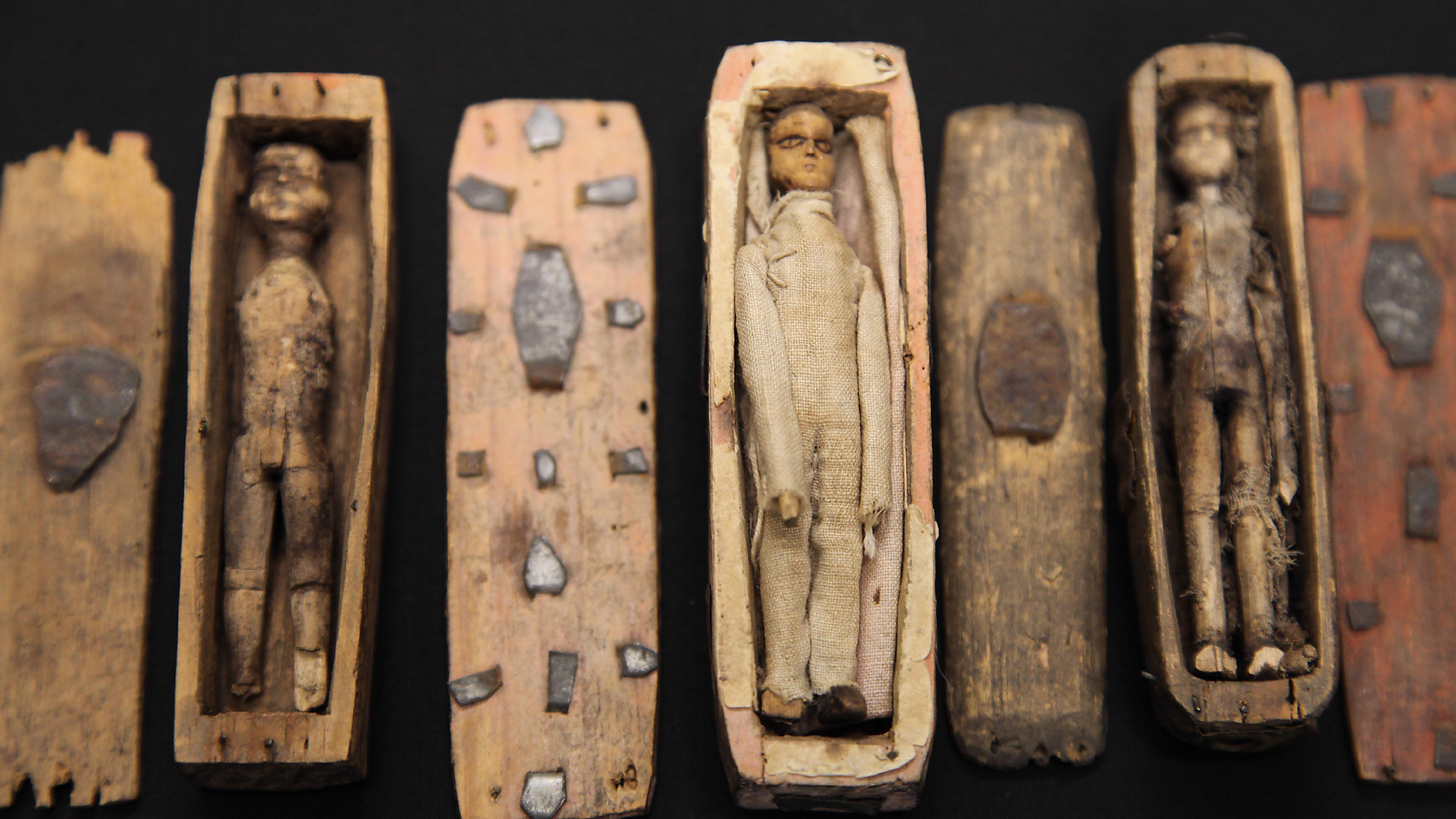
Seventeen miniature coffins were discovered high above Edinburgh in 1836, and eight of them survive today in the collection of the National Museum of Scotland.

It may have been Charles Fort who described the strange discovery best:

London Times, July 20, 1836:

That, early in July, 1836, some boys were searching for rabbits’ burrows in the rocky formation, near Edinburgh, known as Arthur’s Seat. In the side of a cliff, they came upon some thin sheets of slate, which they pulled out.

Little cave.

Seventeen tiny coffins.

Three or four inches long.

In the coffins were miniature wooden figures. They were dressed differently in both style and material. There were two tiers of eight coffins each, and a third one begun, with one coffin.

The extraordinary datum, which has especially made mystery here: More

Lord Dacre’s ghost

Lord+Dacre_0

Hugh Trevor-Roper (Lord Dacre)

Adam Sisman’s sympathetic new biography of Hugh Trevor-Roper (Lord Dacre), the brilliant if acerbic historian, contains an unexpectedly fascinating passage on the great controversialist’s declining years that sheds a ray of light on the way in which witnesses perceive ghosts.

In his late 80s, Sisman notes, Trevor-Roper was diagnosed with glaucoma and then developed a cataract. Soon afterwards, he began to suffer some alarming hallucinations: “He would look up from his desk and see the trees in leaf in mid-winter, or the landscape whizzing by as if he were aboard a train… Once, as he went to put out the dustbin, he found himself lost in a cemetery of dead machines, surrounded by rusting combine harvesters, lorries, cranes and derricks. Inside, the house grew an extra staircase.” Other outlandish figments of the historian’s imagination included gigantic trees and even a complete train at a platform at Didcot Station (which Trevor-Roper attempted to board).

All of this eventually led to a diagnosis of Charles Bonnet Syndrome –  a little-known condition, first described well over 200 years ago, in which those suffering from failing vision unconsciously compensate by dredging up memories with which to populate the fading landscape. Typically these vsions are what are known as “Lilliput hallucinations” (in which the hallucinated objects appear on a reduced scale), but as Trevor-Roper’s own case shows, it’s also possible to experience the opposite, and also extremely realistic visions of human figures, even within one’s own home. An experience of the latter sort occurred to Trevor-Roper in 2002. More