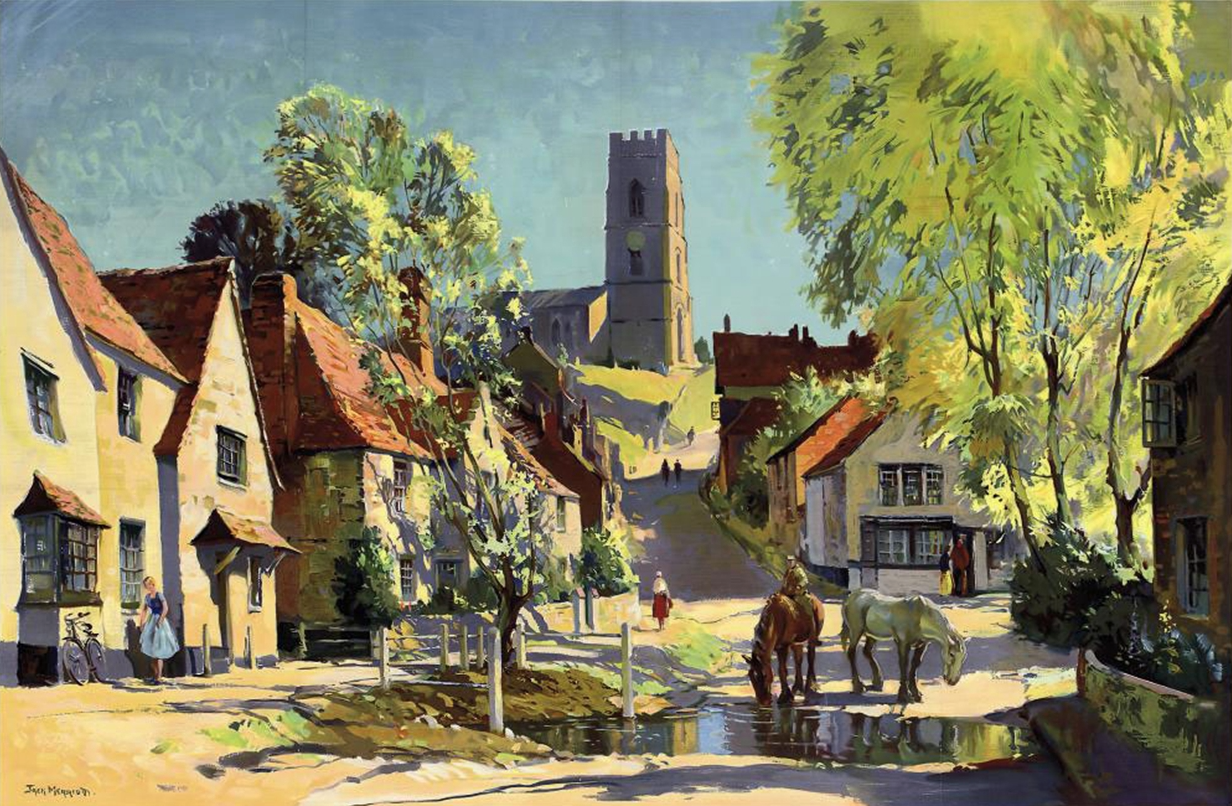
Three 1950s youths in a medieval plague village

Kersey in 1957. Although Jack Merriott's watercolor presents an idealized image of the village – it was commissioned for use in a railway advertising campaign – it does give an idea of just how 'old' Kersey must have looked to strangers in the year it became central to a 'timeslip' case.

Kersey in 1957. Although Jack Merriott’s watercolor presents an idealized image of the village – it was commissioned for use in a railway advertising campaign – it does give an idea of just how ‘old’ Kersey must have looked to strangers in the year it became central to a ‘timeslip’ case.

Looking back, the really strange thing was the silence. The way the church bells stopped ringing as the little group of naval cadets neared the village. The way even the ducks stood quiet and motionless by the shallow stream that ran across the road where the main street began.

And, when the boys thought about it afterward, they recalled that even the autumn birdsong faded as they neared the first houses. The wind had dropped to nothing, too.

Not a leaf stirred on the trees they passed. And the trees appeared to cast no shadows.

The street itself was quite deserted—not so odd, perhaps, for a Sunday morning in 1957, especially in the rural heart of England. But even the remotest British hamlets displayed some signs of modernity by then—cars parked by the roadside, phone wires strung along the roads, aerials on roofs—and there was nothing of that sort in this village. In fact, the houses on the high street all looked ancient; they were ragged, hand-built, timber-framed: “almost medieval in appearance,” one boy thought.

The three, all Royal Navy cadets, walked up to the nearest building and pressed their faces to its grimy windows. They could see that it was some sort of butcher’s shop, but what they glimpsed in the interior was even more unsettling. As one of them recalled for the author Andrew MacKenzie:

There were no tables or counters, just two or three whole oxen carcasses which had been skinned and in places were quite green with age. There was a green-painted door and windows with smallish glass panes, one at the front and one at the side, rather dirty-looking. I remember that as we three looked through that window in disbelief at the green and mouldy green carcasses… the general feeling certainly was one of disbelief and unreality… Who would believe that in 1957 that the health authorities would allow such conditions?

They peered into another house. More

Moving on up

Change of address...

A Blast From the Past will have a spanking new home from tomorrow.

That’s right – the blog’s been picked up by the Smithsonian Institution, which has decided to expand the coverage its magazine site offers to include a regular history blog. It’s all very flattering, because the Smithsonian looked at an awful lot of other sites before contacting me. On top of that it is, of course, pretty much the biggest and best museum in the world, and the associated magazine it publishes is of extremely high quality – I’ve spent a lot of time reading it over the years, and it’ll be a great pleasure to contribute regularly.

Anyway, here’s the scoop, and so far as I can see it ought to work for everybody. More

“Kipper und wipper”: rogue traders, rogue princes, rogue nuns and the German financial meltdown of 1621-23

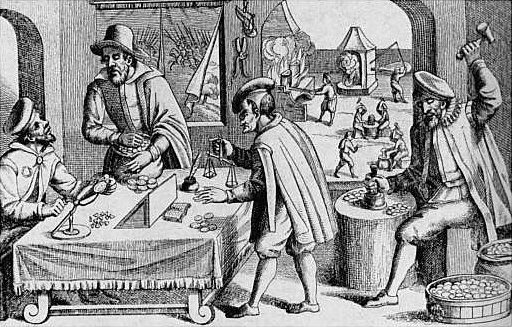
A German mint hard at work producing debased coinage designed to be palmed off on the nearest neighbouring state, c.1620

The great German hyperinflation of 1923 is passing out of living memory now, but that doesn’t mean that it has been forgotten. Indeed, you don’t have to go too far to hear it cited as a terrible example of what can happen when a government lets the economy spin out of control, and the episode still remains a minor feature of the British history curriculum, studied – briefly – by 15 and 16 year olds taking their GCSE. In consequence, a surprisingly large number of Brits can recall at least some of the details of that period. They may remember, for instance, that at its peak German inflation hit 325,000,000 percent, while the exchange rate plummeted from 9 marks to 4.2 billion marks to the dollar. They may recall that it became cheaper to decorate a room with high-denomination banknotes than with wallpaper; or that when thieves robbed a worker who had used a wheelbarrow to cart off the billions of reichsmarks that were his week’s wages, it was reported that they stole the wheelbarrow but left the useless wads of cash piled on the kerb. Others have had one or other of the famous photos taken in this period burned into their memories, such as one that shows a German housewife firing her boiler with an imposing pile of worthless notes [below left].

It’s easy, in these circumstances, to suppose that 1923 was a uniquely strange and terrible episode, but the truth is that it was not. Indeed, the German hyperinflation was not even the worst of the twentieth century; its Hungarian equivalent, dating to 1945-46, was so much more severe that prices in Budapest began to double every 15 hours. (At the peak of this crisis, the Hungarian government was forced to announce the latest inflation rate via radio each morning, so workers could negotiate a new pay scale with their bosses, and issue the largest denomination banknote ever to be legal tender: the 100 quintillion (1020) pengo note. When the debased currency was finally withdrawn, the total value of all the cash then in circulation in the country was reckoned at 1/10th of a cent. [Bomberger & Makinen pp.801-24; Judt p.87])   Nor was 1923 even the first time that Germany had experienced an uncontrollable rise in prices. It had also happened long before, back in the early years of the 17th century. And that hyperinflation (which is generally known by its evocative German name, the kipper- und wipperzeit) was a whole lot stranger and more colourful than what happened in 1923. More

The Old Man of the Lake

Crater Lake

It would not be difficult to argue that Crater Lake, in central Oregon, is the most beautiful body of fresh water in the world. The lake, which is almost perfectly circular in shape, in unquestionably startling. It sits at the top of a 7,000-foot-high dormant volcano and fills its crater. It is about six miles from side to side, a remarkable 1,950 feet deep (ranking it ninth in the world in terms of depth), and is almost entirely surrounded by cliffs that rise to heights of nearly 2,000 feet above its chilly waters. No rivers or even streams flow into it; the lake is filled entirely with snowmelt and rainwater, and though it practically glows indigo in the North West’s summer sunshine, its water is actually so crystal clear that plant life has been found merrily photosynthesizing on the bottom at depths of 350 feet.

What makes Crater Lake unique, though, is its most celebrated occupant: not a fish, not a bird, but a floating tree trunk known familiarly for decades as the Old Man of the Lake. More

The strange tale of the Warsaw basilisk

A basilisk–a lethally poisonous monster hatched from a cock’s egg–illustrated in a mediaeval bestiary. Note the weasel gnawing at its breast; only they were impervious to basilisk venom.

A basilisk–a lethally poisonous monster hatched from a cock’s egg–illustrated in a mediaeval bestiary. Note the weasel gnawing at its breast; only they were impervious to basilisk venom.

Few creatures have struck more terror into more hearts for longer than the basilisk: a crested snake, hatched from a cock’s egg, that was widely believed to wither landscapes with its breath and kill with a glare. The example to the right comes from a German bestiary, but the earliest description that we have was given by Pliny the Elder, who described the basilisk in his pioneering Natural History (79AD) – the 37 volumes of which he completed shortly before being suffocated by the sulphurous fumes of Vesuvius while investigating the eruption that consumed Pompeii. According to the Roman savant, it was a small animal, “not more than 12 fingers in length,” but astoundingly deadly nonetheless. “He does not impel his body, like other serpents, by a multiplied flexion,” Pliny wrote, “but advances loftily and upright” – a description that accords with the popular notion that the basilisk is the king of serpents – and “kills the shrubs, not only by contact, but by breathing on them, and splits rocks, such power of evil is there in him.” The basilisk was native to Libya, it was said, and the Romans believed that the Sahara had been fertile land until an infestation of basilisks turned it into a desert.

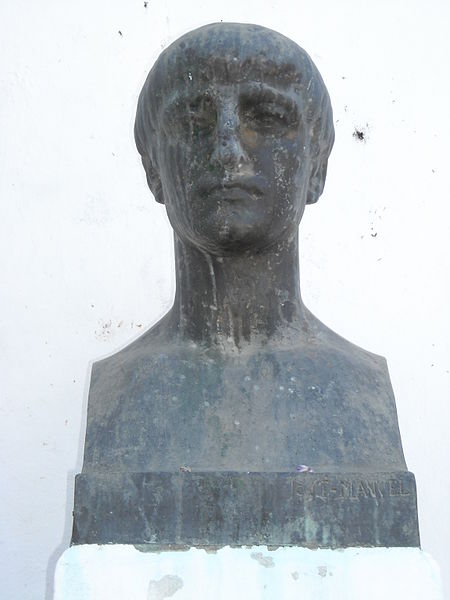
The Roman poet Lucan was one of the first authors to describe the basilisk. His work stressed the horrors of the monster’s lethal venom.

The Roman poet Lucan stressed the horrors of the monster’s lethal venom.

Pliny is not the only ancient author to mention the basilisk. The Roman poet Lucan, writing only a few years later, described another characteristic commonly ascribed to the monster – the idea that it was so venomous that if a man on horseback stabbed one with a spear, the poison would flow up through the weapon and kill not only the rider but the horse as well. The only creature that the basilisk feared was the weasel, which ate rue to render it impervious to its venom, and would chase and kill the serpent in its lair.

The basilisk was popular in medieval bestiaries, and it was in this period that a great deal of additional myth grew up around it. It became less a serpent than a mix of snake and rooster; it was almost literally hellish. More

“They don’t like it up ’em…” Revisiting the sordid deaths of Edmund Ironside, Edward II, Kenneth II and James I of Scotland

Edward II – still the only English monarch to be subject of his own ‘anal rape narrative’

To be a king and to be murdered – one might say – is no more than a hazard of the job. To be a king and to be murdered in one’s privy, however, is to suffer a considerable indignity. Yet precisely this fate was visited on at least two British royals, if certain sources are believed – and to that number we might add the awful fate of a third king, Edward II, popularly thought to have been done in by means of a red-hot poker forced into his rectum, not to mention the fortunate if malodorous escape of a royal consort, Gerald of Windsor, whose ravishing Welsh wife, Princess Nest, lived an adventurous life early in the twelfth century. More

Natives of the Red Dragon

The Welsh dragon on the First World War memorial to the men of the 38th (Welsh) division at Mametz Wood.

The Welsh dragon on the First World War memorial to the men of the 38th (Welsh) division at Mametz Wood.

Today is St David’s Day, the national day of Wales, and it seems an appropriate moment to post what remains perhaps my very favourite story among all the thousands of strange tales that I have read.

That is a large claim – I tend to read a fair bit – but I still find what follows so surreal and so magical, in its combination of the gentle, the mundane and the extraordinary, that for me each reading is like immersing myself in a warm bath. All right, it’s pretty hard to credit that it’s literally ‘true’; it helps that it’s a Welsh story, and that I’m a proud Welshman – and that the tale remains all but unknown; the account first appeared in print in 1928, and so far as I can tell has never made it onto the Internet. The names of the characters involved are so common that it would be extremely difficult to check if they were actually real or not; Radnor Forest, though, is real – and is, according to local legend, the place where the last Welsh dragon still lies sleeping (Daniel Parry-Jones, A Country Parson. London: Batsford, 1975). The strange stamps you’re about to read of did exist. No other comment is possible – but then perhaps none is necessary.

Here, then, is the story as I first read it – it is based, as mentioned in the first lines, on an article originally published in the 1920s in a children’s stamp magazine [The Stamp Lover, 1928 p.274]  The best thing to do is simply to sit back and enjoy. More

An abandoned lifeboat at world’s end

Breaking news: a credible solution to the Bouvet Island lifeboat mystery has been found. See comments for 22-27 May 2011, 12 November 2011, 17-20 March & 9 April 2016, and 28 December 2023.

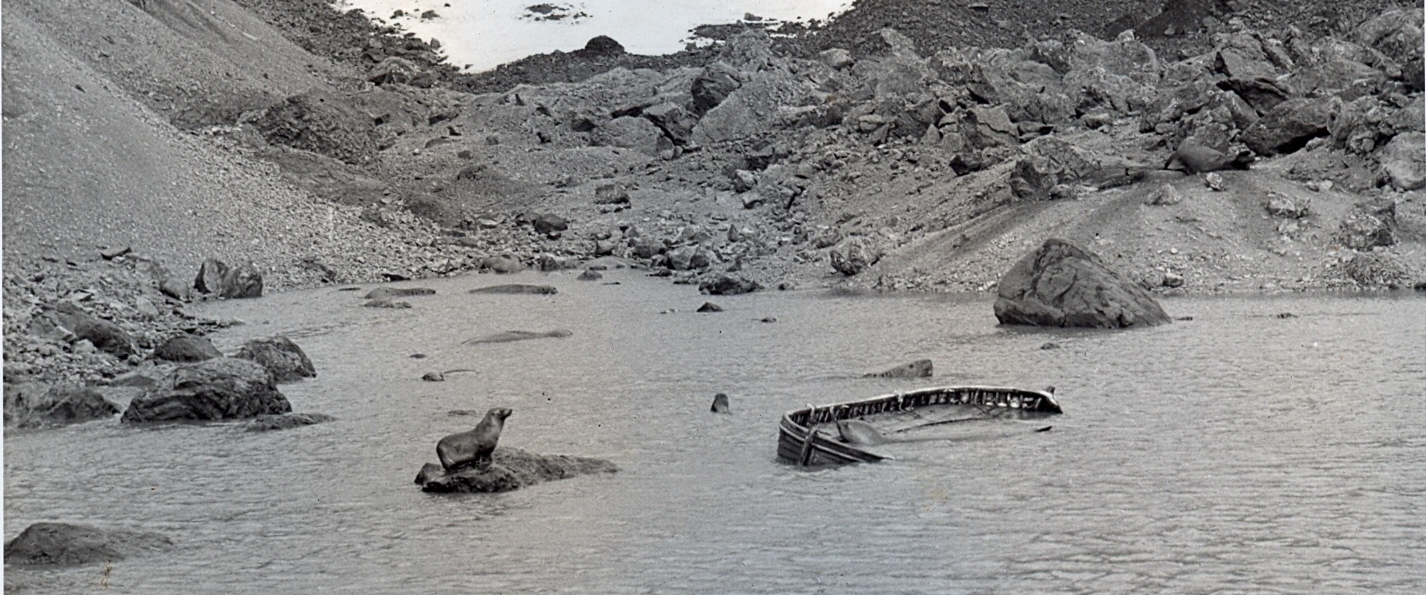
The unidentified whaler or ship's lifeboat found abandoned on Bouvet Island on 2 April 1964

The unidentified whaler or ship’s lifeboat found abandoned on Bouvet Island on 2 April 1964

LongreadsThere is no more forbidding place on earth.

Bouvet Island lies in the furthest reaches of the storm-wracked Southern Ocean, far south even of the Roaring Forties. It is a speck of ice in the middle of a freezing fastness: a few square miles of uninhabited volcanic basalt groaning under several hundred feet of glacier, scraped raw by gales, shrouded by drifts of sea-fog, and utterly devoid of trees, shelter, or landing places.

What it does have is a mystery. More

Some experiments with severed heads

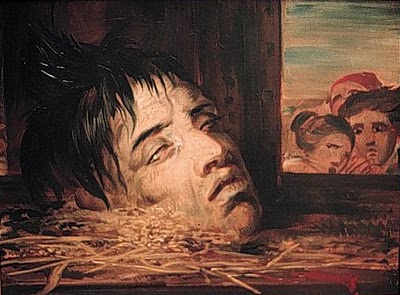
Antoine Joseph Wiertz: Guillotined Head (1855). Musée Antoine Wiertz, Brussels.

Antoine Joseph Wiertz: Guillotined Head (1855). Musée Antoine Wiertz, Brussels.

Early on the morning of 18 February 1848, two men and a woman walked into the square in front of the Porte de Hal, in Brussels, where a public execution was due to take place shortly after dawn. They were there to conduct a ground-breaking scientific study, and, by prior arrangement with the Belgian penal authorities, were permitted to climb onto the scaffold and wait next to the guillotine at the spot where the severed heads of two condemned criminals were scheduled to drop into a blood red sack.

One of the men was Antoine Joseph Wiertz, a well known Belgian painter and also a fine hypnotic subject. With him were his friend, Monsieur D_____, a noted hypnotist, and a witness. Wiertz’s purpose on that winter’s day was to carry out a unique and extraordinary experiment. Long haunted by the desire to know whether a severed head remained conscious after a guillotining, the painter had agreed to be hypnotised and instructed to identify himself with a man who was about to be executed for murder. More

Hey, I won…

Gwynie leaves a damp patch on the stage

Thank the stars I’m not Gwyneth Paltrow. It should mean that I’ll get through this post reasonably sniffle-free.

I woke up this morning to an email from Cliopatria, which is the blog portion of the History News Network, which is, in turn, probably the world’s largest history website. I can’t be sure of that, because I don’t see the stats, but it is very large and very busy, and one of the things that it does every year at about this time is hand out awards for the best in history blogging at a special dinner that takes place during the annual conference of the American Historical Association.

The Cliopatria Awards have been running for six years now, which I imagine means that the awards dinner is large and long and glittery and hosted by Billy Crystal. Sort of like the Oscars for history blogging. I wouldn’t know, because I didn’t get invited, but More