Gavrilo Princip’s sandwich

Gavrilo Princip is arrested for the assassination of Archduke Franz Ferdinand and his wife–Sarajevo, June 28, 1914.

It was the great flash point of the 20th century, an act that set off a chain reaction of calamity: two World Wars, 80 million deaths, the Russian Revolution, the rise of Hitler, the atomic bomb. Yet it might never have happened–we’re now told– had Gavrilo Princip not got hungry for a sandwich.

We’re talking the assassination of Archduke Franz Ferdinand, of course—the murder that set the crumbling Austro-Hungarian Empire on a collision course with Serbia, and Europe down the slippery slope that led to the outbreak of the First World War a month after Princip pulled the trigger on June 28, 1914. More specifically, though, we’re talking the version of events that’s being taught in many schools today. It’s an account that, while respectful of the significance of Franz Ferdinand’s death, hooks pupils’ attention by stressing a tiny, awe-inspiring detail: that if Princip had not stopped to eat a sandwich where he did, he would never have been in the right place to spot his target. No sandwich, no shooting. No shooting, no war.

It’s a compelling story, and one that is told in serious books and on multiple websites. For the most part, it goes something like this:

It is the summer of 1914, and Bosnia has just become part of the Austro-Hungarian empire. A handful of young Bosnian-born Serbs decide to strike a blow for the integration of their people into a homeland for southern Slavs by assassinating the heir to the Austrian throne. Their opportunity comes when it is announced that Franz Ferdinand will be making a state visit to the provincial capital, Sarajevo.

Continue reading
Pablo Fanque’s fair

Pablo Fanque: expert equestrian, tightrope walker, acrobat, showman–and Britain’s first black circus owner.

Anyone who has ever listened to The Beatles’ Sergeant Pepper’s Lonely Hearts Club Band–and that’s a few hundred million people at the last estimate–will know the swirling melody and appealingly nonsensical lyrics of “Being for the Benefit of Mr. Kite,” one of the most unusual tracks on that most eclectic of albums.

For the benefit of Mr. Kite
There will be a show tonight on trampoline
The Hendersons will all be there
Late of Pablo Fanque’s Fair—what a scene
Over men and horses, hoops and garters
Lastly through a hogshead of real fire!
In this way Mr. K. will challenge the world!

But who are these people, these horsemen and acrobats and “somerset turners” of a bygone age? Those who know a bit about the history of the circus in its mid-Victorian heyday–before the coming of the music halls and the cinema stole its audience, at a time when a traveling show could set up in a mid-size town and play for two or three months without exhausting demand–will recognize that John Lennon got his vocabulary right when he wrote those lyrics. “Garters” are banners stretched between poles aloft held by two men; the “trampoline,” in those days, was simply a springboard, and the “somersets” Mr. Henderson undertakes to “throw on solid ground” were somersaults.

While true Beatlemaniacs will know that Mr. Kite and his companions were real performers in a real troupe, however, few will realize that they were associates of what was probably the most successful, and almost certainly the most beloved, “fair” to tour Britain in the mid-Victorian period. And almost none will know that Pablo Fanque–the man who owned the circus—was more than simply an exceptional showman and perhaps the finest horsemen of his day. He was also a black man making his way in an almost uniformly white society, and doing it so successfully that he played to mostly capacity houses for the best part of 30 years. Continue reading

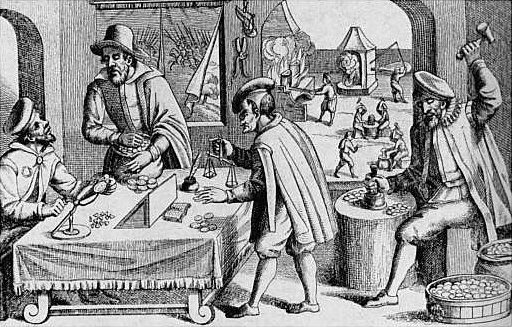
“Kipper und wipper”: rogue traders, rogue princes, rogue nuns and the German financial meltdown of 1621-23

A German mint hard at work producing debased coinage designed to be palmed off on the nearest neighbouring state, c.1620

The great German hyperinflation of 1923 is passing out of living memory now, but that doesn’t mean that it has been forgotten. Indeed, you don’t have to go too far to hear it cited as a terrible example of what can happen when a government lets the economy spin out of control, and the episode still remains a minor feature of the British history curriculum, studied – briefly – by 15 and 16 year olds taking their GCSE. In consequence, a surprisingly large number of Brits can recall at least some of the details of that period. They may remember, for instance, that at its peak German inflation hit 325,000,000 percent, while the exchange rate plummeted from 9 marks to 4.2 billion marks to the dollar. They may recall that it became cheaper to decorate a room with high-denomination banknotes than with wallpaper; or that when thieves robbed a worker who had used a wheelbarrow to cart off the billions of reichsmarks that were his week’s wages, it was reported that they stole the wheelbarrow but left the useless wads of cash piled on the kerb. Others have had one or other of the famous photos taken in this period burned into their memories, such as one that shows a German housewife firing her boiler with an imposing pile of worthless notes [below left].

It’s easy, in these circumstances, to suppose that 1923 was a uniquely strange and terrible episode, but the truth is that it was not. Indeed, the German hyperinflation was not even the worst of the twentieth century; its Hungarian equivalent, dating to 1945-46, was so much more severe that prices in Budapest began to double every 15 hours. (At the peak of this crisis, the Hungarian government was forced to announce the latest inflation rate via radio each morning, so workers could negotiate a new pay scale with their bosses, and issue the largest denomination banknote ever to be legal tender: the 100 quintillion (1020) pengo note. When the debased currency was finally withdrawn, the total value of all the cash then in circulation in the country was reckoned at 1/10th of a cent. [Bomberger & Makinen pp.801-24; Judt p.87])   Nor was 1923 even the first time that Germany had experienced an uncontrollable rise in prices. It had also happened long before, back in the early years of the 17th century. And that hyperinflation (which is generally known by its evocative German name, the kipper- und wipperzeit) was a whole lot stranger and more colourful than what happened in 1923. More

The Old Man of the Lake

Crater Lake

It would not be difficult to argue that Crater Lake, in central Oregon, is the most beautiful body of fresh water in the world. The lake, which is almost perfectly circular in shape, in unquestionably startling. It sits at the top of a 7,000-foot-high dormant volcano and fills its crater. It is about six miles from side to side, a remarkable 1,950 feet deep (ranking it ninth in the world in terms of depth), and is almost entirely surrounded by cliffs that rise to heights of nearly 2,000 feet above its chilly waters. No rivers or even streams flow into it; the lake is filled entirely with snowmelt and rainwater, and though it practically glows indigo in the North West’s summer sunshine, its water is actually so crystal clear that plant life has been found merrily photosynthesizing on the bottom at depths of 350 feet.

What makes Crater Lake unique, though, is its most celebrated occupant: not a fish, not a bird, but a floating tree trunk known familiarly for decades as the Old Man of the Lake. More

Some experiments with severed heads

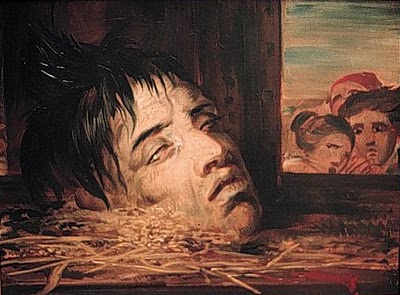
Antoine Joseph Wiertz: Guillotined Head (1855). Musée Antoine Wiertz, Brussels.

Antoine Joseph Wiertz: Guillotined Head (1855). Musée Antoine Wiertz, Brussels.

Early on the morning of 18 February 1848, two men and a woman walked into the square in front of the Porte de Hal, in Brussels, where a public execution was due to take place shortly after dawn. They were there to conduct a ground-breaking scientific study, and, by prior arrangement with the Belgian penal authorities, were permitted to climb onto the scaffold and wait next to the guillotine at the spot where the severed heads of two condemned criminals were scheduled to drop into a blood red sack.

One of the men was Antoine Joseph Wiertz, a well known Belgian painter and also a fine hypnotic subject. With him were his friend, Monsieur D_____, a noted hypnotist, and a witness. Wiertz’s purpose on that winter’s day was to carry out a unique and extraordinary experiment. Long haunted by the desire to know whether a severed head remained conscious after a guillotining, the painter had agreed to be hypnotised and instructed to identify himself with a man who was about to be executed for murder. More