“They don’t like it up ’em…” Revisiting the sordid deaths of Edmund Ironside, Edward II, Kenneth II and James I of Scotland

Edward II – still the only English monarch to be subject of his own ‘anal rape narrative’

To be a king and to be murdered – one might say – is no more than a hazard of the job. To be a king and to be murdered in one’s privy, however, is to suffer a considerable indignity. Yet precisely this fate was visited on at least two British royals, if certain sources are believed – and to that number we might add the awful fate of a third king, Edward II, popularly thought to have been done in by means of a red-hot poker forced into his rectum, not to mention the fortunate if malodorous escape of a royal consort, Gerald of Windsor, whose ravishing Welsh wife, Princess Nest, lived an adventurous life early in the twelfth century. More

Natives of the Red Dragon

The Welsh dragon on the First World War memorial to the men of the 38th (Welsh) division at Mametz Wood.

The Welsh dragon on the First World War memorial to the men of the 38th (Welsh) division at Mametz Wood.

Today is St David’s Day, the national day of Wales, and it seems an appropriate moment to post what remains perhaps my very favourite story among all the thousands of strange tales that I have read.

That is a large claim – I tend to read a fair bit – but I still find what follows so surreal and so magical, in its combination of the gentle, the mundane and the extraordinary, that for me each reading is like immersing myself in a warm bath. All right, it’s pretty hard to credit that it’s literally ‘true’; it helps that it’s a Welsh story, and that I’m a proud Welshman – and that the tale remains all but unknown; the account first appeared in print in 1928, and so far as I can tell has never made it onto the Internet. The names of the characters involved are so common that it would be extremely difficult to check if they were actually real or not; Radnor Forest, though, is real – and is, according to local legend, the place where the last Welsh dragon still lies sleeping (Daniel Parry-Jones, A Country Parson. London: Batsford, 1975). The strange stamps you’re about to read of did exist. No other comment is possible – but then perhaps none is necessary.

Here, then, is the story as I first read it – it is based, as mentioned in the first lines, on an article originally published in the 1920s in a children’s stamp magazine [The Stamp Lover, 1928 p.274]  The best thing to do is simply to sit back and enjoy. More

Erotic secrets of Lord Byron’s tomb

Byron in death, Greece, spring 1824.

It was hot and dusty in the crypt, and it had been hard work breaking into it. Now the vicar had gone, along with his invited guests, to take his supper. The churchwarden and two workmen armed with spades were left to wait for their return, loitering by the grave they had come to examine – the tomb of Lord Byron the poet.

We didn’t take too kindly to that,” said Arnold Houldsworth. “I mean, we’d done the work. And Jim Bettridge suddenly says, ‘Let’s have a look on him.’ ‘You can’t do that,’ I says. ‘Just you watch me,’ says Jim. He put his spade in, there was a layer of wood, then one of lead, and I think another one of wood. And there he was, old Byron.”

“Good God, what did he look like?” I said.

“Just like in the portraits. He was bone from the elbows to his hands and from the knees down, but the rest was perfect. Good-looking man putting on a bit of weight, he’d gone bald. He was quite naked, you know,” and then he stopped, listening for something that must have been a clatter of china in the kitchen, where his wife was making tea for us, for he went on very quickly,  “Look, I’ve been in the Army, I’ve been in bathhouses, I’ve seen men. But I never saw nothing like him.” He stopped again, and nodding his head, meaningfully, as novelists say, began to tap a spot just above his knee. “He was built like a pony.”

“How many of you take sugar?” said Mrs Houldsworth, coming with the tea. More

Naked as nature intended? Catherine Crowe in Edinburgh, February 1854

You might call it parapsychology’s greatest mystery. Did Catherine Crowe – sixtysomething literary stalwart of the mid-nineteenth century, passionate advocate of the German ghost story, and author of that runaway best-seller The Night Side of Nature (London, 2 vols.: Newby, 1848) – really tear through the streets of Edinburgh at the end of February 1854, naked but for a handkerchief clutched in one plump hand and a visiting card in the other? And, if she did, was it because she had experienced a nervous breakdown, or because the spirits had convinced her that, once her clothes were shed, she would become invisible? More

The miniature coffins found on Arthur’s Seat

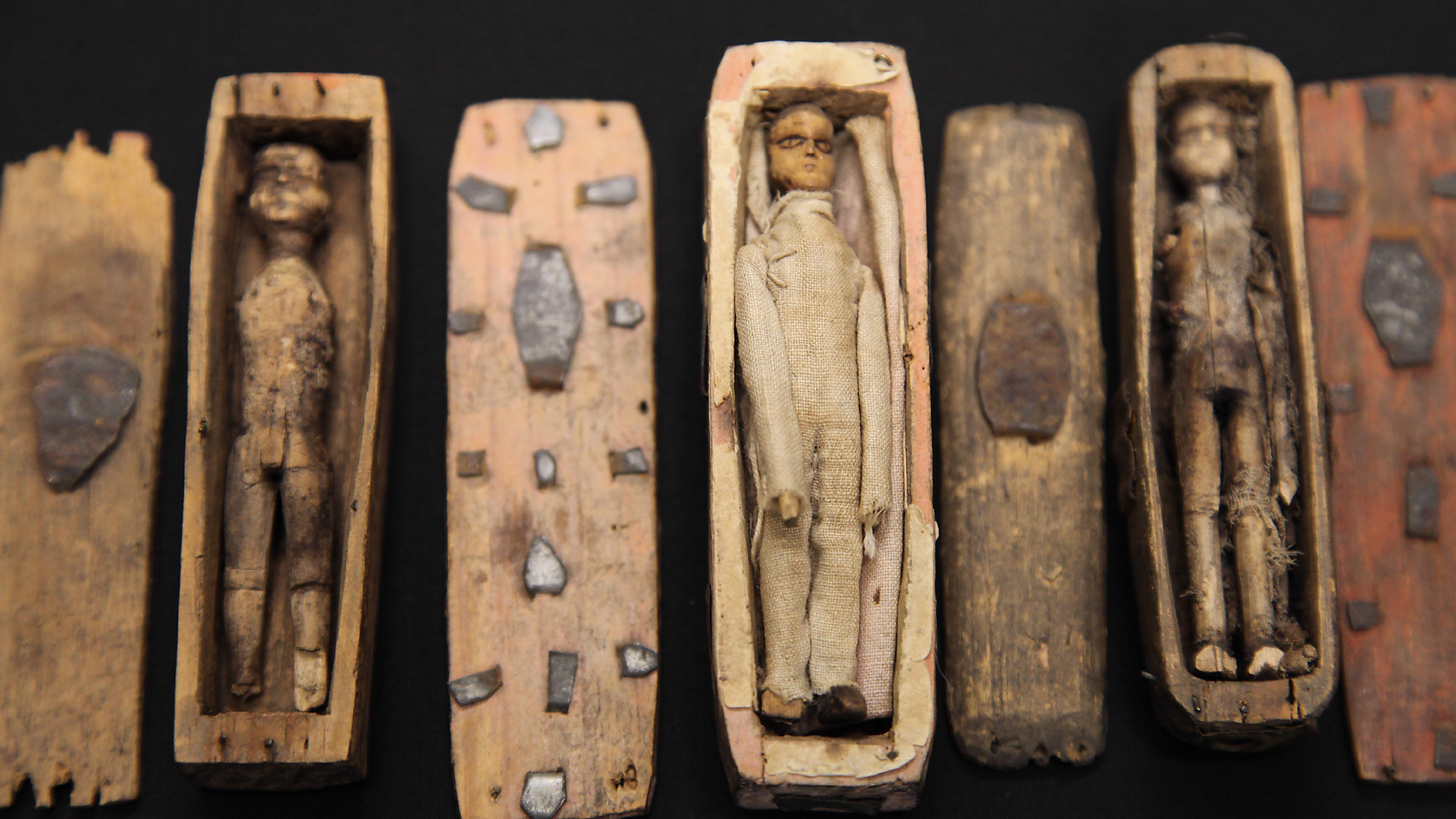
Seventeen miniature coffins were discovered high above Edinburgh in 1836, and eight of them survive today in the collection of the National Museum of Scotland.

It may have been Charles Fort who described the strange discovery best:

London Times, July 20, 1836:

That, early in July, 1836, some boys were searching for rabbits’ burrows in the rocky formation, near Edinburgh, known as Arthur’s Seat. In the side of a cliff, they came upon some thin sheets of slate, which they pulled out.

Little cave.

Seventeen tiny coffins.

Three or four inches long.

In the coffins were miniature wooden figures. They were dressed differently in both style and material. There were two tiers of eight coffins each, and a third one begun, with one coffin.

The extraordinary datum, which has especially made mystery here: More

Lord Dacre’s ghost

Lord+Dacre_0

Hugh Trevor-Roper (Lord Dacre)

Adam Sisman’s sympathetic new biography of Hugh Trevor-Roper (Lord Dacre), the brilliant if acerbic historian, contains an unexpectedly fascinating passage on the great controversialist’s declining years that sheds a ray of light on the way in which witnesses perceive ghosts.

In his late 80s, Sisman notes, Trevor-Roper was diagnosed with glaucoma and then developed a cataract. Soon afterwards, he began to suffer some alarming hallucinations: “He would look up from his desk and see the trees in leaf in mid-winter, or the landscape whizzing by as if he were aboard a train… Once, as he went to put out the dustbin, he found himself lost in a cemetery of dead machines, surrounded by rusting combine harvesters, lorries, cranes and derricks. Inside, the house grew an extra staircase.” Other outlandish figments of the historian’s imagination included gigantic trees and even a complete train at a platform at Didcot Station (which Trevor-Roper attempted to board).

All of this eventually led to a diagnosis of Charles Bonnet Syndrome –  a little-known condition, first described well over 200 years ago, in which those suffering from failing vision unconsciously compensate by dredging up memories with which to populate the fading landscape. Typically these vsions are what are known as “Lilliput hallucinations” (in which the hallucinated objects appear on a reduced scale), but as Trevor-Roper’s own case shows, it’s also possible to experience the opposite, and also extremely realistic visions of human figures, even within one’s own home. An experience of the latter sort occurred to Trevor-Roper in 2002. More

The Monster of Glamis: a first draft

Glamis[For a completely revised and more detailed account of the same mystery, featuring the fruits of much new research, see here.]

Glamis Castle, in Scotland, is a famous place: a picture-postcard tourist destination, childhood home of the late-lamented Queen Mother Gawd Bless ‘Er™, and – not incidentally for the purposes of this blog – notoriously the most haunted ‘house’ in Britain. Any number of spook stories are associated with the castle, from tales of ghosts materializing in visitors’ bedrooms to the legend of the infamous Earl Beardie, the so-called “Tiger Earl” – a fifteenth century Earl of Crawford whose soul is said to have been claimed by the devil while he unrepentantly played cards at Glamis upon the Sabbath day.

Best known by far, however, is the strange story of the Monster of Glamis, which (thanks in large part to its vague royal associations) has some claim to be ranked among the more pervasive legends of the twentieth century. In its evolved form (and it took some time to evolve, as we will see), this legend relates how, in the early nineteenth century, the wife of the then heir to the Earl of Strathmore gave birth in the castle to an boy who was so hideously deformed that the family took the decision to lock the child away in a secret room, denying him the chance to succeed to the earldom. More

The Grey Dog of Meoble

LochanPhoto courtesy of Iain Thornber

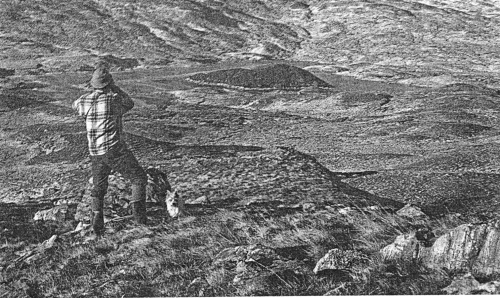
A friend’s mention of Loch Morar the other day – a phenomenally beautiful place tucked away in the heart of the ‘Rough Bounds’ of the Scottish Highlands – put me in mind of a legend from that district that is not at all well known even to folklorists, but which combines, in an interesting way, two distinct storytelling motifs: those of the ‘loyal pet’ and the ‘harbinger of death’.

The Grey Dog of Meoble (which I have seen given, in the Gaelic in which the story was first told, as an cuth glas Meobhail or an cu glas Mheobail) is a gigantic, shaggy-haired Scottish deerhound whose preternatural appearances are said to presage death to members of the Macdonald clan in the south Morar districts where the tradition first flourished. Tales of the spectral animal’s appearances certainly date to the first half of the nineteenth century; we know that Caraid nan Gaidheal, a renowned Highland piper who died in 1867, had heard the legend (John Gibson, Old and New World Highland Bagpiping (Montreal: McGill-Queen’s Press, 2002, p.318). They come not only from the tiny crofting hamlet of Meoble (pronounced “Meeble”) – a settlement, now all but abandoned, in an isolated district a mile from the shores of Loch Morar – but from other parts of Scotland and even Canada.

Most tales of the Grey Dog concern the hound’s appearances to Morar MacDonalds who are on the point of death
More

The horrible history of the Ostrich Inn

draft_lens3253522module29629372photo_1240684025The_Ostrich_Inn_Colnbrook_Slough_500x524

The Ostrich Inn, Colnbrook

An old friend, Alan Murdie, has written an interesting  essay which discusses, among several gory stories, the supposedly spook-infested Ostrich Inn in Colnbrook, Buckinghamshire – where ‘a past landlord named Jarman is supposed to have murdered up to 60 guests on the premises, in either the 16th or 18th century’. The pub’s unusual name rang a bell, and after a short hunt I turned up a story about the same place that I clipped from the Daily Telegraph, 31 October 1989:

In the shadow of one of London’s ghastliest locations, one of England’s oldest pubs is on the market – together with a ghastly history.

The Ostrich Inn, a Grade II listed freehouse near Heathrow Airport, is said to date back to 1106 and was the scene of 60 grisly murders committed by 12th century landlord John Jarman and his wife.

After inviting wealthy travellers to sleep on a specially-made hinged bed, Jarman would say to his wife, “There is now a fat pig to be had if you want one.” She would answer: “I pray you put him in the hogsty till tomorrow.” The victim would then fall through a trapdoor into a vat of boiling water. More

Wonderful, terrific and eccentric magazines

wonderful+1

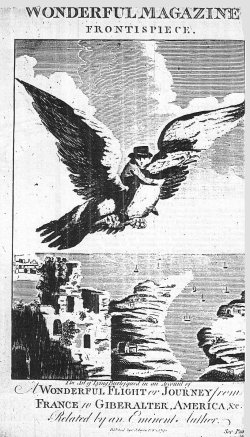
Frontispiece for the Wonderful Magazine

I love history and I love research: always have done, to a degree other people find – well, let’s just say ‘unusual’. To give you an idea of what I mean, let me take you back to the summer of 1982, and the last term of my first year at university. Now, first years at most Cambridge colleges sit their Prelims in that term – that’s preliminary exams, the sort that don’t count towards your degree but do count when it comes to ruining one’s summer. By sheer dumb luck, however, I had gone up to Peterhouse, the oldest and most eccentric of colleges, and Peterhouse scorned Prelims. This meant that I spent the eight weeks of that term with a lot of spare time on my hands; most of my friends, the ones at other colleges, were feverishly revising, and there wasn’t a great deal going on. My fellow Petreans took advantage of this freedom to do a lot of drinking, punting, and garden partying, but even aged 19, I have to say, my idea of a good time was more to head to the University Library and read.

I wasn’t quite swot enough, in truth, to spend the time reading stuff that might have helped me academically. What I actually did was to retreat to the dusty pastures of North Front 6, where it was always cool and dark and the smell of ancient books was overpowering. Nobody ever seemed to go North Front 6, which had tiny windows and no natural light, and was, and probably still is, a sort of elephants’ graveyard where old, moribund and essentially useless periodicals went to die. It was paradise for me, though, and it was up there, that term, that I first chanced upon a run of one of the magazines that I want to talk about today.

It was called The Mirror of Literature, Art and Amusement, published in London in the 1820s and the 1830s, and it was filled with an extensive selection of eye-opening stories of the sort that nowadays appear in the “news in brief” columns of national newspapers. More