The wizard of Mauritius

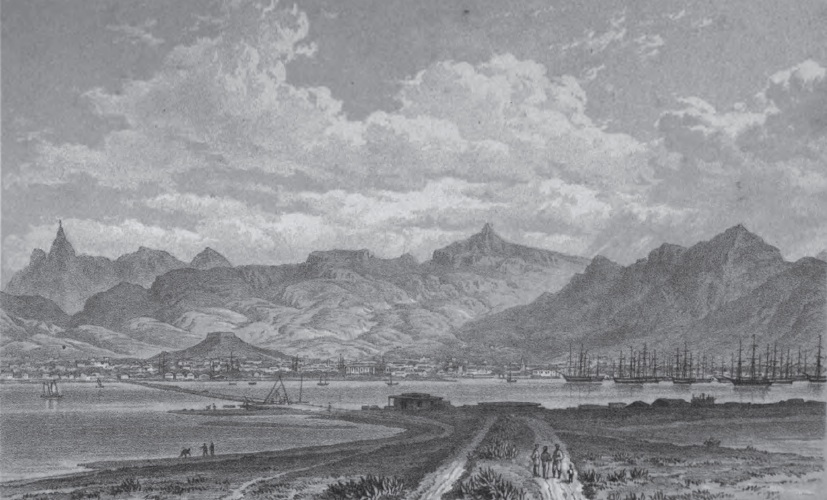
Port Louis, Mauritius, in the first half of the nineteenth century

Port Louis, Mauritius, August 1782. The French Indian Ocean colony—highly vulnerable to British attack at the height of the American Revolutionary War—is in a state of alert. The governor, Viscomte François de Souillac, has been warned that a flotilla of 11 ships is approaching his island. Fearing that this is the long-awaited invasion fleet, De Souillac orders a sloop-of-war out to reconnoiter. But before the vessel can report, the panic ends. De Souillac is informed that the fleet has altered course and is now steering away from Mauritius. A few days later, when the sloop returns, the governor gets confirmation: the ships were actually East Indiamen, British merchant vessels making for Fort William in India.

All this is remarkable chiefly for the source of De Souillac’s intelligence. The governor had his information not from signals made by ships sailing far offshore, nor from land-based lookouts armed with high-powered telescopes, but from a minor member of the local engineering corps, one Étienne Bottineau. And Bottineau was chiefly renowned in Mauritius (or “Île de France,” to give it its contemporary French name) as a man who won a lot of bets in waterfront taverns thanks to his uncanny ability to foresee the arrival of ships that were anywhere from 350 to 700 miles from the island when he announced their approach.
Continue reading

In search of Queen Victoria’s voice

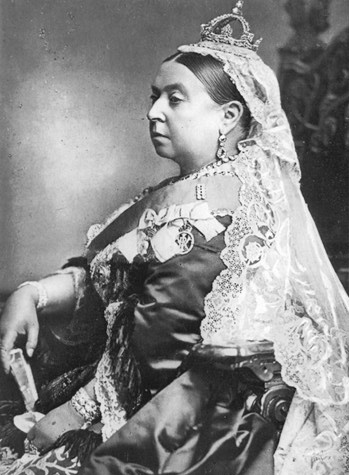
“Greetings, Britons and everybody.” Queen Victoria in 1887, at about the time she made her Graphophone recording.

It is a woman’s voice, but it sounds as though it comes drifting toward us across some vast and unbridgeable distance. It is all but drowned out by the snaps and the crackles and pops of what is by any standard a primitive recording. And yet—listened to over and over again—the voice does begin to sound refined. Perhaps even a little bit imperious.

The words that the woman speaks are muffled, but it is possible to make at least a few of them out. Some people have sworn that they can hear “tomatoes,” for example, blurted out toward the end of the track. But what about the very first syllables preserved on the recording—a 20-second audio segment believed to have been made more than 130 years ago, late in 1888, in the earliest days of the recording industry? Is that really the voice of Her Imperial Majesty Queen Victoria? And, if it is, can she really be welcoming her listeners with the words: “Greetings, Britons and everybody”?

There is no real doubt that Britain’s longest-reigning monarch allowed her voice to be recorded in that long-ago fall. The man who made the recording freely discussed it and it is recalled in a letter in the Royal Archives, dated 1907; the incident also rates a passing mention (without a source attribution) in Elizabeth Longford’s exhaustive biography of the Queen, Victoria R.I. The question is what happened to the recording after it was made—and, in a broader sense, why it matters whether it still exists. The search for the recording takes us from the New Jersey laboratories of Thomas Edison to the Highlands of Scotland, and from the archives of the Rolls-Royce motor company to the vaults beneath London’s Science Museum. Before we set of on that trail, though, we first need to understand why anyone should be interested in a few utterly unimportant phrases spoken by a long-dead queen. Continue reading

Amazons: inside the King of Dahomey’s all-woman army

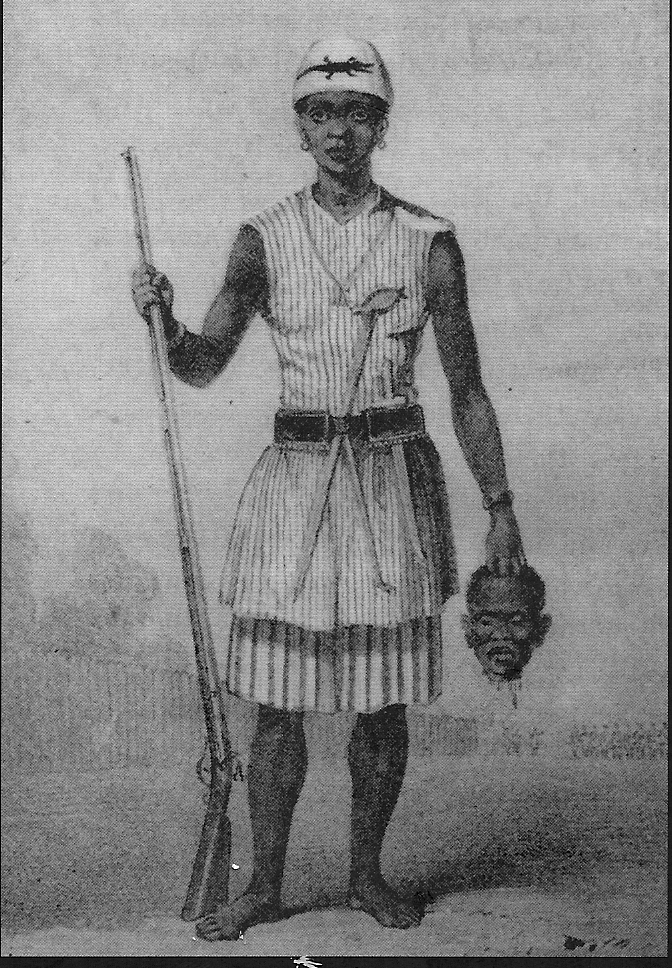
One of Dahomeys’ amazons, with a musket, club, dagger—and her enemy’s severed head. From Forbes, Dahomy and the Dahomans (1851).

It is noon on a humid Saturday in the fall of 1861, and a missionary by the name of Francesco Borghero has been summoned to a parade ground in Abomey, the capital of the small West African state of Dahomey. He is seated on one side of a huge, open square right in the center of the town–Dahomey is renowned as a “Black Sparta,” a fiercely militaristic society bent on conquest, whose soldiers strike fear into their enemies all along what is still known as the Slave Coast. The maneuvers begin in the face of a looming downpour, but King Glele is eager to show off the finest unit in his army to his European guest.

As Father Borghero fans himself, 3,000 heavily armed soldiers march into the square and begin a mock assault on a series of defenses designed to represent an enemy capital. The Dahomean troops are a fearsome sight, barefoot and bristling with clubs and knives. A few, known as Reapers, are armed with gleaming three-foot-long straight razors, each wielded two-handed and capable, the priest is told, of slicing a man clean in two. Continue reading

Gavrilo Princip’s sandwich

Gavrilo Princip is arrested for the assassination of Archduke Franz Ferdinand and his wife–Sarajevo, June 28, 1914.

It was the great flash point of the 20th century, an act that set off a chain reaction of calamity: two World Wars, 80 million deaths, the Russian Revolution, the rise of Hitler, the atomic bomb. Yet it might never have happened–we’re now told– had Gavrilo Princip not got hungry for a sandwich.

We’re talking the assassination of Archduke Franz Ferdinand, of course—the murder that set the crumbling Austro-Hungarian Empire on a collision course with Serbia, and Europe down the slippery slope that led to the outbreak of the First World War a month after Princip pulled the trigger on June 28, 1914. More specifically, though, we’re talking the version of events that’s being taught in many schools today. It’s an account that, while respectful of the significance of Franz Ferdinand’s death, hooks pupils’ attention by stressing a tiny, awe-inspiring detail: that if Princip had not stopped to eat a sandwich where he did, he would never have been in the right place to spot his target. No sandwich, no shooting. No shooting, no war.

It’s a compelling story, and one that is told in serious books and on multiple websites. For the most part, it goes something like this:

It is the summer of 1914, and Bosnia has just become part of the Austro-Hungarian empire. A handful of young Bosnian-born Serbs decide to strike a blow for the integration of their people into a homeland for southern Slavs by assassinating the heir to the Austrian throne. Their opportunity comes when it is announced that Franz Ferdinand will be making a state visit to the provincial capital, Sarajevo.

Continue reading

Pablo Fanque’s fair

Pablo Fanque: expert equestrian, tightrope walker, acrobat, showman–and Britain’s first black circus owner.

Anyone who has ever listened to The Beatles’ Sergeant Pepper’s Lonely Hearts Club Band–and that’s a few hundred million people at the last estimate–will know the swirling melody and appealingly nonsensical lyrics of “Being for the Benefit of Mr. Kite,” one of the most unusual tracks on that most eclectic of albums.

For the benefit of Mr. Kite
There will be a show tonight on trampoline
The Hendersons will all be there
Late of Pablo Fanque’s Fair—what a scene
Over men and horses, hoops and garters
Lastly through a hogshead of real fire!
In this way Mr. K. will challenge the world!

But who are these people, these horsemen and acrobats and “somerset turners” of a bygone age? Those who know a bit about the history of the circus in its mid-Victorian heyday–before the coming of the music halls and the cinema stole its audience, at a time when a traveling show could set up in a mid-size town and play for two or three months without exhausting demand–will recognize that John Lennon got his vocabulary right when he wrote those lyrics. “Garters” are banners stretched between poles aloft held by two men; the “trampoline,” in those days, was simply a springboard, and the “somersets” Mr. Henderson undertakes to “throw on solid ground” were somersaults.

While true Beatlemaniacs will know that Mr. Kite and his companions were real performers in a real troupe, however, few will realize that they were associates of what was probably the most successful, and almost certainly the most beloved, “fair” to tour Britain in the mid-Victorian period. And almost none will know that Pablo Fanque–the man who owned the circus—was more than simply an exceptional showman and perhaps the finest horsemen of his day. He was also a black man making his way in an almost uniformly white society, and doing it so successfully that he played to mostly capacity houses for the best part of 30 years. Continue reading

Inside the Great Pyramid

The Great Pyramid–built for the Pharaoh Khufu in about 2570 B.C., sole survivor of the Seven Wonders of the ancient world, and still arguably the most mysterious structure on the planet

The Great Pyramid–built for the Pharaoh Khufu in about 2570 B.C. [rear], sole survivor of the Seven Wonders of the ancient world, and still arguably the most mysterious structure on the planet

There is a story, regrettably apocryphal, about Napoleon and the Great Pyramid. When Bonaparte visited Giza during his Nile expedition of 1798 (it goes), he determined to spend a night alone inside the King’s Chamber, the granite-lined vault that lies precisely in the center of the pyramid. This chamber is generally acknowledged as the spot where Khufu, the most powerful ruler of Egypt’s Old Kingdom (c.2690-2180 BC), was interred for all eternity, and it still contains the remains of Pharaoh’s sarcophagus—a fractured mass of red stone that is said to ring like a bell when struck.

Having ventured alone into the pyramid’s forbidding interior and navigated its cramped passages armed with nothing but a guttering candle, Napoleon emerged the next morning white and shaken, and thenceforth refused to answer any questions about what had befallen him that night. Not until 23 years later, as he lay on his death bed, did the emperor at last consent to talk about his experience. Hauling himself painfully upright, he began to speak—only to halt almost immediately.

“Oh, what’s the use,” he murmured, sinking back. “You’d never believe me.” Continue reading

One man against tyranny: Georg Elser’s lone attempt to blow up Hitler

Georg Elser, whose attempt to kill Hitler came within moments of succeeding, commemorated on a stamp. The German phrase means “I wanted to prevent war.”

Maria Strobel could not believe it of her Führer. Adolf Hitler and his party—a group of senior Nazis that included Heinrich Himmler, Joseph Goebbels and Reinhard Heydrich—had spent more than an hour in her Munich bierkeller. Hitler had delivered a trademark speech, and, while they listened, Himmler and the others had run up a large beer bill. But the whole group had left in a hurry—leaving the tab unpaid and Strobel untippped.

Much annoyed, the Bavarian waitress set about clearing up the mess. She had made only a small dent in the pile of steins when, at 9:20 p.m. precisely, there was a huge explosion only a few feet behind her. A stone pillar disintegrated in the blast, bringing part of the ceiling crashing down in a rain of wood and masonry. The explosion hurled Strobel the length of the hall and out through the bierkeller’s doors. Though stunned, she survived—the person closest to the blast to do so. Eight others were not so fortunate, and a further 63 were so badly injured that they had to be helped out into the open air. As they staggered toward safety, the dais where Hitler had been standing eight minutes earlier lay crushed beneath six feet of heavy timber, bricks and rubble.

Hitler always said he had “the luck of the devil,” Continue reading

“Tamám Shud”

Mortuary photo of the unknown man found dead on Somerton Beach, south of Adelaide, Australia, in December 1948. Sixty-three years later, the man’s identity remains a mystery, and it’s still not clear how – or even if – he was murdered.

Most murders aren’t that difficult to solve. The husband did it. The wife did it. The boyfriend did it, or the ex-boyfriend did. The crimes fit a pattern, the motives are generally clear.

Of course, there are always a handful of cases that don’t fit the template, where the killer is a stranger or the reason for the killing is bizarre. It’s fair to say, however, that nowadays the authorities usually have something to go on. Thanks in part to advances such as DNA technology, the police are seldom baffled anymore.

They certainly were baffled, though, in Adelaide, the capital of South Australia, in December 1948. And the only thing that seems to have changed since then is that a story that began simply—with the discovery of a body on the beach on the first day of that southern summer—has become ever more mysterious. In fact, this case (which remains, theoretically at least, an active investigation) is so opaque that we still do not know the victim’s identity, have no real idea what killed him, and cannot even be certain whether his death was murder or suicide.

What we can say is that the clues in the Somerton Beach mystery (or the enigma of the “Unknown Man,” as it is known Down Under) add up to one of the world’s most perplexing cold cases. It may be the most mysterious of them all. Continue reading

The last of the Cornish packmen

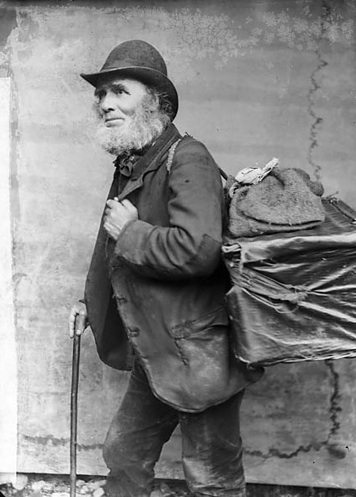
Elis the pedlar, a Welsh packman working the villages around Llanfair in about 1885. John Thomas Collection, National Library of Wales

Before the coming of the railways, and the buses, and the motor car, when it was not uncommon for isolated farms to be a day’s walk from the nearest shops, the closest many people got to a department store was when a wandering peddler came to call.

Wheeled transport was still expensive then, and most rural roads remained unmade, so the great majority of these traveling salesmen carried their goods on their backs. Their packs usually weighed about a hundredweight (100 pounds, or about 50 kilos—not much less than their owners), and they concealed a treasure trove of bits and pieces, everything from household goods to horsehair wigs, all neatly arranged in drawers.  Since the customers were practically all female, the best-sellers were almost always beauty products; readers of Anne of Green Gables may recall that she procured the dye that colored her hair green from just such a peddler.

Over the years, these fixtures of the rural scene went by many names; they were buffers, or duffers, or packmen, or dustyfoots. Some were crooks, but a surprisingly high proportion of them were honest tradesmen, more or less, for it was not possible to built a profitable round without providing customers with a reasonable service. By the middle of the nineteenth century, it has been estimated, an honest packman on the roads of England might earn more than a pound a week, a pretty decent income at that time. More

The king of hard currency

The island of Yap from the air: a wester Pacific paradise where almost everything needed to sustain life grew comfortably to hand.

The island of Yap from the air: a western Pacific paradise where almost everything needed to sustain life grew comfortably to hand.

It was a typhoon, or so it’s said, that cast up David O’Keefe on Yap in 1871, and when he finally left the island 30 years later, it was another typhoon that drowned him as he made his way home to Savannah.

Between those dates, though, O’Keefe carved himself a permanent place in the history of the Pacific. So far as the press was concerned, he did it by turning himself into the “king of the cannibal islands”: a 6-foot-2, red-haired Irishman who lived an idyllic tropical existence, was “ruler of thousands” of indigenous people, and commanded “a standing army of twelve naked savages.” (“They were untutored, but they revered him, and his law was theirs.”) [New York Times; New York Tribune; Watchman & Southron] It was this version of O’Keefe’s story that made it to the silver screen half a century later in the forgettable Burt Lancaster vehicle His Majesty O’Keefe (1954), and this version, says scholar Janet Butler, that is still believed by O’Keefe’s descendants in Georgia. [Butler pp.177-8, 191]

The reality is rather different, and in some ways even more remarkable. For if O’Keefe was never a king, he certainly did build the most successful private trading company in the Pacific, and—at a time when most Western merchants in the region exploited the islanders they dealt with, then called in U.S. or European warships to back them up—he worked closely with them, understood them and made his fortune by winning their trust and help. This itself makes O’Keefe worthy of remembrance, for while the old sea-captain was most assuredly not perfect (he had at least three wives and several mistresses, and introduced the Yapese to both alcohol and firearms), he is still fondly recalled on the island. It doesn’t hurt, so far as the strangeness of the story goes, that O’Keefe ingratiated himself on Yap by securing a monopoly on the supply of the island’s unique currency: giant stone coins, each as much as 12 feet in diameter and weighing up to four and a half tons.

But wait; we’re getting ahead of ourselves. Let’s start with the convoluted history that brought O’Keefe to Yap. More