The Christmas Truce

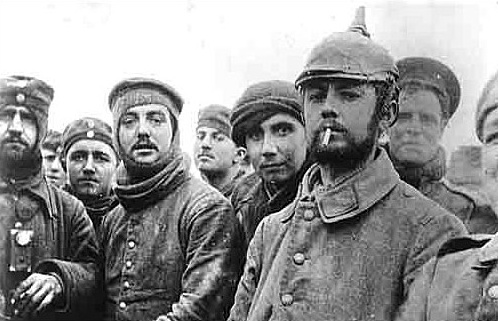
Riflemen Andrew and Grigg (center)—British troops from London—during the Christmas Truce with Saxons of the 104th and 106th Regiments of the Imperial German Army.

Even at the distance of a century, no war seems more terrible than World War I. In the four years between 1914 and 1918, it killed or wounded more than 25 million people–peculiarly horribly, and (in popular opinion, at least) for less apparent purpose than did any other war before or since. Yet there were still odd moments of joy and hope in the trenches of Flanders and France, and one of the most remarkable came during the first Christmas of the war, a few brief hours during which men from both sides on the Western Front laid down their arms, emerged from their trenches, and shared food, carols, games and comradeship.

Their truce–the famous Christmas Truce–was unofficial and illicit. Many officers disapproved, and headquarters on both sides took strong steps to ensure that it could never happen again. While it lasted, though, the truce was magical, leading even the sober Wall Street Journal to observe: “What appears from the winter fog and misery is a Christmas story, a fine Christmas story that is, in truth, the most faded and tattered of adjectives: inspiring.”
Continue reading

The great tea race

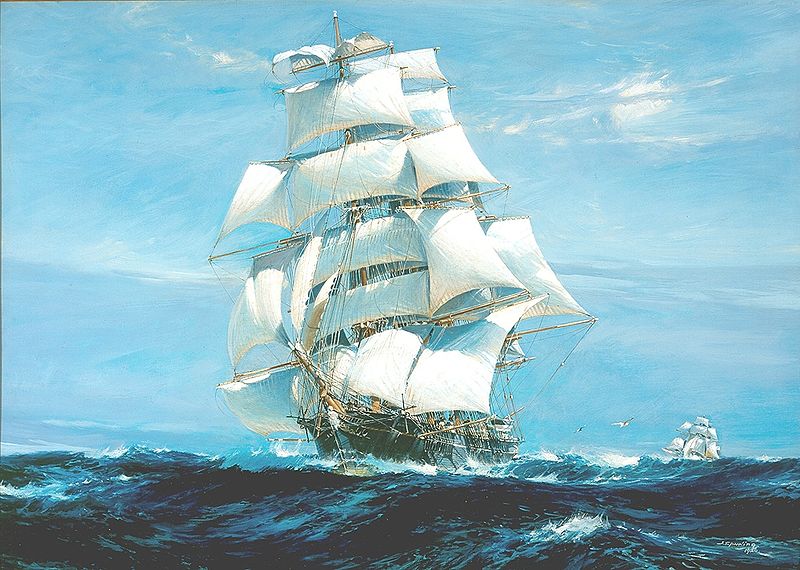
Ariel and Taeping at sea during the great Tea Race of 1866. Oil painting by Jack Spurling, 1926.

Captain John Keay, master of the new British clipper ship Ariel, had good reason to feel pleased with himself. He had secured the first cargo of tea to come to market at the great Chinese port of Foochow (modern Fuzhou) in 1866—560 tons of first and second pickings, freighted at the high price of £7 a ton: the very finest leaves available. The cargo had been floated out to him in lighters, packed in more than 12,000 hand-made tea chests, and stowed below decks in the record time of just four days.

Now Ariel was weighing anchor. It was 5 p.m. on the evening of May 28, which made her the first tea clipper to sail for London that season. She was a brand new ship: “A perfect beauty,” Keay recalled, “to every nautical man who saw her; in symmetrical grace and proportion of hull, spars, sails, rigging and finish she satisfied the eye and put all in love with her without exception. Very light airs gave her headway, and I could trust her like a thing alive in all evolutions.”

Ariel was indeed the fleetest vessel of her time; flying the astounding total of more than 26,000 square feet of canvas, she could reach speeds of 16 knots, far faster than contemporary steamers. But the advantage that Keay held over the other clippers crowded in the port was minimal, and Ariel was unlucky with her tugs. The paddle steamer Island Queen, hired to take the clipper in tow, lacked the power to carry her across the bar of the Min River against a falling tide. Stranded for the night, Keay and his crack crew were forced to lie at anchor and watch as their rivals completed their own hurried loading and started in pursuit. That evening the rival Fiery Cross came down the river towed by a more powerful tug, edged her way into clear water, and set a course east across the China Sea. Keay was still negotiating the bar next morning when two other clippers, Serica and Taeping, appeared beside him. The Tea Race of 1866—the most exciting in the history of the China trade—was on. Continue reading

China’s socialist emperor

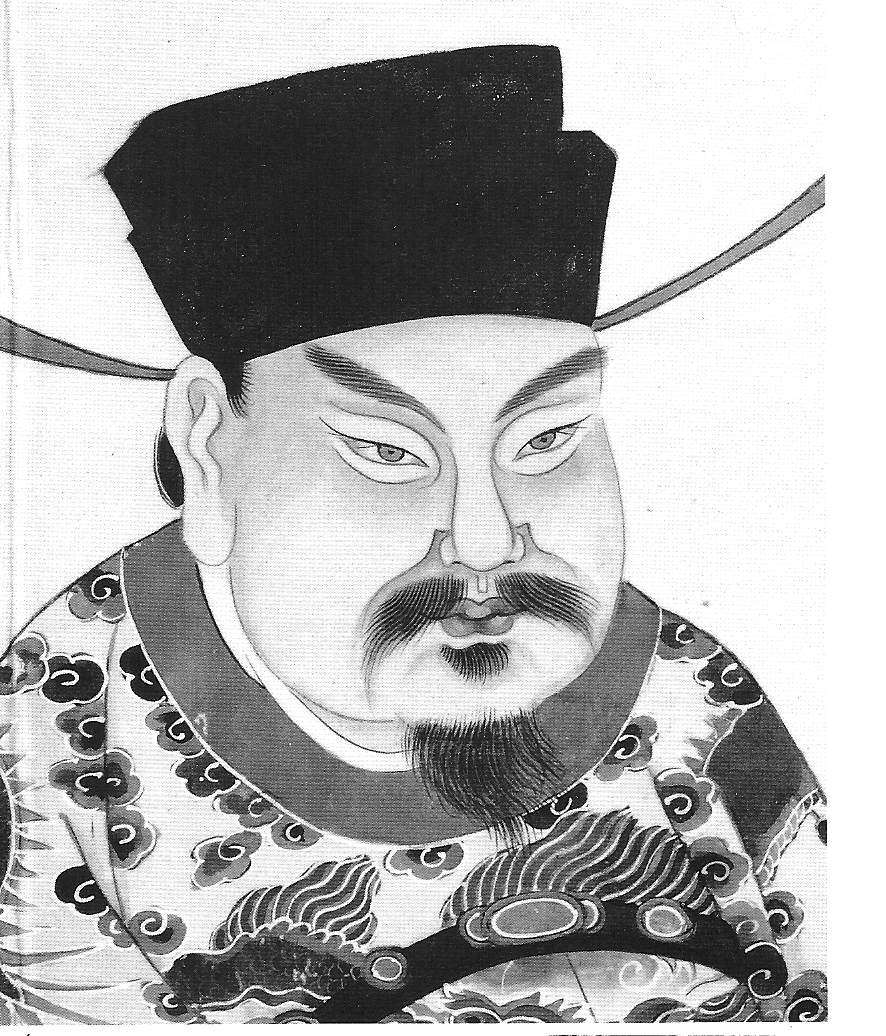
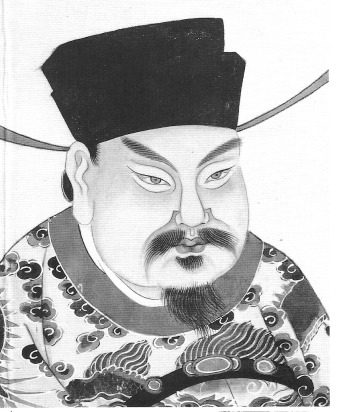
Wang Mang, first and last emperor of China’s Xin Dynasty, went down fighting amid his harem girls as his palace fell in 23 A.D.

October 7, 23 A.D. The imperial Chinese army, 420,000 strong, has been utterly defeated. Nine “Tiger Generals,” sent to lead a corps of 10,000 elite soldiers, have been swept aside as rebel forces close in. The last available troops—convicts  released from the local jails—have fled. Three days ago, rebels breached the defenses of China’s great capital, Chang’an; now, after some bloody fighting, they are scaling the walls of the emperor’s private compound.

Deep within his Endless Palace, Emperor Wang Mang waits for death. For 20 years, ever since he first contemplated the overthrow of the dissolute remnants of the Han Dynasty, the usurper Wang had driven himself to keep to an inhuman schedule, working through the night and sleeping at his desk as he labored to transform China. When the rebellion against him gained strength, however, Wang appeared to give up. He retreated to his palace and summoned magicians with whom he passed his time testing spells; he began to assign strange, mystical titles to his army commanders: “The Colonel Holding a Great Axe to Chop Down Withered Wood” was one.

Such excesses seemed out of character for Wang, a Confucian scholar and renowned ascetic. The numismatist Rob Tye, who has made a study of the emperor’s reign, believes that he succumbed to despair. “Frankly, my own assessment is that he was high on drugs for most of the period,” Tye writes. “Knowing all was lost, he chose to escape reality, seeking a few last weeks of pleasure.”

When the rebels broke into his palace, Wang was in the imperial harem, surrounded by his three Harmonious Ladies, nine official wives, 27 handpicked “beauties” and their 81 attendants. He had dyed his white hair in order to look calm and youthful. Desperate officials persuaded him to retire with them to a high tower surrounded by water in the center of the capital. There, a thousand loyalists made a last stand before the armies of the revived Han, retreating step by step up twisting stairs until the emperor was cornered on the highest floor. Wang was slain late in the afternoon, his head severed, his body torn to pieces by soldiers seeking mementos, his tongue cut out and eaten by an enemy. Did he wonder, as he died, how it had come to this—how his attempts at reform had inflamed a whole nation? And did it strike him as ironic that the peasants he had tried to help—with a program so seemingly radical that some scholars describe it as socialist, even “communistic”—had been the first to turn against him?
Continue reading

On hidden history

5 writersThe best stories from history lie beyond the margins of textbooks, says the historian. He tells us about five extraordinary tales from the past, from visions of the Virgin Mary to the golden age of the American con artist.

Here’s the text of a long interview that I gave to the brilliant The Browser site about ‘hidden history’ – what it is, what bits of it are most worth reading, and why we should care. I’m pretty happy with how it came out, and if you like the sort of stories featured in this blog and are looking for some recommendations for further reading, it’s not a bad place to start.

Will you start by telling me what you mean by “hidden history”?

For me, it’s the history that exists beyond the margins and the textbooks and what we normally consider to be history: George Washington, Henry VIII, Hitler. I have the capacity to be interested in pretty much all history, because it’s all about us being human. But I’m most interested in stuff no one else is interested in – I really like knowing things that other people have missed out on. All the books I’ve recommended are about periods and episodes in history that are little known but which I find peculiarly fascinating. I think that’s because they are all, ultimately, about the extremes of human experience. We can learn a lot about ourselves as human beings by seeing how we react in instances where we are confronted by extremes – whether they are economic, as in my book Tulipomania [about the 17th century tulip market in Holland], or life-threatening, as in Batavia’s Graveyard [about a Dutch East India company ship that was shipwrecked in 1629].

And all these books you’ve chosen, as well as your own, are very much about the individuals and their stories?

Yes, I’m interested in the ordinary people of history. One of the things I try to do when I write is to dignify them by showing a bit of interest in their lives and what happened to them, rather than treating them as if they’re another disposable number, which is how, quite often, they were treated in life. All these books I’ve chosen have a similar sort of approach. For example, Joseph Mitchell is renowned for taking seriously people who were very much at the margins of New York society. Continue reading

Santa Claus Smith

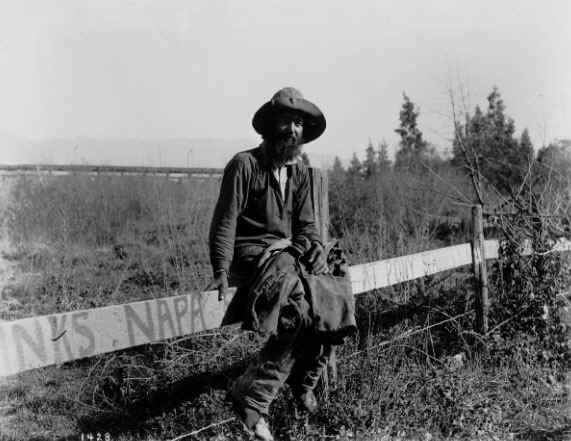
A Depression-era hobo–one of thousands who traveled the roads and rails of the United States during the 1930s.

On the evening of July 18, 1935, in an America still crushed in the coils of the Great Depression, an old man with a long white beard appeared on the front lawn of a farm off Route 1 in Metamora, Indiana.

It was late, nearly dusk, and when the farmer’s wife came out to ask what the man wanted, he begged her for a piece of bread. “He had a very kind face,” she wrote some days later,

and it has always been my custom to give to tramps if I have anything I can handy [sic] give. He was carrying a pack on his back so I told him to set it down on the lawn. I had a nice warm supper cooked so I served him on the lawn. He seemed to be very hungry. I gave him a second serving. When he finished he took from his pack two checks copied from brown paper, looked like they were cut from paper bags. He came forward and handed these to me with his plate.

According to this woman, “his face was so kind it is hard to believe he meant anything false.” But when she looked down at the paper cheques, she saw that one had been written for $25,000, and the other for $1,000.
Continue reading

The mystery of the five wounds

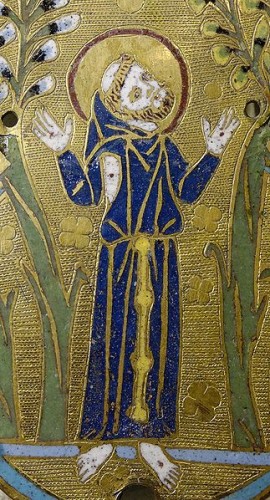
St Francis receives the stigmata. From a foil plaque on a 13th- century reliquary.

On September 14, 1224, a Saturday, Francis of Assisi—noted ascetic and holy man, future saint—was preparing to enter the second month of a retreat with a few close companions on Monte La Verna, overlooking the River Arno in Tuscany. Francis had spent the previous few weeks in prolonged contemplation of the suffering Jesus Christ on the cross, and he may well have been weak from protracted fasting. As he knelt to pray in the first light of dawn (notes the Fioretti—the ‘Little flowers of St Francis of Assisi,’ a collection of legends and stories about the saint),

he began to contemplate the Passion of Christ… and his fervor grew so strong within him that he became wholly transformed into Jesus through love and compassion…. While he was thus inflamed, he saw a seraph with six shining, fiery wings descend from heaven. This seraph drew near to St Francis in swift flight, so that he could see him clearly and recognize that he had the form of a man crucified… After a long period of secret converse, this mysterious vision faded, leaving… in his body a wonderful image and imprint of the Passion of Christ. For in the hands and feet of Saint Francis forthwith began to appear the marks of the nails in the same manner as he had seen them in the body of Jesus crucified.

In all, Francis found that he bore five marks: two on his palms and two on his feet, where the nails that fixed Christ to the cross were traditionally believed to have been hammered home, and the fifth on his side, where the Bible says Jesus had received a spear thrust from a Roman centurion.

Thus was the first case of stigmata—the appearance of marks or actual wounds paralleling those Christ received during Crucifixion—described. Later stigmatics (and there have been several hundred of them) have exhibited similar marks, though some bear only one or two wounds, while others also display scratches on their foreheads, where Christ would have been injured by his crown of thorns. Through the centuries, stigmata has become one of the best-documented, and most controversial, of mystical phenomena. The extensive record makes it possible to compare cases that occurred centuries apart.
Continue reading

History heroes: Marc Bloch

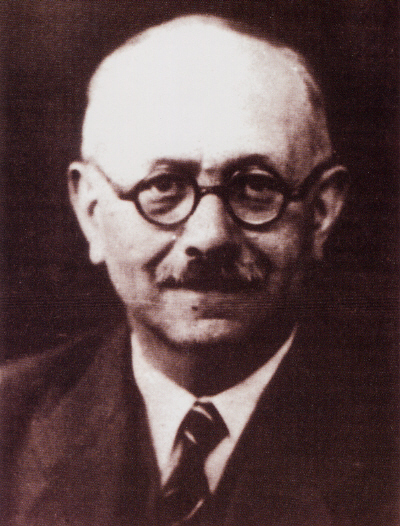
Marc Bloch: Historian. French Resistance leader. Hero.

At eight on the evening of June 16, 1944—not long before dusk on the tenth day after the Allied invasion of France–the Gestapo dragged 28 French resistance fighters from the cells where they had been incarcerated, tortured and interrogated at Montluc prison, Lyon. Handcuffed in pairs, the men were thrust onto an open truck and driven to an empty field outside a little village known as Saint-Didier-de-Formans. Along the way, a German officer bragged to them that the war would still be won, and that London was about to be destroyed by V1 flying bombs.

London would, of course, survive, and the war would not be won by Nazi Germany, but that was scant consolation to the resistance men as they were taken four by four into the field for execution. The accounts of two men among the prisoners who miraculously survived being shot in the back at close range allow us to know something of their final moments. There were no pleas for mercy. Some of the men shouted out last words as they were led into the field—”Adieu ma femme!” one of them called—but most remarkable was the brief scene that played out between the oldest and the youngest of the prisoners.

The younger man was really a boy, 16 years old and terrified of what was about to happen. The older was small, balding but distinguished-looking, and, at 58, he wore round glasses and the haggard look of a prisoner who had survived repeated torture. As the execution party cocked its guns, the boy groaned, “This is going to hurt.” “No, my boy, it doesn’t hurt,” the older man assured him. He reached out to enclose the child’s hands in his own and held them, shouting “Vive la France!” as the first volley of machine-gun fire rang out.
Continue reading

William Shakespeare: gangster

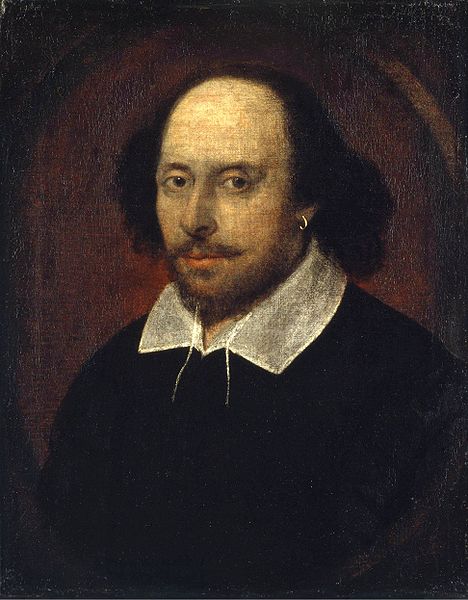
The “Chandos Portrait” of Shakespeare–dating to c.1600 and one of only two that may have been painted from life–is thought to be the work of the playwright’s “intimate friend” John Taylor of the Painter-Stainers’ Company (though it may not show Shakespeare at all). Its be-earringed playwright, pictured without the usual ruff, seems to show an altogether tougher character than the figure that appears in more familiar likenesses.

You wouldn’t think it by looking at the long line of Shakespeare biographies on the library shelves, but everything we know for sure about the life of the world’s most revered playwright would fit comfortably onto a few pages.

Yes, we know that a man named Will Shakespeare was born in the Warwickshire town of Stratford-upon-Avon in 1564. We know that someone of pretty much the same name married and had children there (the baptismal register says Shaxpere, the marriage bond Shagspere), that he went to London, was an actor. We know that some of the most wonderful plays ever written were published under this man’s name–though we also know so little about his education, experiences and influences that an entire literary industry exists to prove that Shaxpere-Shagspere did not write, could not have written, them. We know that our Shakespeare gave evidence in a single obscure court case, signed a couple of documents, went home to Stratford, made a will and died in 1616.

And that’s just about it.

In one sense, this is not especially surprising. We know as much about Shakespeare as we know about most of his contemporaries–Ben Jonson, for instance, remains such a cipher that we can’t be sure where he was born, to whom, or even exactly when. “The documentation for William Shakespeare is exactly what you would expect of a person of his position at that time,” says David Thomas of Britain’s National Archives. “It seems like a dearth only because we are so intensely interested in him.” Continue reading

“Above the Senior Wrangler”

Philippa Fawcett. When she placed first in the Cambridge mathematical tripos in 1890, she forced a reassessment of nineteenth-century belief in the inferiority of the “weaker sex.”

To be a woman in the Victorian age was to be weak: the connection was that definite. To be female was also to be fragile, dependent, prone to nerves and—not least—possessed of a mind that was several degrees inferior to a man’s. For much of the 19th century, women were not expected to shine either academically or athletically, and those who attempted to do so were cautioned that they were taking an appalling risk. Mainstream medicine was clear on this point: to dream of studying at the university level was to chance madness or sterility, if not both.

It took generations to transform this received opinion; that, a long series of scientific studies, and the determination and hard work of many thousands of women. For all that, though, it is still possible to point to one single achievement, and one single day, and say: this is when everything began to change. That day was June 7, 1890, when—for the first and only time—a woman ranked first in the mathematical examinations held at the University of Cambridge. It was the day that Philippa Fawcett placed “above the Senior Wrangler.”

To understand why one woman’s achievement so shook the prejudices of the Victorian age—and why newspapers from the New York Times to the Times of India thought it worthwhile to devote thousands of words to an exam that today means little to anybody but the students themselves—it is necessary to understand why Cambridge mathematics mattered in the 19th century. Continue reading

An ice cream war

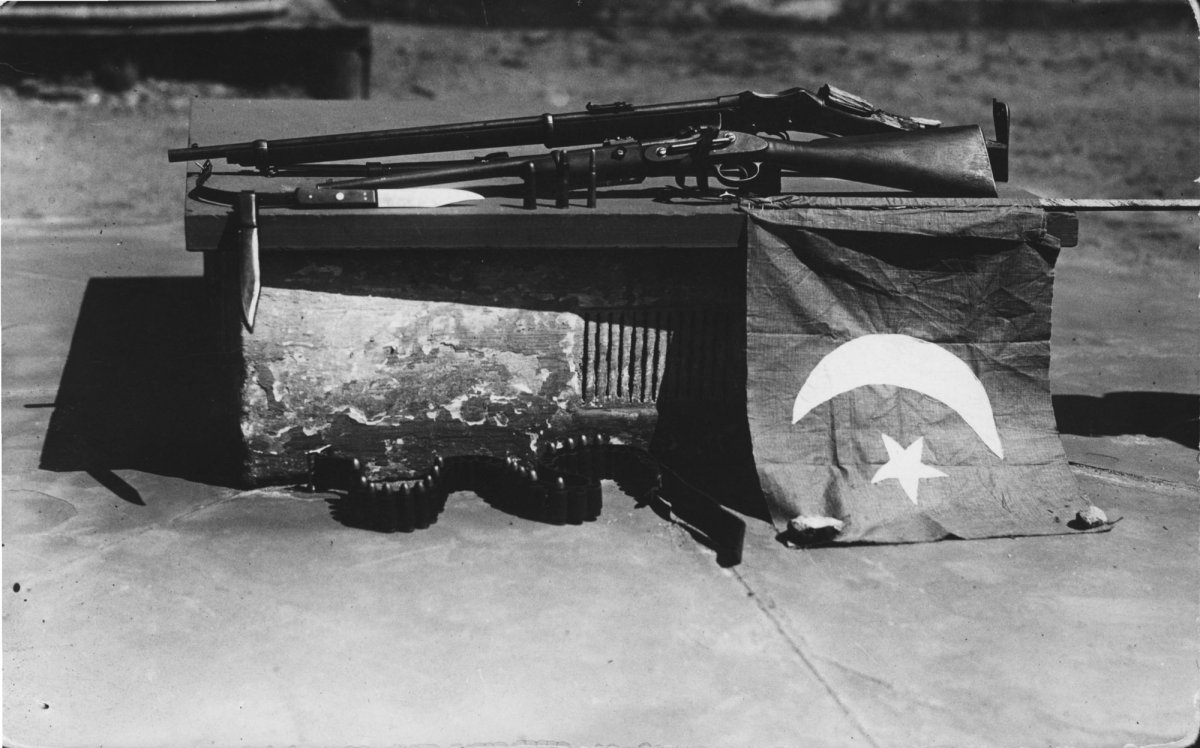
The Turkish flag flown, and rifles used, by Mullah Abdullah and Gool Mohammed in their two-man war against the British empire launched at Broken Hill, New South Wales, on 1 January 1915

The Turkish flag flown, and rifles used, by Mullah Abdullah and Gool Mohammed in their two-man war against the British empire launched at Broken Hill, New South Wales, on 1 January 1915

The war seemed a very long way away to the citizens of Broken Hill that January 1.

It was the height of the southern summer, and the Australian silver-mining town baked in the outback desert heat, 720 miles from Sydney and half a world away from the mud and blood of the Western Front. The First World War was less than five months old, and only a fool would have accused the hardened miners of Broken Hill of lacking patriotism, but on that first day of 1915 they wanted nothing more than to enjoy a rare holiday with their families and forget about their troubles—not just the war, which Australia had joined alongside Britain on the day it was declared, but also the grim economic times that were closing mines and putting miners out of work.

More than 1,200 men, women and children clambered aboard the makeshift train that would take them a few miles up the line to Silverton for the annual town picnic. But for Broken Hill that New Year’s Day, war was not 12,000 miles away; it was just over a ridge a mile or two along the track, where a couple of Afghans had raised the Turkish flag over an ice cream cart and were preparing to launch a two-man war. Continue reading