
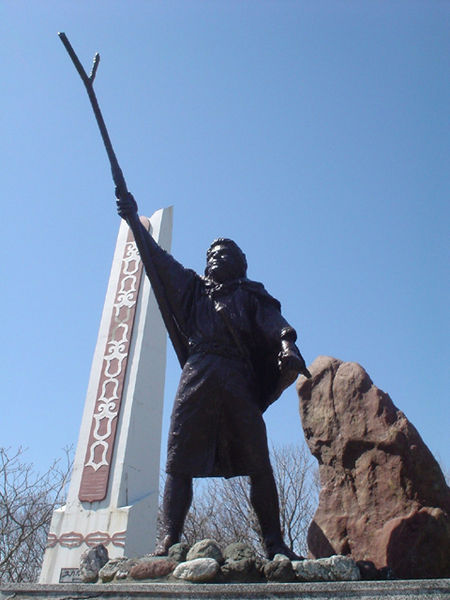
Shakushain, the leader of Ainu resistance to Japan, is shown in this modern memorial on Hokkaido. Thanks to a postwar revival of Ainu nationalism, celebrations of indigenous culture are held each year at this spot. Photo: Wikicommons.
There has always been something otherworldly about Hokkaido. It is the most northerly of the four great land masses that make up Japan, and although separated from the mainland, Honshu, by a strait only a few miles wide, the island remains geologically and geographically distinct. Spiked with mountains, thick with forests, and never more than sparsely populated, it has a stark and wintry beauty that sets it apart from the more temperate landscapes to the south.
Hokkaido is such a familiar feature on maps of Japan that it is easy to forget what a recent addition it is to both the nation and the state. It does not appear in Japanese chronicles until around 1450, and was not formally incorporated into greater Japan until 1869. As late as 1650, the island was known as “Ezo,” and was a distant frontier zone, only tenuously controlled from Edo (modern Tokyo). Even in the 1740s, Tessa Morris-Suzuki notes, maps of the region still showed it “disappearing over the horizon and petering out in a splash of unconvincing islands.” And while it seems always to have possessed a small population of Japanese hunters and merchants, Hokkaido was home to, and for the most part run by, a significantly larger group of indigenous tribes known collectively as the Ainu.
Continue reading
 A Blast From The Past