One man against tyranny: Georg Elser’s lone attempt to blow up Hitler

Georg Elser, whose attempt to kill Hitler came within moments of succeeding, commemorated on a stamp. The German phrase means “I wanted to prevent war.”

Maria Strobel could not believe it of her Führer. Adolf Hitler and his party—a group of senior Nazis that included Heinrich Himmler, Joseph Goebbels and Reinhard Heydrich—had spent more than an hour in her Munich bierkeller. Hitler had delivered a trademark speech, and, while they listened, Himmler and the others had run up a large beer bill. But the whole group had left in a hurry—leaving the tab unpaid and Strobel untippped.

Much annoyed, the Bavarian waitress set about clearing up the mess. She had made only a small dent in the pile of steins when, at 9:20 p.m. precisely, there was a huge explosion only a few feet behind her. A stone pillar disintegrated in the blast, bringing part of the ceiling crashing down in a rain of wood and masonry. The explosion hurled Strobel the length of the hall and out through the bierkeller’s doors. Though stunned, she survived—the person closest to the blast to do so. Eight others were not so fortunate, and a further 63 were so badly injured that they had to be helped out into the open air. As they staggered toward safety, the dais where Hitler had been standing eight minutes earlier lay crushed beneath six feet of heavy timber, bricks and rubble.

Hitler always said he had “the luck of the devil,” Continue reading

“Tamám Shud”

Mortuary photo of the unknown man found dead on Somerton Beach, south of Adelaide, Australia, in December 1948. Sixty-three years later, the man’s identity remains a mystery, and it’s still not clear how – or even if – he was murdered.

Most murders aren’t that difficult to solve. The husband did it. The wife did it. The boyfriend did it, or the ex-boyfriend did. The crimes fit a pattern, the motives are generally clear.

Of course, there are always a handful of cases that don’t fit the template, where the killer is a stranger or the reason for the killing is bizarre. It’s fair to say, however, that nowadays the authorities usually have something to go on. Thanks in part to advances such as DNA technology, the police are seldom baffled anymore.

They certainly were baffled, though, in Adelaide, the capital of South Australia, in December 1948. And the only thing that seems to have changed since then is that a story that began simply—with the discovery of a body on the beach on the first day of that southern summer—has become ever more mysterious. In fact, this case (which remains, theoretically at least, an active investigation) is so opaque that we still do not know the victim’s identity, have no real idea what killed him, and cannot even be certain whether his death was murder or suicide.

What we can say is that the clues in the Somerton Beach mystery (or the enigma of the “Unknown Man,” as it is known Down Under) add up to one of the world’s most perplexing cold cases. It may be the most mysterious of them all. Continue reading

The last of the Cornish packmen

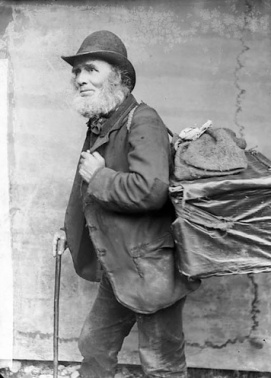
Elis the pedlar, a Welsh packman working the villages around Llanfair in about 1885. John Thomas Collection, National Library of Wales

Before the coming of the railways, and the buses, and the motor car, when it was not uncommon for isolated farms to be a day’s walk from the nearest shops, the closest many people got to a department store was when a wandering peddler came to call.

Wheeled transport was still expensive then, and most rural roads remained unmade, so the great majority of these traveling salesmen carried their goods on their backs. Their packs usually weighed about a hundredweight (100 pounds, or about 50 kilos—not much less than their owners), and they concealed a treasure trove of bits and pieces, everything from household goods to horsehair wigs, all neatly arranged in drawers.  Since the customers were practically all female, the best-sellers were almost always beauty products; readers of Anne of Green Gables may recall that she procured the dye that colored her hair green from just such a peddler.

Over the years, these fixtures of the rural scene went by many names; they were buffers, or duffers, or packmen, or dustyfoots. Some were crooks, but a surprisingly high proportion of them were honest tradesmen, more or less, for it was not possible to built a profitable round without providing customers with a reasonable service. By the middle of the nineteenth century, it has been estimated, an honest packman on the roads of England might earn more than a pound a week, a pretty decent income at that time. More