The king of hard currency

The island of Yap from the air: a wester Pacific paradise where almost everything needed to sustain life grew comfortably to hand.

The island of Yap from the air: a western Pacific paradise where almost everything needed to sustain life grew comfortably to hand.

It was a typhoon, or so it’s said, that cast up David O’Keefe on Yap in 1871, and when he finally left the island 30 years later, it was another typhoon that drowned him as he made his way home to Savannah.

Between those dates, though, O’Keefe carved himself a permanent place in the history of the Pacific. So far as the press was concerned, he did it by turning himself into the “king of the cannibal islands”: a 6-foot-2, red-haired Irishman who lived an idyllic tropical existence, was “ruler of thousands” of indigenous people, and commanded “a standing army of twelve naked savages.” (“They were untutored, but they revered him, and his law was theirs.”) [New York Times; New York Tribune; Watchman & Southron] It was this version of O’Keefe’s story that made it to the silver screen half a century later in the forgettable Burt Lancaster vehicle His Majesty O’Keefe (1954), and this version, says scholar Janet Butler, that is still believed by O’Keefe’s descendants in Georgia. [Butler pp.177-8, 191]

The reality is rather different, and in some ways even more remarkable. For if O’Keefe was never a king, he certainly did build the most successful private trading company in the Pacific, and—at a time when most Western merchants in the region exploited the islanders they dealt with, then called in U.S. or European warships to back them up—he worked closely with them, understood them and made his fortune by winning their trust and help. This itself makes O’Keefe worthy of remembrance, for while the old sea-captain was most assuredly not perfect (he had at least three wives and several mistresses, and introduced the Yapese to both alcohol and firearms), he is still fondly recalled on the island. It doesn’t hurt, so far as the strangeness of the story goes, that O’Keefe ingratiated himself on Yap by securing a monopoly on the supply of the island’s unique currency: giant stone coins, each as much as 12 feet in diameter and weighing up to four and a half tons.

But wait; we’re getting ahead of ourselves. Let’s start with the convoluted history that brought O’Keefe to Yap. More
Three 1950s youths in a medieval plague village

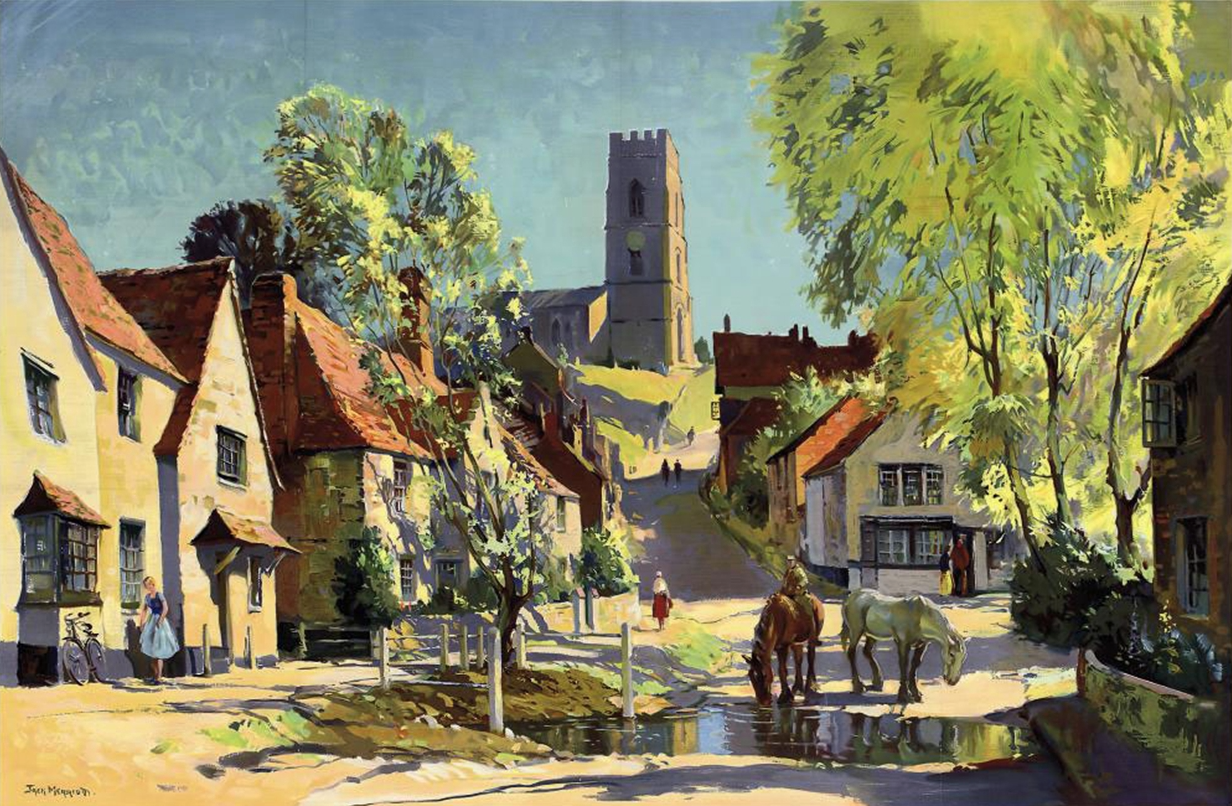
Kersey in 1957. Although Jack Merriott's watercolor presents an idealized image of the village – it was commissioned for use in a railway advertising campaign – it does give an idea of just how 'old' Kersey must have looked to strangers in the year it became central to a 'timeslip' case.

Kersey in 1957. Although Jack Merriott’s watercolor presents an idealized image of the village – it was commissioned for use in a railway advertising campaign – it does give an idea of just how ‘old’ Kersey must have looked to strangers in the year it became central to a ‘timeslip’ case.

Looking back, the really strange thing was the silence. The way the church bells stopped ringing as the little group of naval cadets neared the village. The way even the ducks stood quiet and motionless by the shallow stream that ran across the road where the main street began.

And, when the boys thought about it afterward, they recalled that even the autumn birdsong faded as they neared the first houses. The wind had dropped to nothing, too.

Not a leaf stirred on the trees they passed. And the trees appeared to cast no shadows.

The street itself was quite deserted—not so odd, perhaps, for a Sunday morning in 1957, especially in the rural heart of England. But even the remotest British hamlets displayed some signs of modernity by then—cars parked by the roadside, phone wires strung along the roads, aerials on roofs—and there was nothing of that sort in this village. In fact, the houses on the high street all looked ancient; they were ragged, hand-built, timber-framed: “almost medieval in appearance,” one boy thought.

The three, all Royal Navy cadets, walked up to the nearest building and pressed their faces to its grimy windows. They could see that it was some sort of butcher’s shop, but what they glimpsed in the interior was even more unsettling. As one of them recalled for the author Andrew MacKenzie:

There were no tables or counters, just two or three whole oxen carcasses which had been skinned and in places were quite green with age. There was a green-painted door and windows with smallish glass panes, one at the front and one at the side, rather dirty-looking. I remember that as we three looked through that window in disbelief at the green and mouldy green carcasses… the general feeling certainly was one of disbelief and unreality… Who would believe that in 1957 that the health authorities would allow such conditions?

They peered into another house. More

Moving on up

Change of address...

A Blast From the Past will have a spanking new home from tomorrow.

That’s right – the blog’s been picked up by the Smithsonian Institution, which has decided to expand the coverage its magazine site offers to include a regular history blog. It’s all very flattering, because the Smithsonian looked at an awful lot of other sites before contacting me. On top of that it is, of course, pretty much the biggest and best museum in the world, and the associated magazine it publishes is of extremely high quality – I’ve spent a lot of time reading it over the years, and it’ll be a great pleasure to contribute regularly.

Anyway, here’s the scoop, and so far as I can see it ought to work for everybody. More

“Kipper und wipper”: rogue traders, rogue princes, rogue nuns and the German financial meltdown of 1621-23

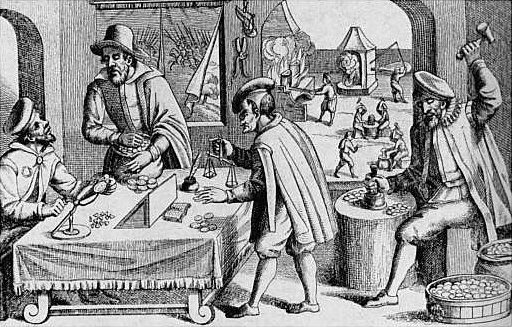
A German mint hard at work producing debased coinage designed to be palmed off on the nearest neighbouring state, c.1620

The great German hyperinflation of 1923 is passing out of living memory now, but that doesn’t mean that it has been forgotten. Indeed, you don’t have to go too far to hear it cited as a terrible example of what can happen when a government lets the economy spin out of control, and the episode still remains a minor feature of the British history curriculum, studied – briefly – by 15 and 16 year olds taking their GCSE. In consequence, a surprisingly large number of Brits can recall at least some of the details of that period. They may remember, for instance, that at its peak German inflation hit 325,000,000 percent, while the exchange rate plummeted from 9 marks to 4.2 billion marks to the dollar. They may recall that it became cheaper to decorate a room with high-denomination banknotes than with wallpaper; or that when thieves robbed a worker who had used a wheelbarrow to cart off the billions of reichsmarks that were his week’s wages, it was reported that they stole the wheelbarrow but left the useless wads of cash piled on the kerb. Others have had one or other of the famous photos taken in this period burned into their memories, such as one that shows a German housewife firing her boiler with an imposing pile of worthless notes [below left].

It’s easy, in these circumstances, to suppose that 1923 was a uniquely strange and terrible episode, but the truth is that it was not. Indeed, the German hyperinflation was not even the worst of the twentieth century; its Hungarian equivalent, dating to 1945-46, was so much more severe that prices in Budapest began to double every 15 hours. (At the peak of this crisis, the Hungarian government was forced to announce the latest inflation rate via radio each morning, so workers could negotiate a new pay scale with their bosses, and issue the largest denomination banknote ever to be legal tender: the 100 quintillion (1020) pengo note. When the debased currency was finally withdrawn, the total value of all the cash then in circulation in the country was reckoned at 1/10th of a cent. [Bomberger & Makinen pp.801-24; Judt p.87])   Nor was 1923 even the first time that Germany had experienced an uncontrollable rise in prices. It had also happened long before, back in the early years of the 17th century. And that hyperinflation (which is generally known by its evocative German name, the kipper- und wipperzeit) was a whole lot stranger and more colourful than what happened in 1923. More