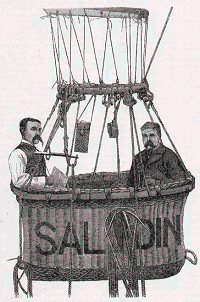
The Saladin balloon, c.1881.
At a time when MPs are in the news, and not often for the right reasons, I want to take a moment to dwell on the more worthwhile, and (from my perspective, anyway) peculiarly illuminating career of a long-forgotten predecessor of the current bunch of petty crooks. His name was Walter Powell (1842-1881) [below right], he was Tory MP for Malmesbury in Wiltshire, and his strange and lonely death offers a good deal of unexpected insight into the perennially fascinating topics of expectant attention and witness perception.
First, a snippet of biography. Walter Powell was the youngest son of a tough and ruthless Welsh mine owner (a tautology, I know) who ran his pits for profit first and safety very much last, emerging during the 1840s as the largest coal exporter in the world. Having driven through a 20% cut in wages and broken the resultant strike, Thomas Powell’s mines were plagued by accidents, culminating in two major explosions at Dyffryn, in Aberdare, and the deaths of more than 80 men. According to Walter Powell’s biographer, the Dyffryn disasters belatedly shamed Thomas senior into repentence for his past behaviour, and inculcated in Walter Powell a determination to use his own inherited wealth more for the public good.
In the late 1860s, Powell moved to Wiltshire, where in 1868 he was selected as Conservative parliamentary candidate for the market town of Malmesbury. Powell won the seat in the subsequent election with a narrow majority of 23, which most likely says something positive about his personality and character, as well as his wealth; the election was a Liberal triumph, and Malmesbury had been a solidly Liberal seat since the 1830s, so Powell’s victory was achieved very much against the prevailing political winds of the day. The evidence suggests he was a good MP and a benefactor to the town; he earned the soubriquet “the poor man’s friend,” and among his achievements was the endowment of a Ragged School there and the supply of 50 tons of coal each winter to Malmesbury’s “aged poor”. More pertinently, from our perspective, Powell was also an enthusiast for all sorts of new inventions. He acquired a magic lantern at around the time just such a contraption was suspected of being used to create the apparitions of the Virgin Mary at Knock, in Ireland, and in 1880, after the death of his wife, he took up ballooning and became very keen on aeronautics.
Ballooning in those days was a preserve of the wealthy. More
 Chance can be a fine thing.
 A Blast From The Past